
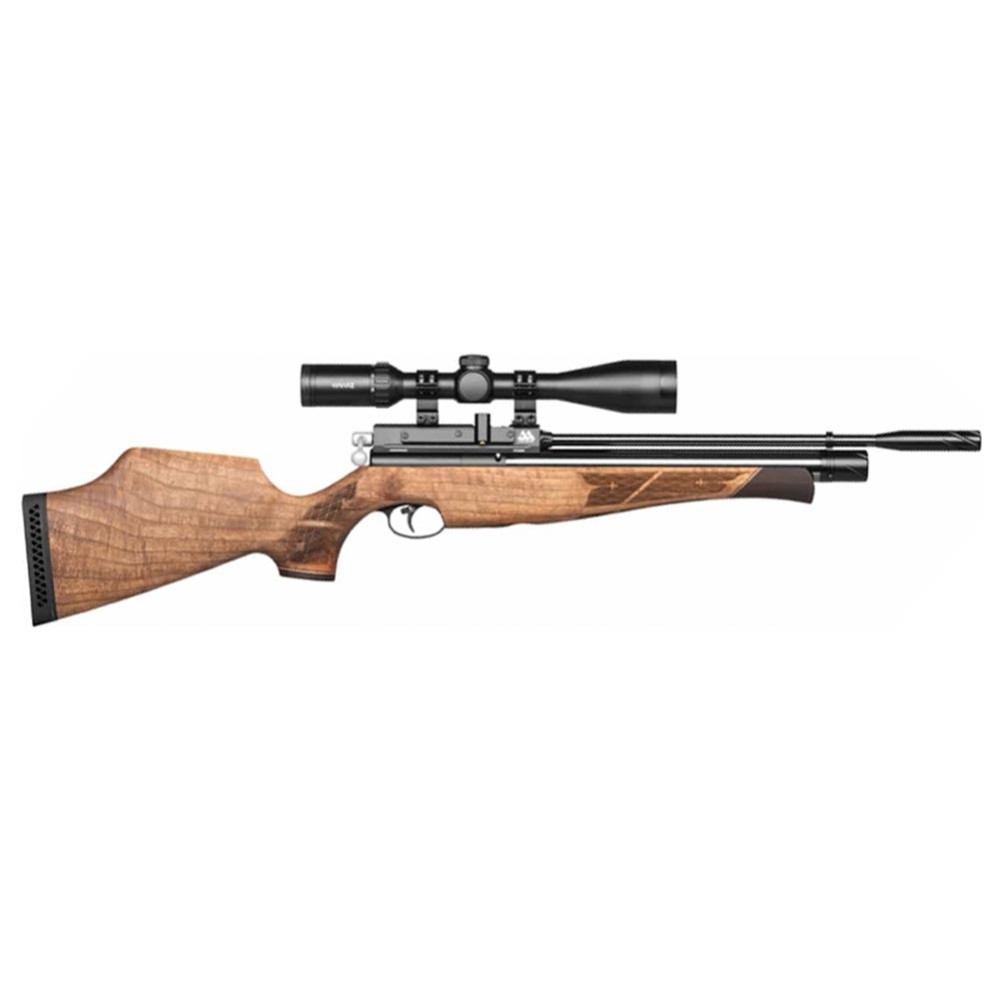
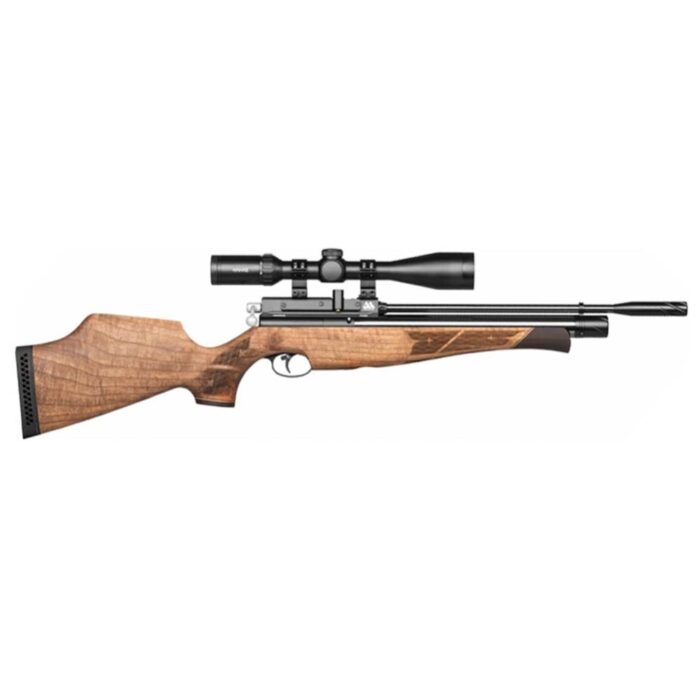
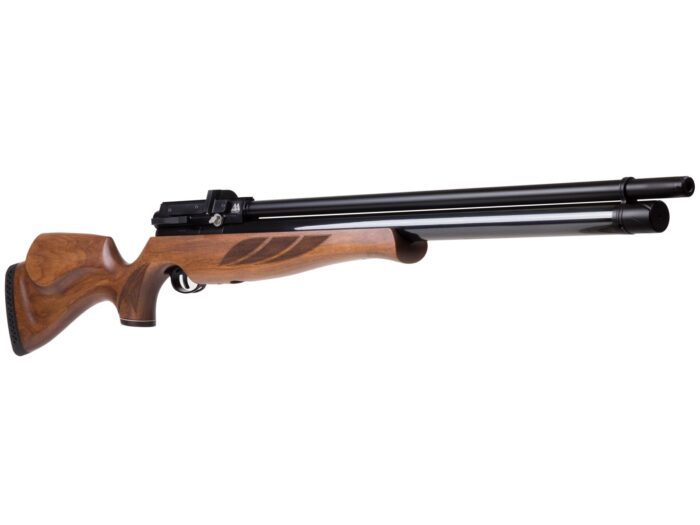
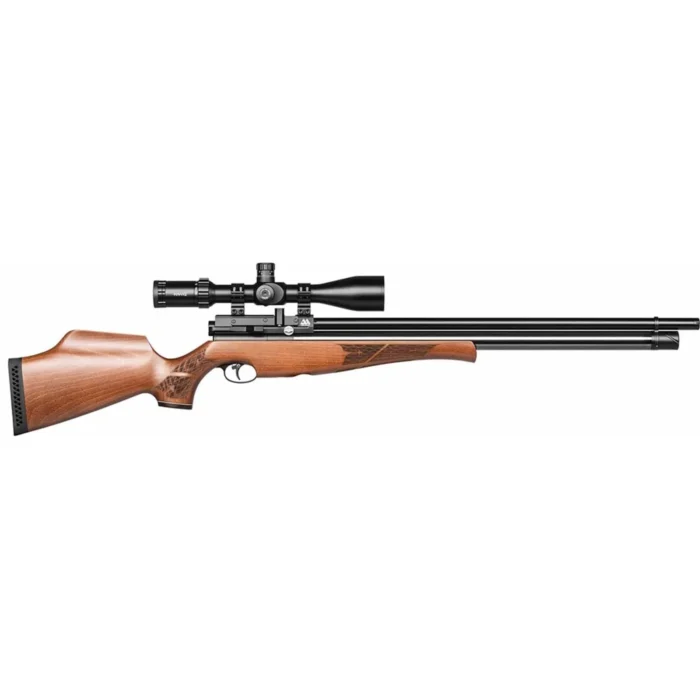
Air Arms S410 Carbine Walnut
€900.00
- Traditional bolt action
- Stainless steel filling connector with in-line 20 micron filter
- Optional moderator
- Trigger mounted safety
- Adjustable two stage trigger
- 10 shot magazine
- Built-in manometer
- Rifle and carbine length actions
Specifications
- Available in .177 & .22
- Shots per Fill – 60 to 80
- Fill Pressure – 190 Bar
- Maximum Power – 11.5ft/lbs /16J
- Overall Length – 925mm
- Barrel Length – 395mm
- Weight 3.1kg
- Left-Hand Stock available
Air Arms S410 Carbine Walnut – Classic PCP Precision, Multi-Shot Performance, Walnut Stock, and Practical Ownership Guide
Air Arms S410 Carbine Walnut Overview, Performance, Calibres, PCP Operation, and Buyer Information
What Is the Air Arms S410 Carbine Walnut?
The Air Arms S410 Carbine Walnut is a compact pre-charged pneumatic air rifle that combines traditional British styling with proven multi-shot operation. Within the wider air arms catalogue, the S410 remains one of the brand’s established PCP designs, offering a walnut stock, .177 or .22 calibre options, and sub-12 ft-lb output in the current UK-listed configuration. Air Arms lists the carbine as non-regulated, distinguishing it from some newer regulated models.
For buyers researching an air gun, air rifles, pellet guns, airguns, airgins, or broader air riflery, the S410 represents a traditional sporting PCP rather than a spring-powered platform.
The term what is an air rifle generally refers to a shoulder-fired gun that propels a pellet using compressed gas, a spring piston, or another pneumatic mechanism rather than conventional firearm propellant.
How Does the PCP System Work?
People often ask how do air guns work. In the S410, compressed air is stored inside an onboard reservoir before shooting. Each shot releases a controlled amount of stored air to propel the pellet.
Therefore, this design is different from a break barrel pellet gun. Anyone researching what is break barrel air rifle should understand that a break-barrel design requires the barrel to pivot downward to cock the powerplant.
The S410 does not operate that way.
Likewise, the phrase air compressor rifle usually refers informally to a PCP system that requires an external filling source. A compatible pcp hand pump, diving cylinder, or suitable compressor can be used according to manufacturer requirements.
Multi-Shot Bolt-Action Operation
The air arms s410 uses a bolt-action system rather than the side-lever mechanism found on newer models such as the air arms s510. Air Arms describes bolt-action PCP systems as mechanically simple and familiar, with the bolt cycling the next pellet from the magazine while preparing the rifle for the next shot.
This design gives the S410 a traditional operating feel while retaining the practical advantages of a magazine-fed PCP.
.177 and .22 Calibre Choices
The S410 Carbine is currently offered in both 177 caliber and .22.
A 177 air rifle generally produces a flatter trajectory with appropriately matched ammunition, which can make it attractive for controlled target work. Searches for cal .177 pellets usually concern the 4.5 mm ammunition used in that configuration.
By comparison, a .22 air rifle uses larger 5.5 mm pellets.
The questions 177 pellet vs.22 pellet and 177 caliber vs 22 usually involve trajectory, pellet mass, wind response, energy retention, and intended use. Air Arms also publishes guidance comparing .177 and .22 for sporting applications.
Understanding air rifle calibers is important because the ammunition must always match the calibre marked on the individual rifle.
Walnut Stock and Traditional Air Arms Styling
The walnut stock is one of the defining visual features of this configuration. Natural walnut provides distinctive grain patterns, meaning each stock may vary slightly in appearance.
The stock contributes to the traditional sporting character associated with several Air Arms air rifle models. Buyers considering a premium wooden-stock PCP may appreciate the balance between classic styling and modern pneumatic operation.
The current manufacturer listing confirms walnut as one of the official stock options for the S410 Carbine.
Comparing the S410 with the S510 Family
The Air Arms S510 XS Ultimate Sporter FAC, Air Arms S510 XS Ultimate Sporter FAC Walnut Stock, Air Arms S510 XS Ultimate Sporter, Air Arms S510 FAC, and Air Arms S510 XS FAC PCP Air Rifle belong to a different product family.
Air Arms currently offers S510 variants in several stock, calibre, power, and regulated configurations, including FAC models.
The S410 uses bolt-action operation and, in its current sub-12 configuration, is non-regulated. By contrast, many current S510 models use a side-lever action and regulated system.
The phrase air arms s510 ultimate sporter .177 sub 12 refers to another configuration rather than the S410 Carbine Walnut.
Other Air Arms Rifles
The air arms tx200 is a different product family built around spring-powered underlever operation rather than PCP technology.
Similarly, prosport air arms refers to another spring-powered Air Arms platform.
These rifles should not be confused with the S410’s pre-charged pneumatic design.
Accuracy and Target Applications
The S410 has developed a strong reputation among owners for smooth operation and consistent shooting characteristics. Air Arms features owner feedback describing the model as dependable and highly consistent with matched pellets.
For target air rifle shooting, accuracy depends on more than the rifle alone. Important factors include:
- Pellet quality
- Pellet fit
- Consistent fill pressure
- Optic quality
- Environmental conditions
- Shooter technique
- Barrel and action condition
Individuals searching for an airgun shooting range near me should use an authorised local range and follow all applicable safety and legal requirements.
Maintenance and Filling Equipment
An Air rifle cleaning kit may help with routine external and bore maintenance when the tools and products are suitable for PCP equipment.
The S410 also requires an appropriate filling method. A pcp hand pump can provide a portable filling solution, while suitable high-pressure cylinders or compressors may offer greater convenience.
Only manufacturer-approved fill pressures, fittings, and procedures should be followed.
Air Pistols and Unrelated Search Categories
The phrase air pisto appears to refer to air pistols rather than shoulder-fired rifles. Pistols use different dimensions, handling characteristics, power systems, and intended applications.
Likewise, the S410 should not be confused with a spring-powered break barrel pellet gun.
Responsible Use and Home-Defence Searches
The phrase air guns for home defense is sometimes used in online searches, but the S410 should be treated as sporting equipment rather than promoted as a defensive weapon.
Its appropriate roles include lawful target shooting, training, and sporting or pest-management applications where legally permitted.
Safe storage, appropriate backstops, eye protection, muzzle discipline, and compliance with local laws remain essential.
Why Choose the Air Arms S410 Carbine Walnut?
The Air Arms S410 Carbine Walnut combines traditional walnut styling, compact dimensions, multi-shot PCP operation, bolt-action simplicity, and the choice of .177 or .22 calibre.
It is especially relevant for buyers who value:
- Traditional wooden-stock styling
- Compact carbine handling
- Proven PCP technology
- Multi-shot convenience
- Straightforward bolt operation
- Established manufacturer support
- Sporting versatility
- British engineering heritage
For buyers comparing PCP platforms, the S410 offers a more traditional operating experience than newer side-lever designs while retaining the precision and convenience associated with pre-charged pneumatic technology.
Final Product Overview
The Air Arms S410 Carbine Walnut remains a distinctive choice within the modern air rifle market. Its walnut stock, bolt-action magazine system, .177 and .22 options, compact carbine configuration, and sub-12 ft-lb setup create a combination of traditional appearance and proven PCP engineering.
Rather than competing directly with every newer model, the S410 appeals to shooters who appreciate simplicity, classic styling, practical multi-shot operation, and the established reputation of the Air Arms platform.
Accuracy, Handling, and Everyday Performance
Designed for Consistent Results
Consistent performance depends on a combination of sound engineering, careful preparation, and regular practice. Although the platform itself provides a strong mechanical foundation, dependable results are usually achieved when the shooter also develops stable routines and maintains the equipment correctly.
Over time, familiarity often improves confidence. As handling becomes more natural, attention can shift toward precision, environmental awareness, and efficient operation.
Why Precision Depends on More Than Power
Precision is influenced by several factors working together rather than by power alone. A smooth action, predictable trigger response, balanced stock, suitable ammunition, and stable shooting position all contribute to better results.
Several elements frequently affect precision:
- Ammunition consistency
- Stable positioning
- Trigger control
- Environmental conditions
- Optic setup
- Maintenance quality
When these factors are controlled carefully, performance generally becomes more predictable.
Comfortable Carbine Handling
A compact carbine format often provides practical advantages during everyday use. Reduced overall length can make the platform easier to carry, position, and operate in confined spaces while still maintaining enough stability for accurate shooting.
Several handling benefits may include:
- Easier movement
- Improved balance
- Faster positioning
- Reduced fatigue
- Greater portability
These qualities frequently contribute to a more comfortable ownership experience.
Understanding Trigger Control
Trigger control plays an important role in precision because abrupt movement can disturb alignment immediately before the shot is released.
A smooth and deliberate technique usually produces better results. Shooters often benefit from maintaining consistent finger placement, steady pressure, and proper follow-through.
Small improvements in trigger technique can significantly improve consistency over time.
The Importance of Stable Positioning
Stability remains one of the foundations of accurate shooting. Even slight movement can influence the final result, particularly when working with smaller targets.
Several practices frequently improve stability:
- Maintaining a comfortable posture
- Supporting the platform consistently
- Controlling breathing
- Avoiding unnecessary movement
- Following through after each shot
These habits frequently create more dependable results.
Environmental Conditions and Performance
Environmental conditions can influence trajectory and overall consistency. Therefore, awareness remains extremely important during every session.
Several factors should be considered carefully:
- Wind speed
- Wind direction
- Temperature changes
- Humidity levels
- Visibility
- Lighting conditions
Understanding these variables often helps shooters make better decisions while improving consistency.
Why Ammunition Selection Matters
Not every projectile performs identically in every barrel. Variations in weight, shape, diameter, and manufacturing consistency can influence accuracy considerably.
Testing several quality options under controlled conditions often helps identify the combination that performs most reliably.
Once a suitable option has been identified, using the same type consistently can help reduce unnecessary variation.
Filling and Pressure Management
Consistent pressure management is important for dependable pneumatic performance. Filling procedures should always follow the manufacturer’s specifications, and excessive pressure should never be introduced.
Several good habits include:
- Inspecting the filling equipment before use.
- Confirming that connectors are clean.
- Monitoring pressure carefully.
- Filling slowly and steadily.
- Disconnecting equipment according to the correct procedure.
These practices help support reliable operation and component longevity.
Routine Maintenance and Long-Term Care
Regular maintenance helps preserve both mechanical performance and appearance. Although modern materials provide good durability, preventive care remains important.
Several maintenance practices are commonly recommended:
- Keep external surfaces clean.
- Protect metal components from moisture.
- Inspect seals and fittings regularly.
- Check mounting screws periodically.
- Store the equipment in a suitable environment.
These habits frequently contribute to dependable long-term performance.
Frequently Asked Questions
Why is a compact format useful?
A shorter overall configuration can improve portability, balance, and ease of handling without sacrificing practical accuracy.
Why should ammunition be tested?
Different ammunition can produce different accuracy results because of variations in weight, diameter, and shape.
Why is pressure management important?
Correct pressure helps maintain reliable operation while protecting internal components from unnecessary stress.
Why does trigger technique matter?
Smooth trigger control reduces unwanted movement and supports more consistent shot placement.
Why is regular maintenance necessary?
Routine maintenance helps preserve reliability, appearance, and long-term durability.
Final Thoughts
Reliable performance is usually achieved through a combination of careful engineering, disciplined handling, proper maintenance, and consistent practice. Individuals who focus on these areas often develop greater confidence while enjoying more predictable accuracy and a more rewarding long-term ownership experience.
Be the first to review “Air Arms S410 Carbine Walnut”
Related products
Air Arms
Air Arms
Air Arms
Air Arms
Reviews
There are no reviews yet.