
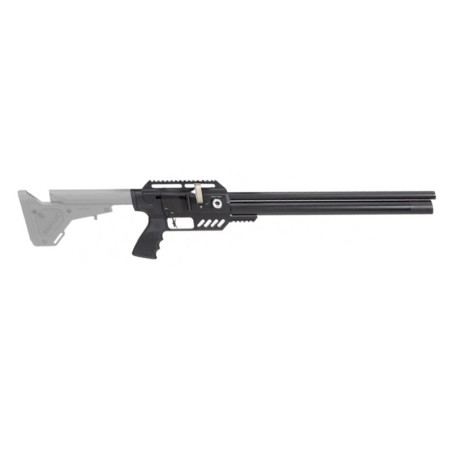
FX Dreamline Tactical
€800.00
This rifle does not come with stock. You will need an AR15 Buffer Tube Assembly and an AR15 Compatible stock. Both of which are availble as extras. If you order these with the gun we will fit them for you. You need an AR15 Armourer’s Wrench to fit the Buffer Tube!
With the introduction of Swedish manufacturer FX Airguns, Dreamline, innovations previously thought of merely as dreams are now quickly becoming a reality. With a laundry list of highly desired features that shooters have long been asking for, the DreamLite combines sleek looks with top-end performance that is unrivaled. The new AMP (Adjustable Match Precision) externally adjustable regulator coupled with the external hammer spring adjustment and 3-step transfer port adjustment allow the user to finely tune the performance of their DreamLite to their desired specs.
The truly innovative part of the Dreamline is the modular design, built to change and evolve with the needs of the owner. Looking to the future, FX plans to offer Dreamline configuration kits, allowing you to turn your DreamLite, into any number of other Dreamline configurations. In addition to this unique ability, the caliber of your Dreamline can also be changed quickly. And on top of all of that, you can even change the Smooth Twist X liners to further dial in the performance of your Dreamline with specific twist rates and bore specifications to suit the ammo of your choice. The possibilities are endless!
The features certainly don’t stop there though. High capacity magazines, a comfortable Hogue grip, two stage adjustable match trigger, smooth sidelever, shrouded barrel with DonnyFL moderatorDreamLite promises to be the PCP airgun of your wildest dreams.
Specification
- Tactical, Lightweight, Take-down Stock
- Externally Adjustable AMP Regulator
- Externally Adjustable Hammer Spring Tension
- STX Smooth Twist X Barrel System
- Two-Stage Adjustable Trigger
- Fully Shrouded barrel with Fixed DonnyFL Moderator
- Buttstock easily removes with one thumb screw
- Hogue AR style grip
- Fore-end picatinny rail for bipod/accessories
- 3-step transfer port adjustment
- 11mm dovetail for optics mounting
- 250cc air cylinder
- 230 BAR / 3,335 PSI Max Fill Pressure
- Smooth Sidelever cocking system
- Magazine Capacity: 21 rds. in .177, 18 rds. in .22, 16 rds. in .25, 14 rds. in .30
- Shots per fill: 100 in .177, 60 in .22, 30 in .25, 25 in .30
- Muzzle Energy: 20 FPE in .177, 32 FPE in .22, 48 FPE in .25
- 500mm (19.685″) barrel in .177 & .22 cal, 600mm (23.62″) barrel in .25 cal
- 1/8″ BSPP Fill Probe
FX Dreamline Tactical – Modular Swedish PCP Precision, Tactical Ergonomics and Adaptable Performance
The FX Dreamline Tactical represents one of the most adaptable configurations within the fx dreamline family. FX describes Dreamline as a fully modular airgun system capable of changing between multiple configurations, including classic sporter and AR-style setups. That modular philosophy is especially important for shooters who want one premium air rifle platform that can evolve as their shooting preferences change.
Unlike a basic pellet gun, the Dreamline uses modern PCP architecture. As part of the wider fx pcp family, compressed air supplies the energy for each shot, allowing the action to operate with the smooth characteristics associated with premium pcp airguns. Therefore, enthusiasts comparing ordinary air guns, a traditional air gun, or a premium pcp air gun will immediately notice that this platform is built around adjustability, consistency, and advanced engineering.
Why Choose the FX Dreamline Tactical?
The strongest reason to consider this rifle is versatility. The Dreamline platform can be reconfigured using FX conversion components, allowing owners to move between different stock styles and shooting formats. FX specifically states that the classic sporter configuration can be converted to use AR-style furniture and accessories.
This makes the Tactical configuration especially attractive to shooters who prefer adjustable ergonomics, accessory mounting flexibility, and a contemporary appearance.
Buyers researching fx airguns, fxairguns, fx air guns, fx air rifle, or simply fx are entering a product ecosystem built by FX Airguns in Mariestad, Sweden. Search phrases such as fx airguns sverige and fx airguns sweden therefore correctly reflect the brand’s Swedish origin, while fx airguns usa and fx usa relate to its United States presence. FX currently lists headquarters in both Mariestad, Sweden, and California.
How the Dreamline Tactical Delivers Precision
Precision comes from the interaction between barrel design, pressure consistency, projectile quality, trigger control, optics, and shooter technique. The Dreamline was engineered as a modular precision platform rather than a fixed-format rifle, which allows its configuration to be tailored to different disciplines.
For shooters focused on performance testing, accessories such as the fx chronograph and fx pocket chronograph can help measure projectile velocity during lawful range evaluation. Meanwhile, suitable fx pellets should be tested according to the rifle’s caliber and configuration to determine which projectile delivers the most consistent grouping.
The broader FX ecosystem also includes fx halo slugs, although projectile compatibility should always be matched carefully to the exact barrel, caliber, power level, and intended shooting discipline.
FX Dreamline Tactical Versus Dreamline Classic
The fx dreamline classic uses the same broader modular philosophy but presents it in a more traditional sporter form. The Tactical version, by comparison, is designed around a more contemporary furniture arrangement.
This distinction matters because some shooters prefer classic handling while others want adjustable tactical ergonomics. Neither approach is automatically superior. Instead, the best choice depends on how the rifle will be used, how the shooter prefers to position the stock, and which accessories are required.
The modular Dreamline system is particularly valuable because the rifle is not permanently restricted to one presentation. FX sells Dreamline conversion kits specifically for rebuilding an existing platform into another Dreamline style or a hybrid configuration.
How It Compares With the FX Impact Family
The Dreamline Tactical occupies a different position from the flagship fx impact line. Current searches often include fx impact m4, f x impact, impact m4, fx m4, impact m4 air rifle, impact m4 500mm, impact m4 ballistic coefficient, and fx impact m4 for sale.
The current Impact M4 focuses heavily on competition-level adjustability, increased rigidity, a redesigned high-capacity magazine, an upgraded regulator, an adjustable scope rail, and FX’s Quick Tune System.
Earlier versions remain widely researched through phrases such as fx impact m3, f x impact m3, fx m3, fx m3 airgun, fx impact m3 air rifle, fx impact m3 .22cal air rifle, fx impact m3 .22cal air rifle. 600mm barrel, and fx impact air rifle.
The Dreamline Tactical offers a different proposition: modular versatility in a comparatively straightforward platform rather than the extensive tuning architecture of the Impact.
Dreamline Tactical Within the Wider FX Range
Anyone comparing high end air rifles may also encounter the FX Panthera MkII, fx panthera, and fxpanthera. FX positions the Panthera MkII around improved rigidity, refined ergonomics, and precision within its Dynamic Block architecture.
Related searches include fx dynamics, fx dynamic, fx leopard, fx leopard airgun, fx leopard air rifle, fx king, fx wildcat, fx wildcat mk3, fx maverick, fx crown, fx crown mk2, fx crown mkii, and the commonly written fx crown mkll. FX currently lists the Crown MKII, Wildcat MKIII, King, Leopard, Dreamline, Impact M4, and newer DRS and Dynamic-platform rifles in its broader range.
Dreamline Tactical Versus the DRS Family
The Dreamline should also be distinguished from the newer fx drs platform. The fx drs classic emphasizes traditional styling, while fx drs tactical adopts a rigid tactical-inspired chassis. The fx drs pro pushes the concept further toward competition-oriented precision.
Likewise, the fx drs air rifle uses a fundamentally different reservoir and chassis architecture from the Dreamline. Therefore, buyers should compare these platforms according to ergonomics, modularity, balance, tuning requirements, and intended discipline rather than treating them as interchangeable.
Where and When the FX Dreamline Tactical Makes Sense
The Dreamline Tactical is especially appropriate for controlled recreational shooting, precision target work, organized sporting disciplines, and shooters who value configurable ergonomics. FX itself markets its sport-shooting platforms around accuracy, control, and adaptable configurations for different competitive disciplines.
People searching fx outdoors, luftgevær, or modern sporting PCP equipment may find the Dreamline particularly appealing because it combines established Swedish engineering with a platform that can change alongside the shooter.
Ultimately, the FX Dreamline Tactical stands out because it does not force the user into one permanent format. Its modular engineering, configurable furniture, precision-oriented design, and access to the wider FX ecosystem make it a compelling choice for shooters who want adaptability without abandoning the refined performance expected from a premium PCP platform.
Engineering Excellence, Handling Characteristics, and Practical Performance
Built Around Adaptability
One of the greatest strengths of a modern sporting rifle lies in its ability to adapt to different situations. Rather than forcing the shooter to work around the limitations of the equipment, a well-designed platform allows adjustments that improve comfort, control, and confidence.
This philosophy becomes especially important during extended shooting sessions. A rifle that feels comfortable in the hands encourages better posture, smoother movements, and greater consistency. Consequently, even small design improvements can have a noticeable influence on overall performance.
A carefully engineered platform also creates opportunities for future upgrades. Instead of replacing an entire rifle, owners can often improve specific components according to their needs and preferences.
Understanding the Importance of Balance
Balance plays an essential role in every shooting discipline. Many new shooters focus entirely on overall weight, yet experienced enthusiasts understand that weight distribution is equally important.
When a rifle is properly balanced, the shooter experiences greater stability and improved control. Transitions between positions become smoother, aiming feels more natural, and fatigue develops more slowly.
These advantages become particularly valuable during lengthy practice sessions, where comfort and concentration directly influence performance.
The Relationship Between Technique and Accuracy
Accuracy is never determined by equipment alone. Even the most carefully engineered rifle cannot compensate for poor technique or inadequate preparation.
Several factors contribute to consistent performance:
- Trigger control.
- Body position.
- Breathing technique.
- Environmental awareness.
- Sight alignment.
- Follow-through.
- Regular practice.
The interaction of these elements determines the quality of every shot. As experience grows, small adjustments gradually produce increasingly significant improvements.
The Importance of Consistency
Consistency is one of the defining characteristics of premium equipment. Reliable performance allows shooters to concentrate on skill development rather than correcting unpredictable variations.
Confidence also increases when performance remains stable from one session to another. Over time, this confidence becomes one of the most valuable assets a shooter can possess.
Experienced enthusiasts often spend years refining their techniques because they understand that continuous improvement requires patience, discipline, and attention to detail.
Performance in Changing Conditions
Environmental conditions rarely remain constant for long. Wind speed, temperature, humidity, lighting conditions, and elevation can all influence performance.
Understanding these factors requires both experience and observation. Shooters gradually learn how environmental changes affect projectile behavior, allowing them to make precise adjustments whenever conditions shift.
This process takes time, yet it also contributes greatly to the satisfaction associated with developing advanced shooting skills.
Maintenance and Long-Term Reliability
Regular maintenance plays a critical role in preserving both performance and appearance. Fortunately, a consistent maintenance routine does not have to be complicated.
Several simple practices can help maintain long-term reliability:
- Keep all external surfaces clean.
- Protect components from excessive moisture.
- Inspect moving parts regularly.
- Store equipment in a secure environment.
- Avoid unnecessary modifications.
- Follow all manufacturer recommendations.
Preventive maintenance often eliminates problems before they become significant concerns.
Storage and Protection
Proper storage conditions are just as important as regular maintenance. Excessive humidity, dust accumulation, and sudden temperature changes can gradually affect equipment over time.
Protective cases provide additional security during transportation and reduce the risk of accidental damage. Many experienced owners also perform routine inspections after each shooting session to ensure that every component remains in excellent condition.
These habits not only protect the rifle itself but also contribute to more consistent performance over the long term.
Choosing Suitable Accessories
The right accessories can significantly improve the overall experience. Optics, mounting systems, carrying cases, and maintenance equipment all contribute to convenience and reliability.
Selection should always reflect the intended application. Some shooters prefer simplicity and portability, whereas others place greater importance on advanced features and extensive adjustment options.
Regardless of individual preferences, reliability should always remain the highest priority.
A Platform Designed for Continued Improvement
Every shooting session presents an opportunity to learn something new. Small refinements in technique eventually become established habits, while greater familiarity leads to improved confidence and control.
This process of continuous improvement explains why experienced enthusiasts devote so much attention to practice, observation, and preparation. Excellence is rarely achieved instantly. Instead, it develops gradually through dedication and experience.
A thoughtfully engineered rifle simply provides the foundation upon which those skills can grow.
Advanced Performance, Ownership Experience, and Practical Advantages
Precision Begins With Preparation
Exceptional performance is rarely achieved by chance. Preparation plays a significant role in determining how consistently a rifle performs over time. Careful inspection before each shooting session allows the shooter to identify minor concerns before they become more significant problems.
Experienced enthusiasts often develop routines that include checking the condition of the barrel, examining mounting hardware, verifying optic alignment, and ensuring that all moving components function correctly. These habits promote reliability while also strengthening confidence.
Consistent preparation creates consistent results.
Developing a Stable Shooting Position
A stable shooting position provides the foundation for accurate shooting. Even small movements can affect the final point of impact, which is why experienced shooters devote considerable attention to posture and body alignment.
Several techniques can improve stability:
- Maintaining a comfortable stance.
- Supporting the rifle properly.
- Relaxing unnecessary muscle tension.
- Controlling breathing patterns.
- Applying smooth trigger pressure.
- Following through after every shot.
Over time, these techniques become natural habits rather than conscious actions. As a result, confidence increases while performance becomes more predictable.
Building Confidence Through Repetition
Every experienced shooter understands the importance of repetition. Skills develop gradually, and even small improvements accumulate over time.
Practice sessions provide opportunities to identify weaknesses, refine techniques, and improve consistency. Moreover, repeated exposure to different environmental conditions allows the shooter to develop a deeper understanding of how external factors influence performance.
Patience remains one of the most valuable qualities throughout this process. Consistent effort generally produces better long-term results than short periods of intense activity.
Managing Environmental Conditions
Outdoor shooting presents unique challenges because conditions change constantly. Wind, humidity, temperature, lighting conditions, and elevation all influence performance to varying degrees.
Learning to interpret these changes requires both experience and careful observation. Many experienced shooters maintain detailed records of their practice sessions so they can identify patterns and make more informed adjustments in the future.
Eventually, understanding environmental conditions becomes as important as understanding the equipment itself.
The Importance of Proper Storage
Storage conditions have a direct influence on long-term reliability. Equipment that is protected from moisture, dust, excessive heat, and accidental damage generally remains in excellent condition for much longer periods.
Protective storage cases provide several advantages:
- Greater protection during transportation.
- Reduced exposure to dust and humidity.
- Improved organization of accessories.
- Better protection against accidental impacts.
- Increased long-term durability.
Simple precautions often prevent costly repairs while preserving both appearance and performance.
Long-Term Reliability and Durability
Durability depends upon a combination of careful engineering, quality materials, and responsible ownership. No matter how well equipment is manufactured, neglect eventually reduces efficiency and reliability.
Routine inspections help ensure that every component continues to function correctly. These inspections also allow owners to detect signs of wear before they become serious concerns.
A disciplined maintenance routine therefore represents one of the most effective ways to protect long-term performance.
Selecting Appropriate Equipment
Accessories should always complement the overall purpose of the rifle rather than complicate its operation unnecessarily. Optical systems, support equipment, carrying cases, and maintenance supplies all contribute to a more efficient and enjoyable shooting experience.
However, purchasing every available accessory is not always necessary. Experienced enthusiasts often recommend focusing on quality rather than quantity because dependable equipment usually provides greater long-term value.
Thoughtful selection also helps maintain balance and ensures that the rifle remains comfortable during extended use.
Continuous Improvement Through Experience
Experience gradually transforms fundamental knowledge into practical skill. Every shooting session presents new opportunities to learn, adapt, and improve.
Some lessons are learned quickly, while others require years of observation and practice. Nevertheless, each experience contributes to greater confidence and a deeper understanding of both technique and equipment.
This commitment to improvement is one of the reasons why precision shooting remains such a rewarding activity for enthusiasts throughout the world.
The Value of Careful Craftsmanship
True craftsmanship reflects attention to detail at every stage of development. Materials are selected carefully, manufacturing processes are refined continuously, and quality standards are maintained rigorously.
These principles create equipment that not only performs effectively but also provides lasting satisfaction to the owner. Reliability, comfort, precision, and durability all work together to create an experience that extends far beyond simple technical specifications.
Ultimately, excellent performance is built upon a foundation of thoughtful engineering, disciplined practice, and consistent care.
Frequently Asked Questions and Final Buying Guide
Is this rifle suitable for long shooting sessions?
Yes. One of the most important characteristics of a well-designed sporting rifle is the ability to provide comfort during extended use. Proper weight distribution reduces fatigue, promotes stability, and allows the shooter to maintain concentration for longer periods.
Comfort becomes especially important when practice sessions involve frequent adjustments, repeated movements, and extended periods of concentration. A balanced platform helps maintain both control and confidence throughout the entire experience.
How important is regular maintenance?
Maintenance should never be viewed as an optional task. Every component contributes to overall performance, and neglecting routine care can eventually reduce reliability.
Fortunately, proper maintenance does not require excessive effort. A consistent routine usually includes cleaning external surfaces, inspecting moving parts, protecting metal components, and ensuring that storage conditions remain suitable.
These simple habits help preserve both performance and appearance.
Does experience matter more than equipment?
Both factors are important, yet experience often has the greater influence. Even highly sophisticated equipment cannot compensate for poor technique, while a skilled shooter can often achieve remarkable results with relatively simple equipment.
Practice develops confidence, and confidence promotes consistency. Over time, experience allows the shooter to recognize patterns, anticipate changes in environmental conditions, and make increasingly precise adjustments.
For this reason, continuous learning remains an essential part of the shooting experience.
Why does balance matter so much?
Balance affects nearly every aspect of performance. A properly balanced rifle is easier to carry, easier to position, and more comfortable to operate.
Poor weight distribution can increase fatigue, reduce stability, and create unnecessary physical strain. Conversely, a balanced design allows movements to become smoother and more controlled.
This advantage becomes particularly noticeable during lengthy practice sessions.
How can accuracy be improved?
Accuracy develops through the combination of several important factors working together simultaneously.
These include:
- Consistent practice.
- Proper breathing techniques.
- Smooth trigger control.
- Stable shooting positions.
- Careful sight alignment.
- Appropriate projectile selection.
- Routine maintenance.
Each of these elements contributes to overall performance, and improvements in one area often enhance results in another.
What role do environmental conditions play?
Environmental conditions influence every aspect of shooting performance. Wind can alter projectile movement, changes in temperature may affect equipment behavior, and variations in lighting conditions can influence visibility.
Experienced shooters learn to observe these factors carefully and adapt accordingly. With enough practice, recognizing these changes becomes second nature.
This ability to adjust to changing circumstances is often one of the defining characteristics of highly skilled shooters.
How should equipment be stored?
Proper storage protects both appearance and functionality. Equipment should be placed in a clean, secure environment that is protected from excessive moisture, direct sunlight, and sudden temperature fluctuations.
Many owners also choose to inspect their equipment regularly, even during periods of limited use. These inspections help ensure that every component remains in excellent condition.
Preventive care almost always proves more effective than corrective repairs.
What characteristics should buyers consider before making a purchase?
Several factors deserve careful consideration before investing in any rifle:
- Intended use.
- Overall balance.
- Weight distribution.
- Ease of maintenance.
- Accessory compatibility.
- Long-term durability.
- Comfort and ergonomics.
Evaluating these characteristics thoroughly helps ensure that expectations align with actual performance.
A Long-Term Investment in Performance
A premium rifle represents far more than a simple purchase. It becomes an investment in reliability, skill development, and long-term enjoyment.
Quality equipment encourages consistent practice because it inspires confidence in its capabilities. As familiarity increases, handling becomes more natural, and performance generally improves as well.
This gradual progression explains why so many enthusiasts devote considerable attention to selecting equipment that will continue to satisfy their needs for many years.
Final Thoughts
Successful shooting is ultimately based upon preparation, patience, consistency, and experience. Equipment plays an important role, yet it remains only one part of a much larger process.
Careful engineering, thoughtful design, regular maintenance, and disciplined practice work together to create dependable performance and lasting satisfaction. When these elements are combined effectively, the result is an experience that remains rewarding long after the first shot has been fired.
Care, Longevity, Safety, and Ownership Experience
Creating a Consistent Maintenance Routine
Every high-quality rifle benefits from regular care and attention. Although modern manufacturing methods have significantly improved durability and reliability, proper maintenance remains essential for preserving long-term performance.
A structured maintenance routine helps ensure that every component continues operating as intended. Rather than waiting for problems to appear, experienced owners often inspect their equipment regularly to identify minor concerns before they become serious issues.
This approach not only protects the condition of the rifle but also helps maintain confidence during every shooting session.
Protecting Internal and External Components
External surfaces are constantly exposed to dust, moisture, changing temperatures, and normal wear. Consequently, cleaning should be performed carefully and consistently.
Particular attention should be given to the following areas:
- Moving mechanical components.
- Metal surfaces.
- Fasteners and mounting points.
- Air seals and connectors.
- Barrel components.
- Stock attachment points.
Routine inspections help preserve performance while reducing the likelihood of unexpected malfunctions.
Understanding the Importance of Proper Storage
Storage conditions have a direct impact on long-term durability. Equipment should always be stored in a secure location where environmental conditions remain relatively stable.
Several factors deserve careful consideration:
- Excessive humidity.
- Extreme temperatures.
- Dust accumulation.
- Direct exposure to sunlight.
- Accidental impacts.
- Poor ventilation.
Protective cases offer additional protection and simplify transportation whenever the rifle must be moved from one location to another.
Building Confidence Through Familiarity
Confidence develops through repetition and experience. The more familiar a shooter becomes with the characteristics of the rifle, the more natural every movement becomes.
This gradual process allows the shooter to develop an understanding of balance, timing, trigger control, breathing techniques, and environmental awareness. Eventually, these actions become instinctive rather than deliberate.
As confidence increases, consistency usually improves as well.
Developing a Long-Term Training Strategy
Short practice sessions often provide greater long-term benefits than infrequent periods of intensive activity. Regular training allows skills to develop gradually while preventing poor habits from becoming firmly established.
Many experienced enthusiasts prefer to establish a structured routine that includes the following elements:
- Equipment inspection.
- Positioning practice.
- Trigger control exercises.
- Sight alignment evaluation.
- Environmental observation.
- Performance analysis.
Following a systematic approach allows progress to be measured more effectively over time.
Common Mistakes to Avoid
Even experienced shooters occasionally develop habits that reduce overall performance. Recognizing these mistakes is the first step toward correcting them.
Some of the most common examples include:
- Applying excessive pressure while gripping the rifle.
- Ignoring environmental conditions.
- Rushing the shooting process.
- Neglecting routine maintenance.
- Improper storage practices.
- Using unsuitable accessories.
Fortunately, most of these problems can be corrected through patience, observation, and consistent practice.
Appreciating Careful Engineering
Exceptional equipment rarely becomes successful by accident. Every design decision influences performance, reliability, durability, and overall comfort.
Engineers devote considerable effort to refining dimensions, selecting materials, improving manufacturing techniques, and optimizing mechanical efficiency. These seemingly minor details often produce significant improvements in real-world performance.
Over time, the cumulative effect of these refinements becomes increasingly apparent.
Responsible Ownership
Ownership carries important responsibilities. Safe handling practices, secure storage methods, and regular maintenance all contribute to a safer and more enjoyable experience.
Responsible owners also recognize the importance of remaining informed about applicable regulations and recommended operating procedures. Understanding these requirements helps ensure that equipment is used correctly and safely at all times.
Knowledge, preparation, and discipline remain the foundations of responsible ownership.
Long-Term Value
True value extends far beyond the initial purchase price. Reliability, durability, ease of maintenance, and consistent performance all contribute to the overall ownership experience.
Equipment that continues to perform well year after year often proves to be the most satisfying investment. Furthermore, dependable performance encourages more frequent practice, which ultimately leads to greater confidence and improved skills.
Conclusion
The combination of careful engineering, disciplined maintenance, thoughtful preparation, and consistent practice creates an experience that extends well beyond simple performance measurements.
When these factors work together, they establish the foundation for long-term satisfaction, dependable operation, and continual improvement. Those qualities ultimately define what separates exceptional equipment from ordinary alternatives.
Be the first to review “FX Dreamline Tactical”
Related products
Air Arms
Air Arms
Air Arms
Air Arms
Reviews
There are no reviews yet.