

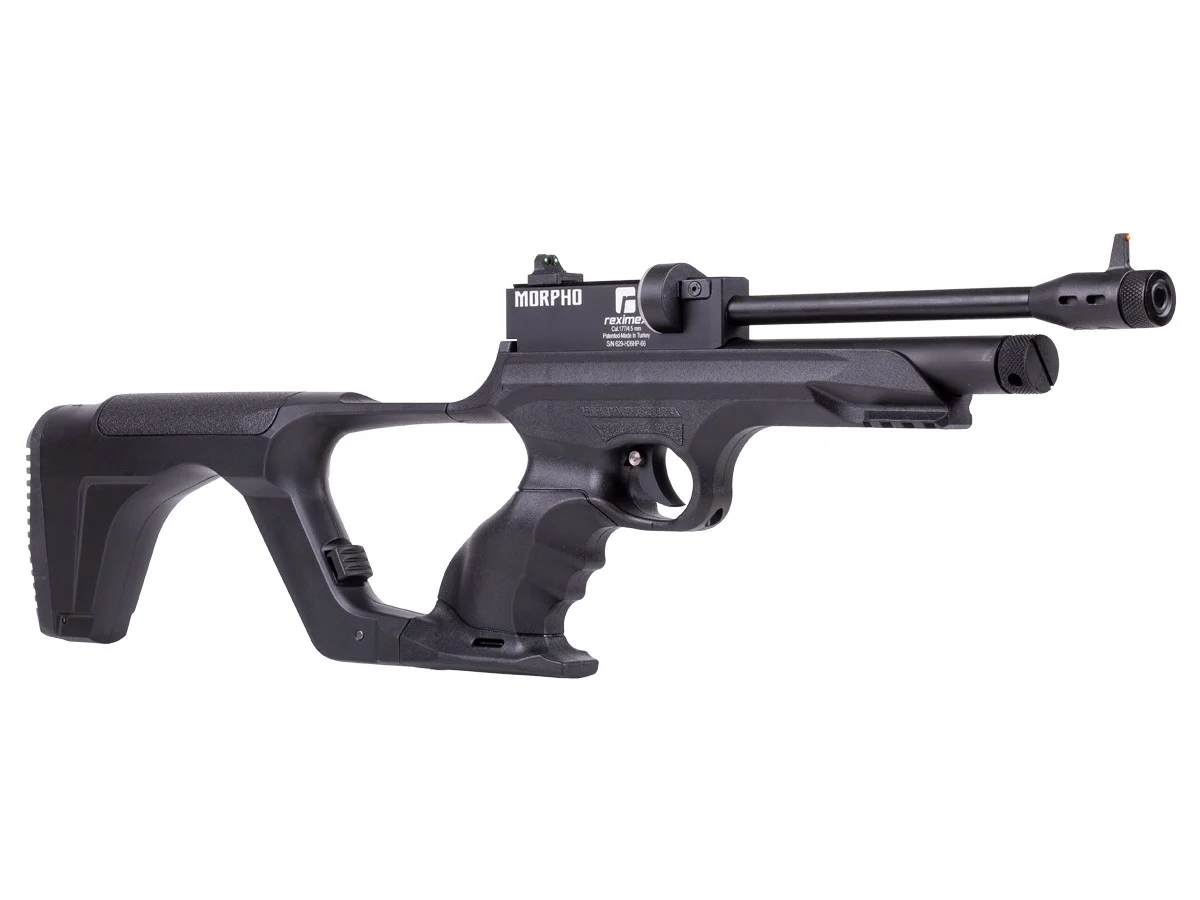
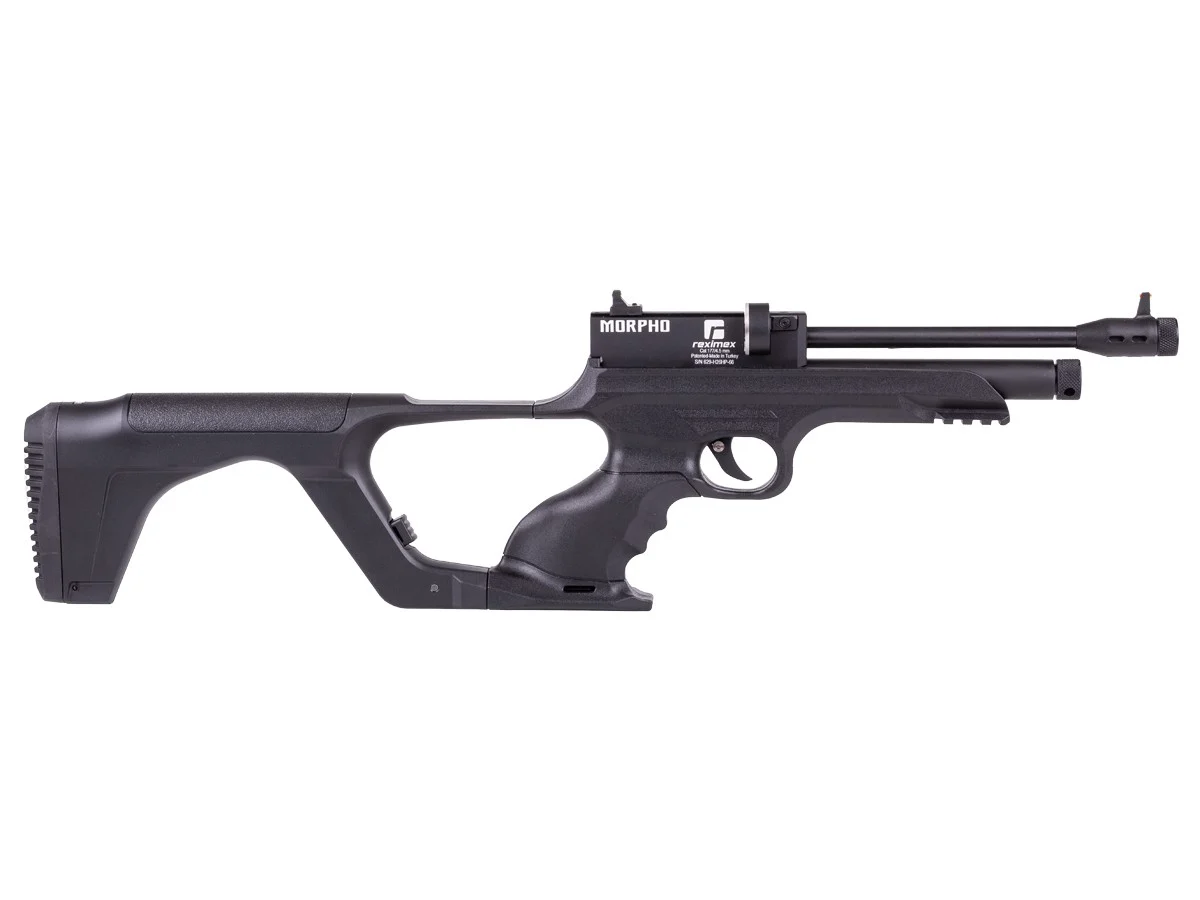
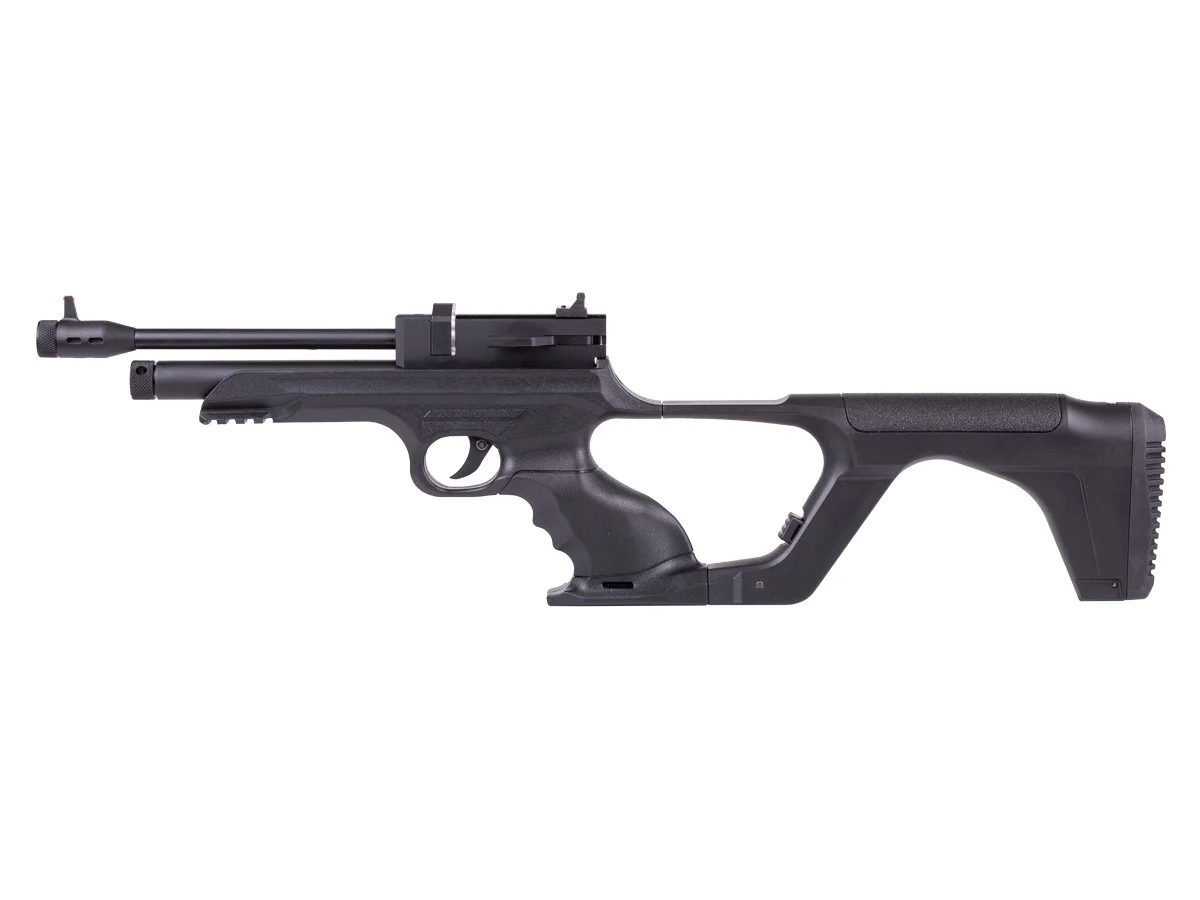


Reximex Morpho Air Pistol
€100.00
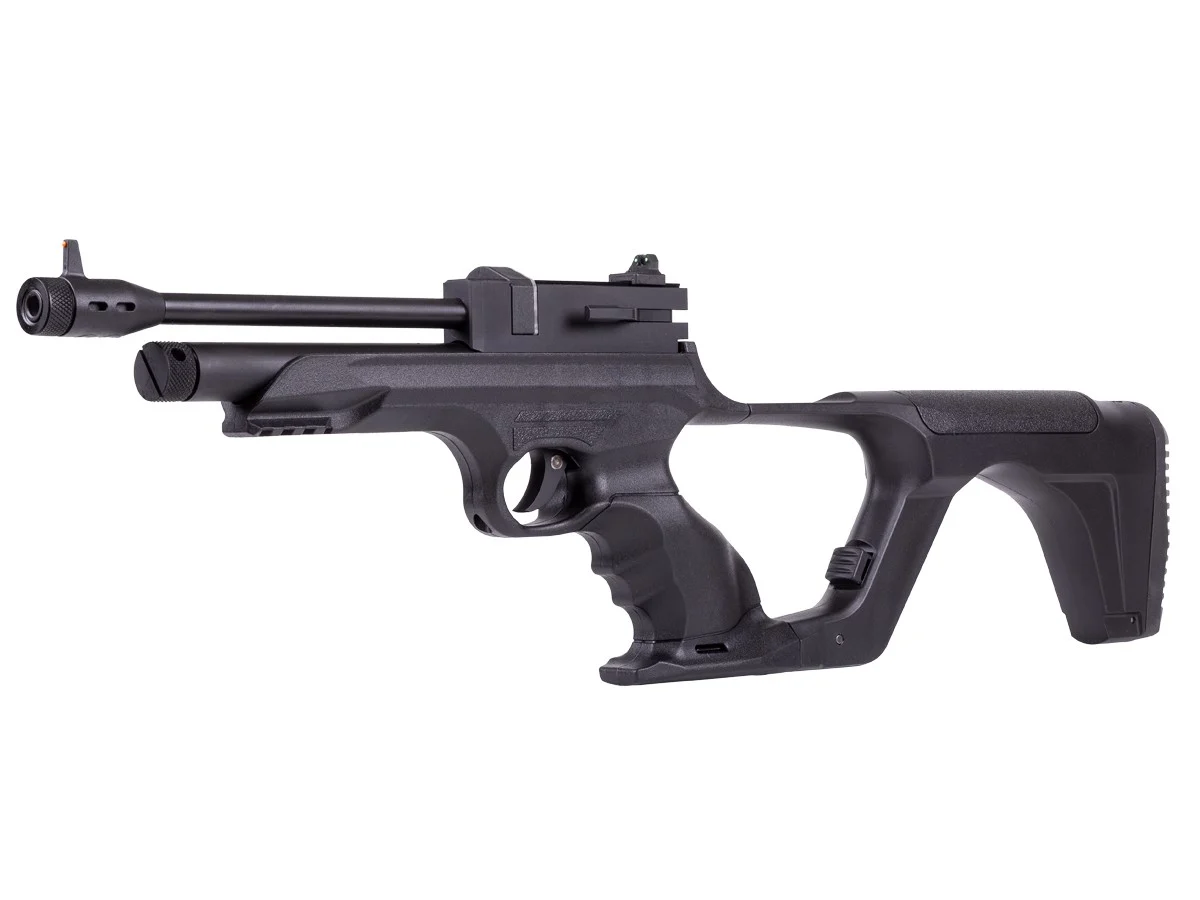
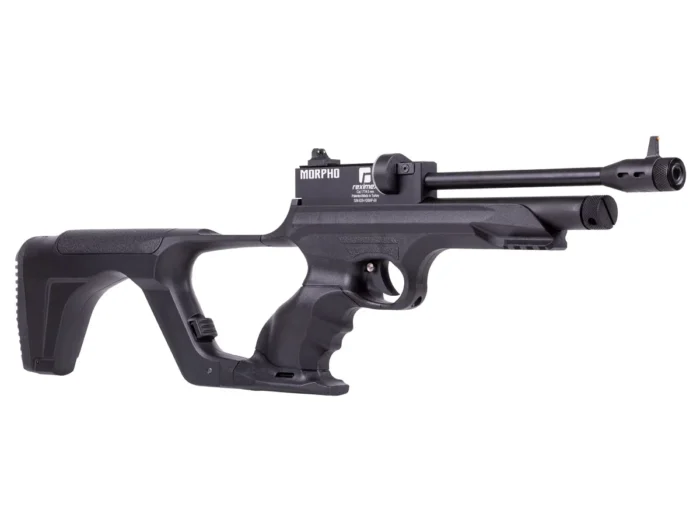
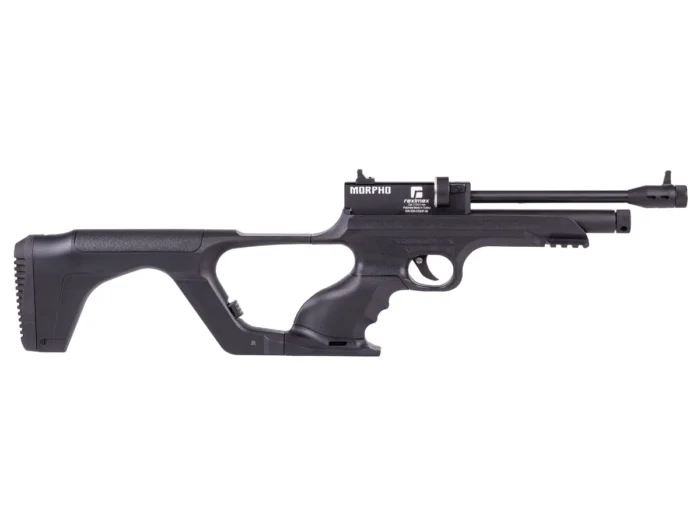
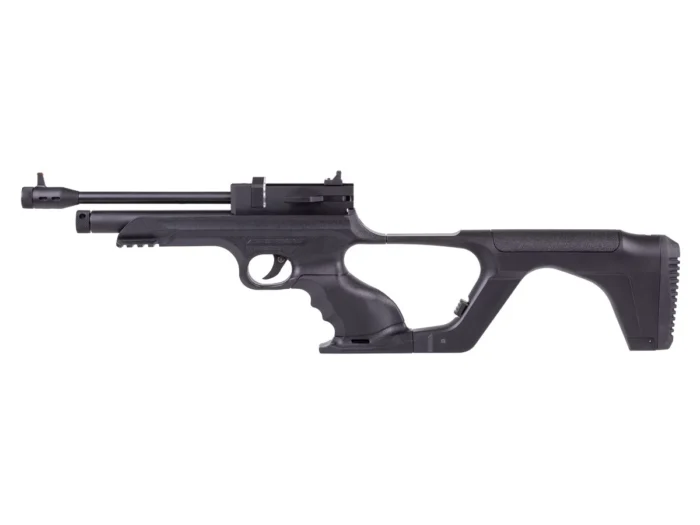
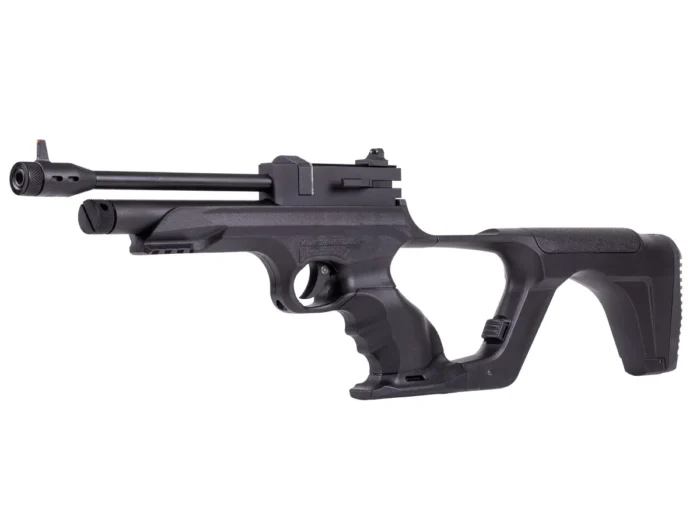
The Reximex Morpho is an affordable CO2 air pistol with detachable stock and the necessary velocity and power for effective and exciting plinking and target shooting. It features a smooth and convenient sidelever for simple cocking, as well as fiber optic front and rear sights for immediate aiming precision.
Key Takeaways
- Detachable stock allows it to convert quickly and easily between an air pistol and a carbine-style air rifle.
- The smooth sidelever provides a simple and effective method of cycling the magazine and cocking for the next shot.
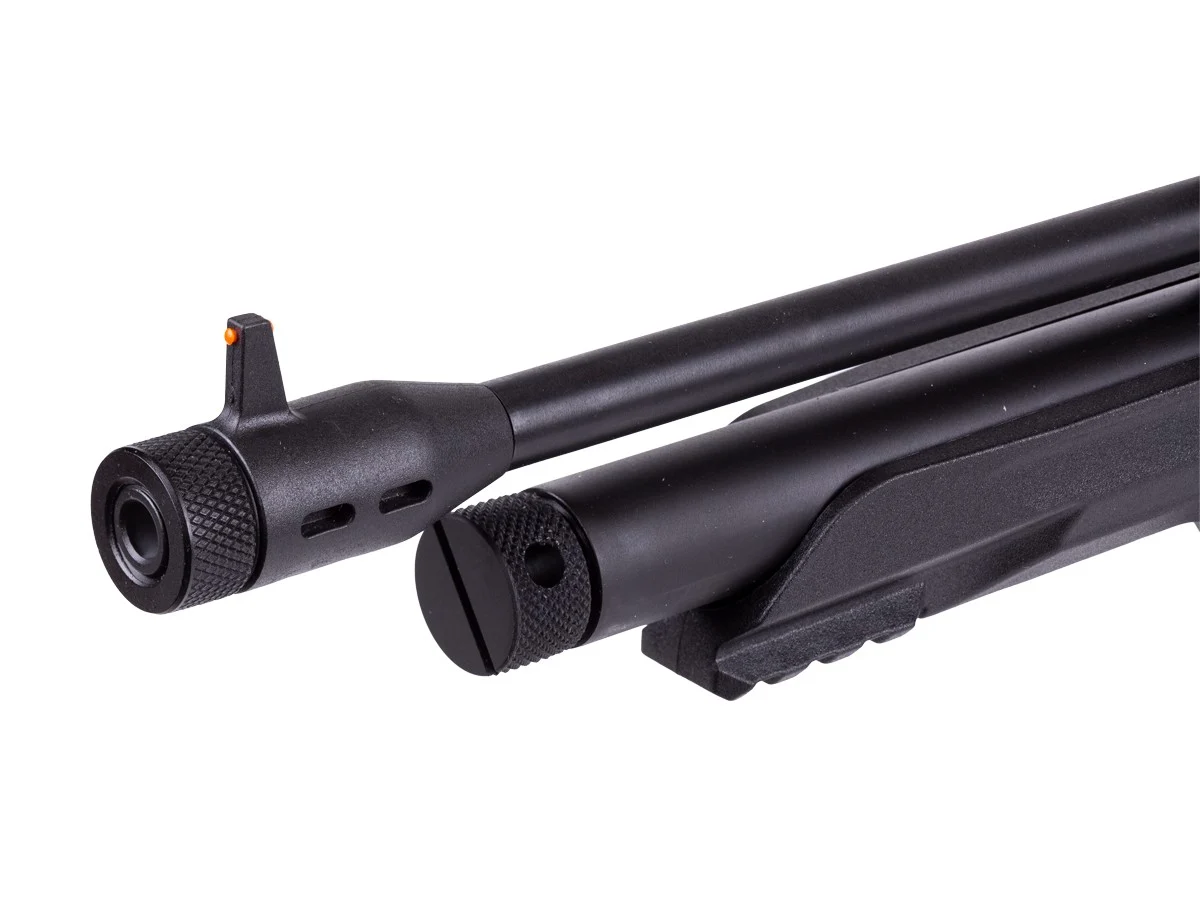
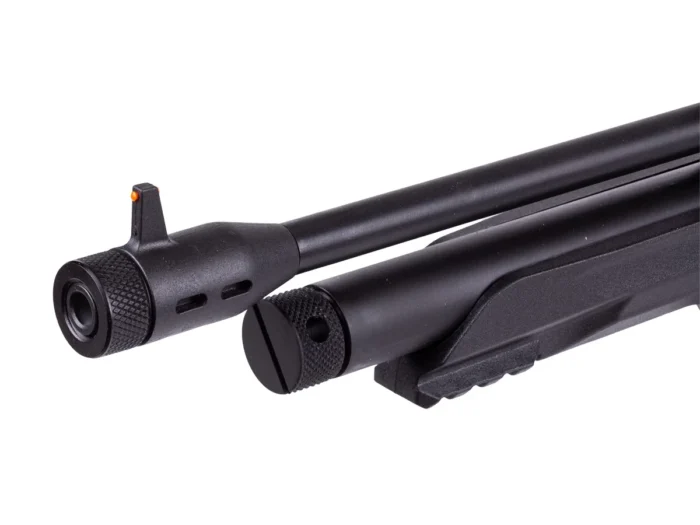
- Included fixed post front and two-dot notch rear fiber optic sights mean accurate aiming without the need to purchase additional equipment.
- The Picatinny accessory rail under the CO2 cartridge tube enables extended functionality with the addition of accessories such as flashlights and lasers.
Converts Between an Air Pistol and an Air Rifle
The Reximex Morpho comes with a detachable stock that allows shooters to switch between a light and accurate air pistol and a carbine-style air rifle that offers added control and a stable hold because of the ridged rubber buttpad. The stock attaches to the bottom rear of the molded pistol grip and the rear of the top of the pistol behind the rear sight for a secure fit.
- Take advantage of the benefits of an air pistol, including compact maneuverability and light weight.
- Enjoy the benefits of a carbine-type air rifle, including added control and a comfortable hold with the detachable stock with ridged rubber buttpad.
Lightweight and Compact
This CO2 air pistol weighs just 1.98 pounds when used as a pistol, and only 2.9 pounds as a carbine-style air rifle with the stock attached. In addition, it is only 14.5 inches long in pistol form, and just 24.09 inches with the stock.
Convenient Smooth Sidelever
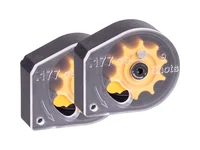
The Reximex Morpho features a smooth sidelever that makes it simple as well as convenient to cock it for the next shot. It also comes with a 9-round magazine in .177 and a 7-round magazine in .22 to offer multi-shot capability.
Features and Benefits
| Feature | Benefit |
|---|---|
| Detachable Stock | Allows this airgun to be used as either a carbine-type air rifle or an air pistol. In either configuration, it is compact and lightweight. |
| Sidelever Cocking | Provides a reliable, smooth, and convenient cocking experience. |
| Front and Rear Fiber Optic Sights | Allows for accurate aiming with no additional equipment required. |
| CO2 Power | Offers Delivers a smooth and consistent shooting experience with virtually no recoil. |
Advantages of the Reximex Morpho
CO2 air pistols such as the Reximex Morpho are valued for their reliability, ease of use, and ability to refill by simply changing the CO2 cartridge.
- Affordable: Lower cost than most competing CO2 air pistols in its class, especially when considering the features provided.
- Detachable Stock: Most CO2 airguns at this price point can’t match this flexible setup that allows shooters to buy one airgun that functions as both an air rifle and an air pistol.
- Picatinny Accessory Rail: Items such as lasers and flashlights can be attached under the CO2 compartment to add additional functions to this airgun, unlike many competing airguns in its price range.
- Smooth Sidelever Cocking: The Reximex Morpho offers easy operation because of the convenient sidelever, whereas many airguns in its class only have a bolt.
Why Buy Reximex at Pyramyd AIR
Reximex Airguns has built their reputation by focusing on manufacturing high-quality airguns that boast a lot of features without costing a lot of money. They are a company at the forefront of the industry in terms of having numerous features and a high price-to-performance ratio. For a reliable and affordable airgun for plinking, target practice, or small-game hunting, choose Reximex.
When you buy from Pyramyd AIR, you’re buying from a leader in airguns and outdoor equipment, with an unmatched selection and expert support. You’ll enjoy fast and free shipping on qualifying orders, earn rewards with our exclusive loyalty program, and benefit from comprehensive services at our Pro Shop. Our knowledgeable staff is passionate about the outdoors and ready to help, and our huge ammo and accessories selection ensures you always have the right pellets, BBs, riflescopes, PCP compressors, and more. In business since 1996, Pyramyd AIR stands for trust and expertise. Buy the Reximex Morpho CO2 Air Pistol today from Pyramyd AIR.
Specifications

Reximex Morpho Air Pistol – Detailed Technical Product Guide
Reximex Morpho Engineering, CO2 Operation, and Model Context
Reximex and Reximex Airguns
Reximex is a Turkish airgun manufacturer founded in Konya-Beyşehir in 2015. The company states that it develops products through modern R&D and manufacturing processes and serves customers across more than 60 countries.
Its catalog includes PCP rifles, PCP pistols, CO2 pistols, and other sporting platforms. That explains why searches such as Reximex Lyra K, Reximex Throne Gen2, Reximex Throne Gen 2, Reximex Mito, Reximex Mitos, Reximex Lieva, Reximex RPA, and even variants such as reximex гр can appear alongside the Morpho.
However, these products should not automatically be treated as mechanically identical.
Morpho CO2 Power System
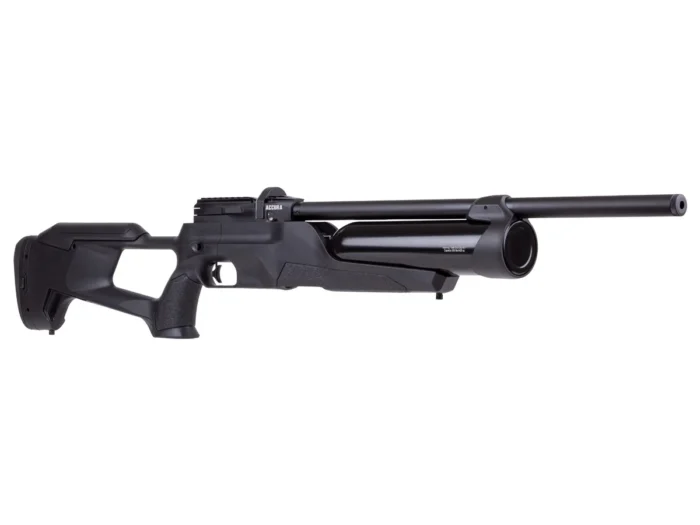
The Morpho differs fundamentally from a PCP rifle such as the Reximex Accura PCP Air Rifle because it uses a disposable 12-gram CO2 cartridge rather than a refillable high-pressure reservoir.
Reximex lists the Morpho specifically within its CO2 pistol category and specifies one 12-gram cartridge as the power source.
This architecture simplifies the external charging requirement because there is no 200- or 250-bar onboard air tube to fill.
However, CO2 performance can still vary with temperature, cartridge condition, projectile choice, and equipment maintenance.
Side-Lever Action
Reximex equips the Morpho with a side-lever operating system.
This mechanical arrangement allows the user to cycle the action while maintaining the compact pistol format.
Smooth operation depends on keeping the mechanism and magazine in suitable condition. Persistent resistance should not be overcome by excessive force because contamination, alignment, or component wear may be responsible.
Manufacturer guidance should remain the primary reference when technical servicing is required.
Caliber Options and Energy
The Morpho is available in .177 and .22 pellet configurations. Reximex lists approximately 400 fps for .177 and 350 fps for .22, producing manufacturer-rated energies of 4.07 and 4.93 joules respectively.
Those values explain why searches for tps to joules calculator, Tps joule calculator, fps to ft Ibs, and airgun joules calculator often appear when users compare airgun performance.
Energy cannot be calculated accurately from velocity alone. Projectile mass must also be known.
Reximex maintains an official airgun calculator for energy conversions, reinforcing the distinction between velocity and actual projectile energy.
Magazine Capacity and Shot Count
The .177 version uses a nine-round magazine, while the .22 version uses a seven-round magazine. Reximex states that one 12-gram CO2 cartridge can provide approximately 40 shots in .177 and 36 shots in .22 under its test conditions.
Actual usable shot count can vary because CO2 pressure is temperature-sensitive.
Consequently, theoretical maximum shot count should not automatically be interpreted as identical velocity from the first shot through the last.
Rifled Barrel and Sighting System
The Morpho uses a rifled barrel measuring approximately 201 mm or 7.9 inches and incorporates fiber-optic sights.
A rifled barrel provides rotational stabilization for suitable pellets, while the fiber-optic sighting arrangement supports clear sight acquisition during controlled recreational target use.
Practical accuracy still depends on pellet consistency, sight alignment, mechanical condition, environmental conditions, and user technique.
Morpho Versus Reximex RPA
The Reximex RPA is a different platform. Reximex identifies the RPA as a lightweight regulated PCP air pistol rather than a CO2 design. It is available in .177 and .22 and uses different magazine arrangements from the Morpho.
Therefore, reximex rра searches should not be treated as alternative names for the Morpho.
The distinction between PCP and CO2 power systems is particularly important when researching maintenance, filling equipment, and compatible accessories.
Reximex Lyra-K PCP Air Rifle Context
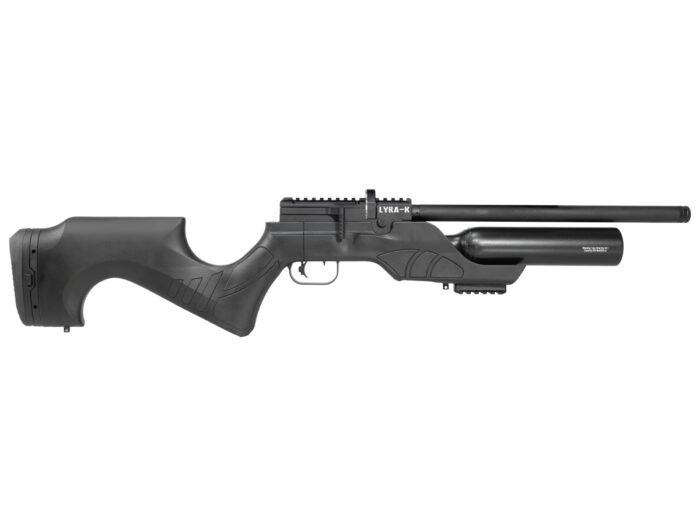
The Reximex Lyra-K PCP air rifle is also mechanically different. Reximex currently lists it with a side lever, 250 cc air tube, 250-bar fill pressure, Turkish walnut stock, and .177, .22, and .25 caliber options.
Search terms including Reximex Lyra-K airgun, Reximex Lyra-K review, Reximex Lyra-K PCP rifle, Reximex Lyra-K regulated PCP, Reximex Lyra-K compact PCP rifle, and Reximex Lyra-K pellet gun refer to that rifle rather than the Morpho.
Likewise, Reximex Lyra-K tactical air rifle, Reximex Lyra-K hunting rifle, Reximex Lyra-K accuracy test, and Reximex Lyra-K scope package describe Lyra-K-related search interests rather than Morpho specifications.
Commercial and Use-Case Search Terms
Phrases such as buy Reximex Lyra-K online and best price Reximex Lyra-K are commercial search terms rather than technical product data.
Similarly, searches such as Reximex Lyra-K for pest control and Reximex Lyra-K small game hunting concern potential use cases for a different platform and should not be transferred to the Morpho.
The Morpho is better understood technically as a compact CO2 pellet pistol intended for controlled recreational and target applications.
Reximex Throne Gen2, Lieva, and Other Models
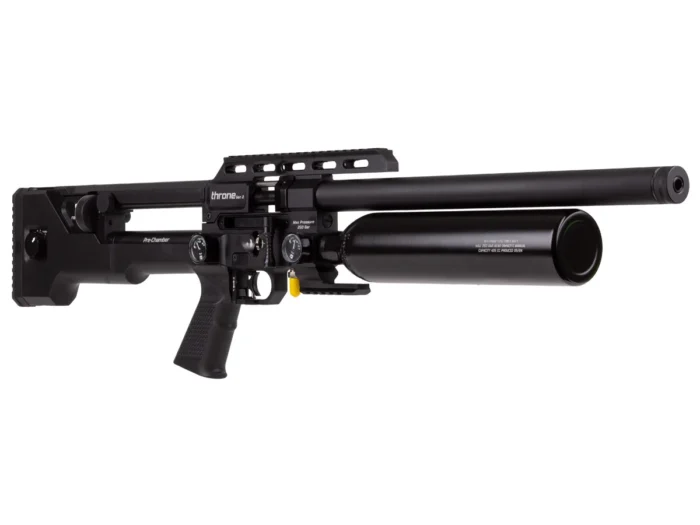
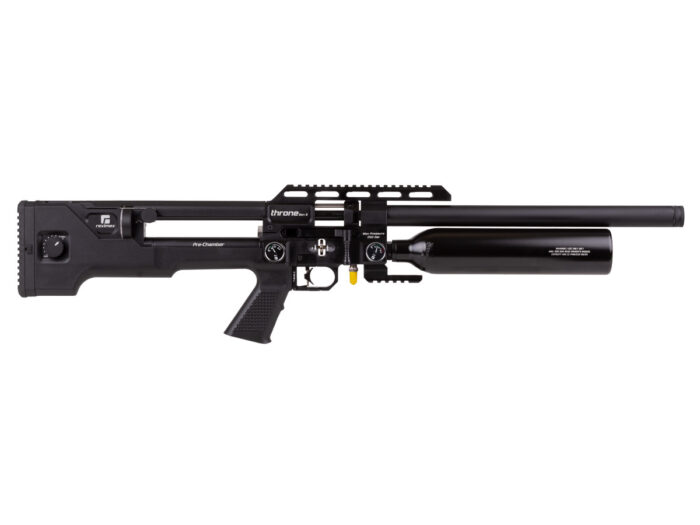
The Reximex Throne Gen2, Reximex Throne Gen 2, and Reximex Lieva are separate PCP products within the wider Reximex catalog. The Lieva, for example, is a lever-action PCP rifle offered in .177, .22, and .25 calibers with a 105 cc air tube and 250-bar fill pressure.
This distinction illustrates why exact model identification is important.
Terms such as roxy max, mx rex, and gunseek should likewise be verified individually rather than assumed to describe Morpho specifications or compatible components.
Precision and Practical Accuracy
The Morpho’s technical configuration combines a rifled 7.9-inch barrel, multi-shot magazine, fiber-optic sights, side-lever operation, and relatively modest CO2 power.
These characteristics create a practical foundation for recreational target shooting, but precision is not determined by one component alone.
Pellet consistency, mechanical condition, sight alignment, temperature, and user technique all influence repeatable results.
Because CO2 pressure changes with temperature, environmental conditions deserve particular consideration when comparing performance between sessions.
Maintenance and Responsible Ownership
Routine maintenance should focus on preserving the barrel, magazine, seals, external surfaces, and operating mechanism.
The CO2 system should be handled according to manufacturer instructions rather than generalized PCP procedures because the Morpho uses a different power source.
Secure storage, eye protection, a reliable backstop, and a controlled environment remain essential because pellet pistols can cause serious injury.
From an engineering standpoint, the Reximex Morpho is best understood as a compact multi-shot CO2 air pistol that emphasizes simple cartridge-powered operation, manageable dimensions, and practical recreational target use rather than the high-pressure pneumatic architecture found elsewhere in the Reximex range.
Engineering Quality, Practical Performance, Precision, and Handling
The Reximex Morpho combines compact construction, cartridge-powered operation, multi-shot functionality, and straightforward ergonomics in a format intended to remain manageable during recreational use. Although technical specifications provide a useful overview, everyday performance depends on how effectively the entire system operates as a unit. Barrel consistency, mechanical condition, gas efficiency, balance, sight alignment, environmental conditions, and user comfort all contribute to the practical experience. Therefore, quality should be evaluated through repeatability, reliability, construction, and ease of ownership rather than maximum performance figures alone.
Engineering and Construction Quality
A compact sporting platform still requires careful integration between its individual components.
The frame, barrel assembly, operating mechanism, grip, sighting components, magazine interface, and internal gas system need to maintain appropriate alignment during normal operation.
Good manufacturing tolerances contribute to a solid mechanical feel. Controls should behave predictably, while structural components should remain stable without unexplained movement.
As ownership continues, familiarity with the equipment’s normal condition becomes valuable because changes in mechanical feel can be recognized more easily.
Compact Design and Practical Benefits
Compact dimensions are one of the platform’s most noticeable characteristics.
A smaller overall format can simplify transportation and storage while reducing the amount of space required in a protective case.
However, compactness should not be confused automatically with ideal ergonomics.
Hand size, grip shape, sighting position, and individual preference influence comfort considerably.
The most useful compact design is one that maintains structural stability and manageable controls without making the physical interface unnecessarily cramped.
Gas-Powered Performance
The cartridge-powered system provides a relatively straightforward source of stored energy.
Instead of requiring a large external filling system during ordinary use, the platform relies on replaceable gas cartridges designed for the system.
Nevertheless, performance can vary according to environmental conditions.
Temperature has a particularly noticeable relationship with gas pressure. As a result, differences between sessions do not automatically indicate a mechanical problem.
Persistent irregularities should still be investigated, especially when they continue under similar environmental conditions.
Understanding Practical Precision
Precision is better understood as repeatability than maximum velocity.
A platform that produces consistent results under controlled conditions provides more useful recreational performance than one judged solely by its highest measured figure.
Several variables contribute to this consistency.
Projectile quality, barrel condition, sight alignment, mechanical operation, temperature, and user technique can all influence results.
Therefore, repeated evaluation under similar conditions provides a more meaningful assessment than isolated outcomes.
Barrel Condition and Stability
The barrel plays an important role in maintaining predictable projectile behavior.
Its condition should remain protected from impacts, contamination, and inappropriate cleaning techniques.
Routine inspection can identify obvious external concerns.
Internal cleaning should follow manufacturer recommendations rather than being performed aggressively after every session.
More frequent cleaning does not automatically improve performance.
If consistency changes unexpectedly, the complete system should be considered before assuming that the barrel alone is responsible.
Sight Alignment and Visibility
A clear sighting arrangement can contribute significantly to a comfortable recreational experience.
The user should be able to establish a natural visual relationship with the sights without excessive head movement or wrist adjustment.
Lighting conditions can influence how easily sighting elements are perceived.
Consequently, practical evaluation should consider the environment as well as the equipment.
Any sighting component that becomes loose or damaged should be inspected appropriately before further recreational use.
Grip Design and Hand Comfort
The grip provides the primary physical interface between the user and the equipment.
Its shape influences wrist angle, finger position, and overall control.
Individual hand dimensions vary considerably, meaning that one design may feel different from one user to another.
Comfort should be evaluated without excessive gripping pressure.
A natural hold can reduce unnecessary muscular tension, particularly during longer sessions.
Any structural modification to the grip should be avoided unless specifically supported by manufacturer guidance.
Mechanical Operating Experience
The operating mechanism contributes strongly to the perception of engineering quality.
Movement should remain predictable and reasonably smooth during normal operation.
Unexpected resistance deserves attention.
Applying excessive force to a mechanism that suddenly becomes difficult to operate may damage components or worsen an existing problem.
Inspection provides a more appropriate response.
When the cause cannot be identified safely, qualified servicing should be considered rather than experimental disassembly.
Magazine Reliability
A multi-shot system depends on the magazine remaining in suitable condition.
Physical damage, contamination, or inappropriate handling may influence reliability.
Magazines should therefore be protected during storage and transportation.
If feeding becomes inconsistent, the condition of the magazine and compatible ammunition should be considered before more extensive mechanical conclusions are made.
Replacement components should match manufacturer specifications to preserve reliable operation.
Temperature and Environmental Conditions
Gas-powered equipment can respond noticeably to temperature.
Cold conditions may reduce available pressure, while warmer environments can change system behavior in the opposite direction.
This makes environmental awareness particularly important when comparing results between different sessions.
Moisture and dust also deserve attention.
After outdoor exposure, external surfaces should receive appropriate care before storage.
The equipment should never be subjected to excessive heat or inappropriate environmental conditions.
Reliability Over Repeated Sessions
Long-term reliability becomes clearer through repeated responsible use.
A dependable system should maintain reasonably predictable mechanical behavior when environmental conditions and equipment condition remain similar.
Small variations can occur naturally.
However, persistent leakage, unusual resistance, unexpected movement, or significant performance changes should not simply be ignored.
Routine observation helps identify these developments before they become more substantial maintenance concerns.
Routine Maintenance
Maintenance should focus on preservation rather than unnecessary intervention.
External surfaces can be kept clean using suitable materials, while the barrel and mechanical components should be maintained according to manufacturer recommendations.
Harsh chemicals should be avoided unless specifically approved.
Frequent internal disassembly is generally unnecessary for routine ownership.
Complex repairs involving internal gas or mechanical components should be handled by someone with appropriate technical knowledge.
Storage and Transportation
Secure storage protects both the equipment and the people around it.
A clean, dry environment can reduce exposure to moisture and contamination, while restricted access helps prevent unauthorized handling.
A protective case provides useful physical protection during transportation.
The equipment should be positioned so that it cannot move excessively or be struck by heavier objects.
Applicable local storage and transportation requirements should always be respected.
Responsible Recreational Use
Practical performance must always be considered alongside responsible handling.
A controlled recreational environment should include reliable containment and remain clear of unintended people, animals, vehicles, and property.
Suitable eye protection should be used, and the equipment should always be treated as capable of causing serious injury.
Experience should reinforce disciplined handling rather than encourage complacency.
Overall Performance Perspective
The Morpho’s practical appeal comes from the relationship between compact dimensions, straightforward operation, multi-shot functionality, manageable ergonomics, and relatively simple routine maintenance.
Its engineering quality is best assessed through consistent mechanical behavior, comfortable handling, dependable gas retention, and long-term durability.
Ultimately, maximum figures provide only a small part of the ownership picture. Proper maintenance, environmental awareness, secure storage, careful transportation, routine inspection, and responsible handling determine how effectively the original engineering is preserved throughout years of lawful recreational ownership.
Build Quality, Durability, Maintenance, and Long-Term Equipment Care
The Reximex Morpho is designed as a compact sporting platform where long-term quality depends on the relationship between construction, mechanical integrity, material durability, and responsible maintenance. Initial appearance and performance can create a strong first impression, but sustained ownership reveals how well individual components tolerate regular handling, environmental exposure, transportation, and storage. Proper care does not require constant intervention. Instead, routine observation, appropriate cleaning, protection from unsuitable conditions, and professional attention when genuine mechanical concerns develop provide the strongest foundation for preserving reliability.
Overall Build Quality
Build quality begins with how securely the major components work together.
The frame, barrel assembly, grip, sighting components, operating mechanism, magazine interface, and internal power system should maintain appropriate alignment throughout normal use.
A well-constructed platform should feel solid without unexplained movement between major structural areas.
Manufacturing consistency also influences the way controls feel. Predictable movement and stable component positioning contribute to the refined experience expected from a modern recreational platform.
Material Selection and Structural Integrity
Different components require different material characteristics.
Structural areas need sufficient strength and dimensional stability, while external surfaces benefit from resistance to ordinary wear and environmental exposure.
Lightweight materials can also contribute to comfortable handling without necessarily reducing durability when they are appropriately engineered.
However, even strong materials can be damaged through severe impacts, inappropriate chemicals, excessive heat, or prolonged moisture exposure.
Responsible handling therefore remains important regardless of construction quality.
External Finish Protection
The external finish contributes to both appearance and material protection.
Normal ownership may gradually introduce fingerprints, light scratches, dust, or small cosmetic marks. These signs do not necessarily indicate structural deterioration.
Cleaning should remain controlled and appropriate for the surface.
Harsh solvents and abrasive products should be avoided unless specifically approved because they may damage protective finishes.
Regular gentle cleaning generally provides a better long-term result than aggressive restoration attempts.
Barrel Preservation
The barrel is an important precision component and should be protected accordingly.
External impacts should be avoided, while the internal surface should not be subjected to unnecessary or aggressive maintenance.
Cleaning should follow manufacturer recommendations and actual equipment condition.
Frequent intervention does not automatically improve performance.
Inappropriate cleaning tools can potentially create unnecessary wear.
When consistency changes, several possible causes should be considered before assuming that extensive barrel maintenance is required.
Gas-System Condition
The internal power system relies on seals, valves, and related components maintaining suitable condition.
Gas retention should remain reasonably predictable during normal ownership.
Persistent leakage or substantial changes in operating behavior may indicate that inspection is necessary.
Because internal components can require specialized knowledge, experimental disassembly should be avoided.
A qualified technician can diagnose problems more effectively while reducing the possibility of accidental damage to neighboring components.
Seal Preservation
Seals play an important role in maintaining reliable operation.
Their condition can gradually change because of age, contamination, environmental exposure, or normal service.
This does not mean that seals require constant replacement.
Instead, owners should pay attention to meaningful changes in gas retention or general operation.
Maintenance products should only be used when they are compatible with the equipment.
Unsuitable substances can damage sealing materials rather than preserve them.
Mechanical Components and Wear
Moving components naturally experience some service-related wear.
Normal wear should be distinguished from abnormal mechanical behavior.
Unexpected resistance, unusual movement, unfamiliar sounds, or controls that suddenly behave differently deserve attention.
Applying excessive force is generally inappropriate when a mechanism does not operate normally.
Inspection should occur first.
If the cause remains uncertain, professional servicing provides a more dependable approach than repeatedly manipulating the component.
Magazine Condition
The magazine should be protected from impacts, dirt, deformation, and unnecessary stress.
A damaged magazine can affect reliability even when the rest of the platform remains in good condition.
During storage and transportation, magazines should be kept where they cannot be crushed or contaminated.
If operation becomes inconsistent, magazine condition should form part of the inspection process.
Compatible replacement components should follow manufacturer specifications rather than relying on assumptions based on appearance alone.
Sight Condition and Alignment
Sighting components deserve routine visual inspection.
Loose, damaged, or misaligned components can affect the user experience and may incorrectly suggest that another part of the system has developed a problem.
External impacts are a common concern because exposed sighting elements may receive direct contact.
After a significant fall or collision, the equipment should be examined carefully.
Professional assessment may be appropriate if structural alignment becomes uncertain.
Environmental Protection
Environmental conditions can influence both materials and internal operation.
Moisture should not remain on external surfaces for extended periods, while dust and contamination should be removed appropriately.
Extreme heat deserves particular attention with cartridge-powered equipment.
The platform and its power source should never be left in environments that exceed manufacturer recommendations.
Temperature stability also helps maintain predictable storage conditions and protects surrounding materials from unnecessary stress.
Cleaning After Recreational Use
Routine cleaning should be simple and purposeful.
External surfaces can generally be wiped with suitable materials to remove fingerprints, dust, and moisture.
The objective is preservation rather than complete disassembly.
Internal mechanical components should remain undisturbed unless maintenance is actually required.
Frequent unnecessary disassembly can introduce damage, lost components, or alignment problems.
Manufacturer instructions should determine when more extensive servicing is appropriate.
Routine Inspection
Regular observation is one of the most valuable maintenance practices.
Before appropriate recreational use, the equipment can be checked for obvious damage, unusual movement, contamination, or significant deterioration.
Inspection becomes particularly important after a substantial impact or extended period of storage.
Owners who understand the normal condition of their equipment can recognize developing problems more easily.
Routine inspection does not replace professional servicing, but it provides an effective early-warning process.
Storage Conditions
Storage should protect the equipment from both environmental damage and unauthorized access.
A clean, dry, secure location is preferable.
Excessive humidity, direct heat, corrosive substances, and unstable surfaces should be avoided.
The equipment should be positioned where it cannot fall or be struck accidentally.
Security is particularly important where children or inexperienced individuals may be present.
Applicable local requirements should determine any additional storage measures.
Transportation Protection
A properly fitted protective case can reduce the risks associated with transportation.
The equipment should remain securely positioned so that it cannot move excessively inside the case.
Other heavy objects should not be placed where they can compress or strike it.
Transportation may also introduce significant temperature changes.
After reaching the destination, allowing equipment to stabilize appropriately can help reduce condensation concerns.
Local transportation regulations should always be followed.
Professional Servicing
Some maintenance concerns require specialized expertise.
Persistent leakage, damaged mechanical components, structural problems, or unexplained operating changes may require professional evaluation.
Attempting complex repairs without suitable knowledge can worsen the original issue.
Qualified servicing also provides an opportunity for the complete platform to be inspected rather than concentrating only on the most obvious symptom.
Manufacturer-approved parts should be preferred whenever replacement becomes necessary.
Long-Term Ownership and Preservation
Good maintenance is primarily preventative.
Careful handling, suitable cleaning, environmental protection, secure storage, and early attention to unusual behavior can prevent many avoidable problems.
Keeping a simple maintenance history can also be useful.
Dates of professional servicing, replacement components, and significant incidents can provide valuable context later.
This information may also help technicians understand the equipment’s history if future servicing becomes necessary.
Overall Durability Perspective
The Morpho’s long-term durability depends on both original construction quality and responsible ownership.
Strong materials, secure component integration, and straightforward mechanical design establish the foundation, while maintenance determines how effectively these characteristics are preserved.
Routine inspection, gentle cleaning, protection from environmental extremes, careful transportation, secure storage, and professional servicing when necessary all contribute to dependable condition.
Ultimately, durability should be measured through structural integrity, predictable operation, stable controls, and consistent condition rather than appearance alone. With appropriate care, the platform can retain its intended characteristics throughout years of lawful and responsible recreational ownership.
Everyday Usability, Comfort, Reliability, and Ownership Experience
The Reximex Morpho is built around a compact format that places emphasis on straightforward handling, manageable dimensions, simple routine care, and a comfortable recreational experience. While specifications provide useful technical information, long-term satisfaction depends on how naturally the complete platform fits into everyday ownership. Balance, grip comfort, mechanical consistency, environmental conditions, transportation, storage, maintenance requirements, and overall durability all contribute to this experience. Therefore, practical value should be evaluated through convenience and predictable operation rather than performance figures alone.
Everyday Handling and Practical Feel
Compact dimensions can make the platform relatively straightforward to handle in an appropriate controlled environment.
Unlike larger sporting equipment, a compact design places less emphasis on shoulder support and more emphasis on hand position, wrist comfort, and overall balance. These characteristics can influence how substantial or manageable the equipment feels.
Individual preferences remain important.
Hand size, wrist position, physical strength, and previous experience can affect comfort. Consequently, the same configuration may feel different from one person to another.
Grip Comfort and Ergonomics
The grip provides the primary physical interface between the equipment and the user.
A comfortable grip should allow the hand to maintain a natural position without excessive pressure or awkward wrist movement.
Longer recreational sessions can make small ergonomic differences increasingly noticeable.
If the hand must constantly compensate for uncomfortable positioning, fatigue may develop more quickly.
Therefore, practical comfort should be assessed over a reasonable period rather than judged exclusively from a brief first impression.
Balance and Weight Distribution
Overall weight is only one element of handling.
Where that weight is concentrated can be equally important. A compact platform with well-distributed mass may feel controlled and predictable, while poor balance can make even relatively lightweight equipment feel uncomfortable.
Accessories can alter this relationship.
Any additional component contributes weight and may change the natural balance point. Consequently, the complete setup should be evaluated when considering handling rather than assuming the original balance will remain unchanged after accessories are installed.
Mechanical Operating Experience
Predictable controls contribute significantly to everyday usability.
The operating mechanism should provide familiar feedback during normal recreational use. As the owner gains experience, normal movement and resistance become easier to recognize.
This familiarity can help identify developing mechanical concerns.
If a control suddenly becomes unusually difficult to operate, additional force should not be the first response.
Inspection is preferable, while qualified servicing may be necessary when the cause cannot be determined safely.
Magazine Convenience
A multi-shot magazine can provide convenient operation during organized recreational sessions.
However, reliability depends on the magazine remaining clean, undamaged, and compatible with the equipment.
Small components should receive appropriate protection during transportation and storage.
A damaged or contaminated magazine may create inconsistent operation even when the rest of the platform remains in suitable condition.
Therefore, magazine condition should be considered whenever unusual feeding behavior develops.
Consistency During Recreational Sessions
Practical quality becomes clearer through repeated use.
A dependable platform should maintain reasonably predictable behavior when equipment condition and environmental circumstances remain similar.
Minor variation can occur naturally, particularly with temperature-sensitive power systems.
For this reason, one unusual result should not automatically be interpreted as a mechanical failure.
Repeated irregularities under similar conditions provide a stronger reason for inspection.
Understanding normal behavior allows meaningful changes to be identified more accurately.
Temperature Awareness
Environmental temperature can influence the practical experience.
Equipment that performs consistently in moderate conditions may behave somewhat differently when exposed to substantially colder or warmer environments.
This should be considered when comparing different recreational sessions.
Extreme heat should always be avoided, particularly where pressurized cartridges are involved.
Manufacturer recommendations should determine acceptable storage and operating conditions.
Leaving equipment in an excessively hot enclosed environment can create unnecessary risk and should be avoided.
Outdoor Conditions
Outdoor environments introduce more than temperature changes.
Dust, moisture, wind, and humidity can influence both equipment condition and practical results.
After exposure to damp conditions, external surfaces should receive appropriate care before storage.
Dust and other contamination should also be removed using suitable materials.
Environmental awareness can reduce unnecessary deterioration while helping owners distinguish external influences from genuine mechanical changes.
Ease of Routine Maintenance
One practical advantage of a compact recreational platform is that routine external maintenance can remain relatively straightforward.
Ordinary care should focus on inspection, appropriate surface cleaning, and protection from unsuitable environmental conditions.
Complex internal disassembly is generally unnecessary for everyday ownership.
When specialized servicing becomes necessary, qualified assistance provides a safer and more dependable solution.
The objective of maintenance should be preservation rather than constant mechanical intervention.
Storage Convenience
Compact dimensions can simplify storage because less physical space is required.
However, convenience should never replace security.
The equipment should remain in a clean, dry, secure location protected from unauthorized access.
Children and inexperienced individuals should not be able to reach it.
The storage arrangement should also prevent accidental falls, crushing, or impacts.
Applicable local regulations should determine any additional security or storage requirements.
Transportation Experience
A suitably sized protective case can make transportation more organized while protecting the equipment from physical damage.
The platform should remain securely positioned inside the case rather than moving freely during travel.
Magazines and other components should also be protected from impacts.
Transportation can expose equipment to temperature changes and vibration, so a brief inspection after arrival can be useful.
Local transportation requirements should always be followed.
Long-Term Reliability
Reliability becomes increasingly meaningful over months and years of ownership.
A well-maintained platform should continue providing predictable mechanical behavior without requiring constant intervention.
However, seals and moving components naturally experience service over time.
Routine observation can identify gradual changes before they develop into more significant problems.
Preventive care should therefore emphasize maintaining normal condition rather than replacing components unnecessarily.
Ownership Confidence
Confidence develops when the equipment behaves predictably and remains easy to maintain.
Familiar controls, stable mechanical operation, comfortable ergonomics, and straightforward storage all contribute to this experience.
Nevertheless, familiarity should never result in careless handling.
The platform should always be treated as capable of causing serious injury.
Responsible habits remain necessary regardless of how frequently the equipment is used or how experienced the owner becomes.
Practical Value Over Time
Long-term value involves considerably more than the original purchase experience.
Equipment that remains comfortable, structurally sound, dependable, and manageable to maintain can continue providing value long after its initial novelty has disappeared.
Durability also contributes because well-preserved equipment requires fewer corrective interventions.
Careful ownership therefore protects both functional condition and the overall quality of the recreational experience.
Responsible Recreational Environment
Everyday usability should always exist within a controlled and lawful environment.
A dependable backstop, appropriate eye protection, and clear separation from unintended people, animals, vehicles, and property are essential considerations.
Secure handling should remain consistent from the beginning of a session through transportation and final storage.
Local regulations concerning possession, use, and transportation should always take priority.
Overall Ownership Perspective
The Morpho combines compact dimensions, straightforward controls, multi-shot convenience, comfortable handling, and relatively simple maintenance into an accessible recreational platform.
Its strongest everyday qualities are portability, manageable ergonomics, predictable operation, convenient storage, and uncomplicated external care.
Ultimately, the ownership experience depends on how effectively these characteristics are preserved. Routine inspection, environmental protection, careful transportation, secure storage, suitable cleaning, and professional servicing when required all contribute to long-term reliability.
When maintained appropriately and used within lawful controlled environments, the platform can continue providing a refined, dependable, and manageable recreational experience over an extended service life.
Be the first to review “Reximex Morpho Air Pistol”
Related products
Reximex
Reximex
Reximex
Reximex
Reximex
Reximex
Reximex
Reviews
There are no reviews yet.