
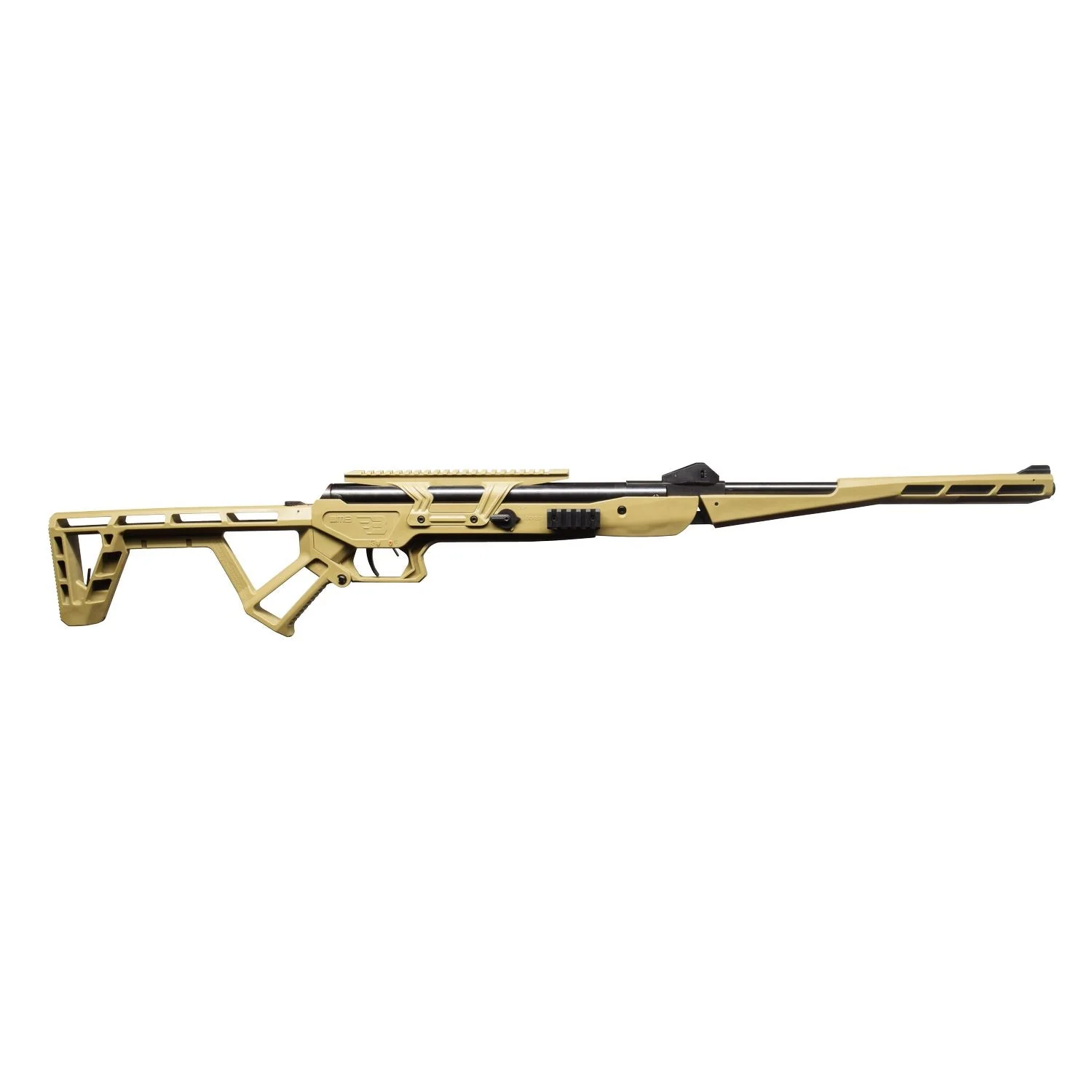
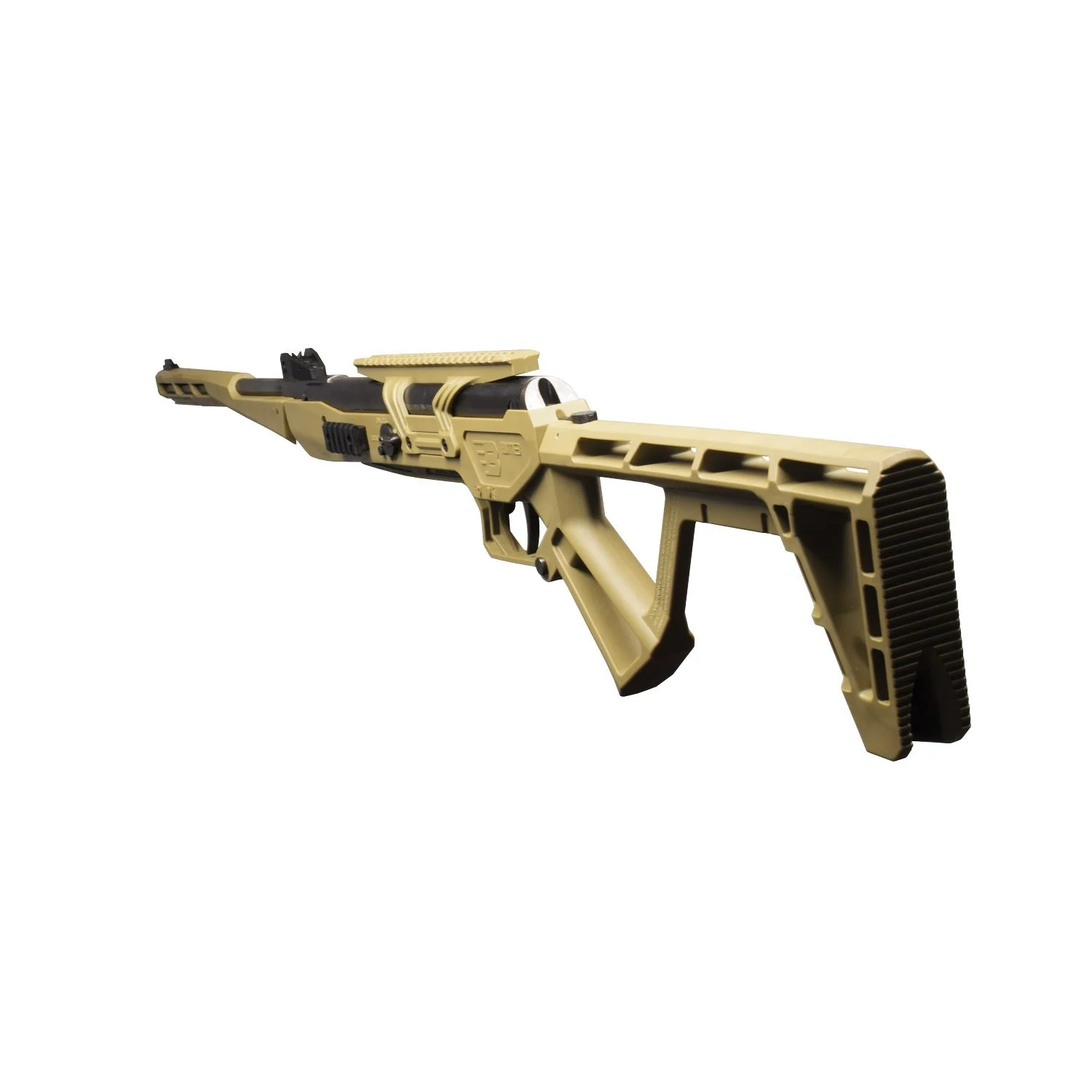
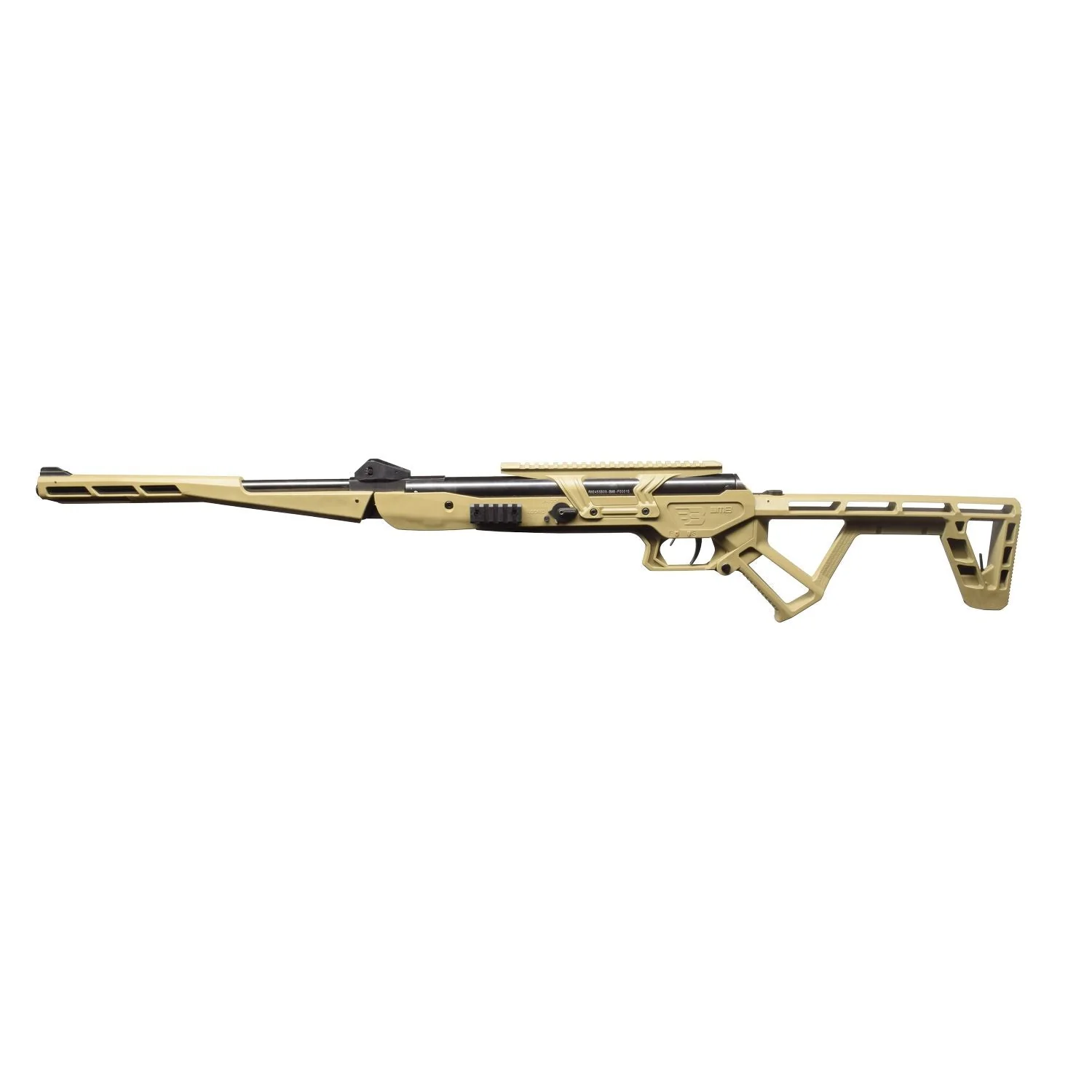
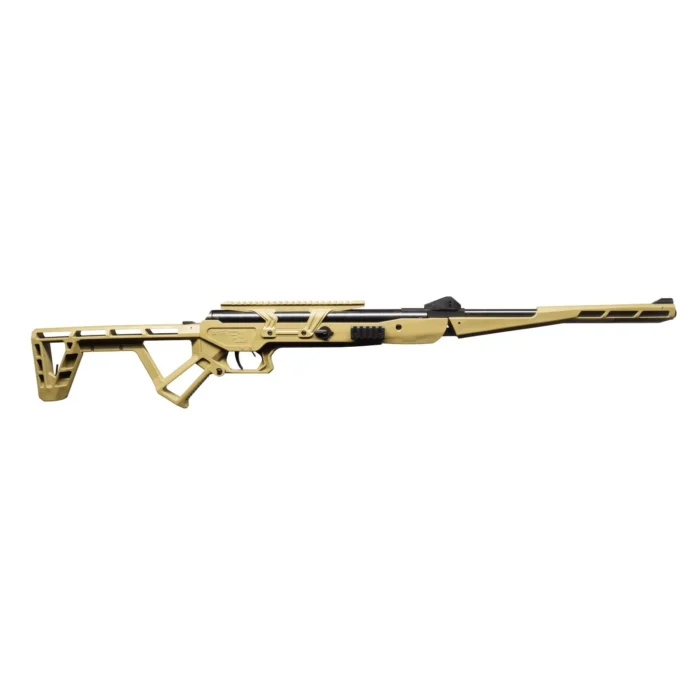
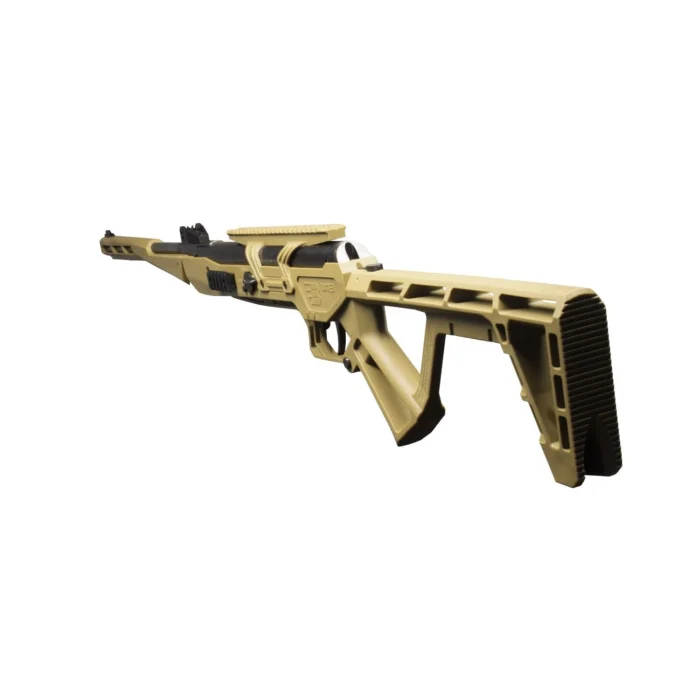
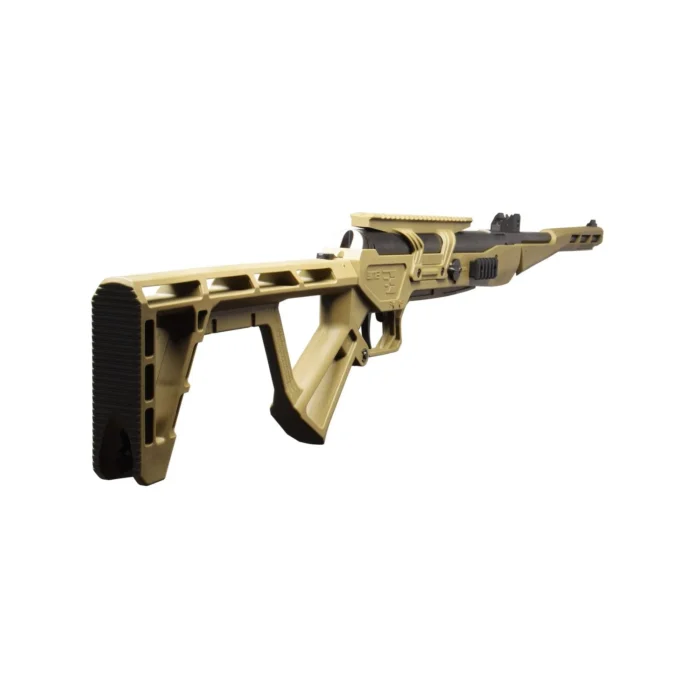
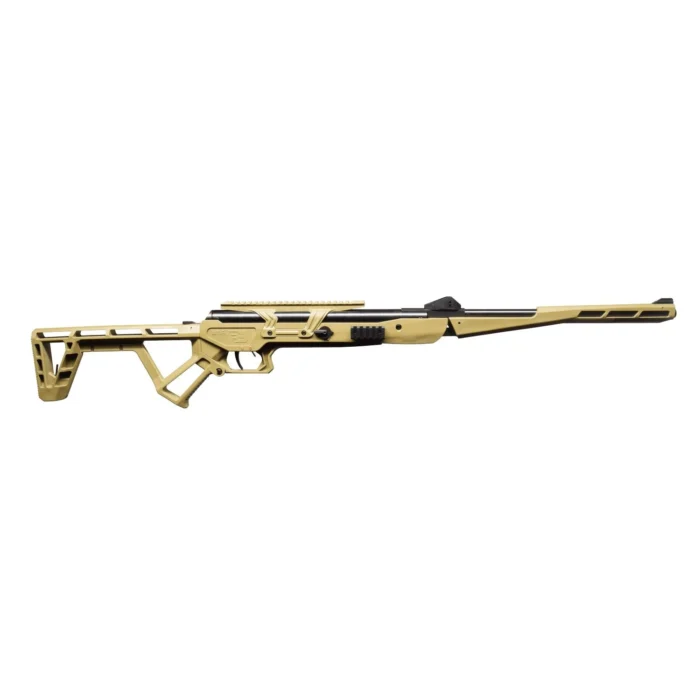
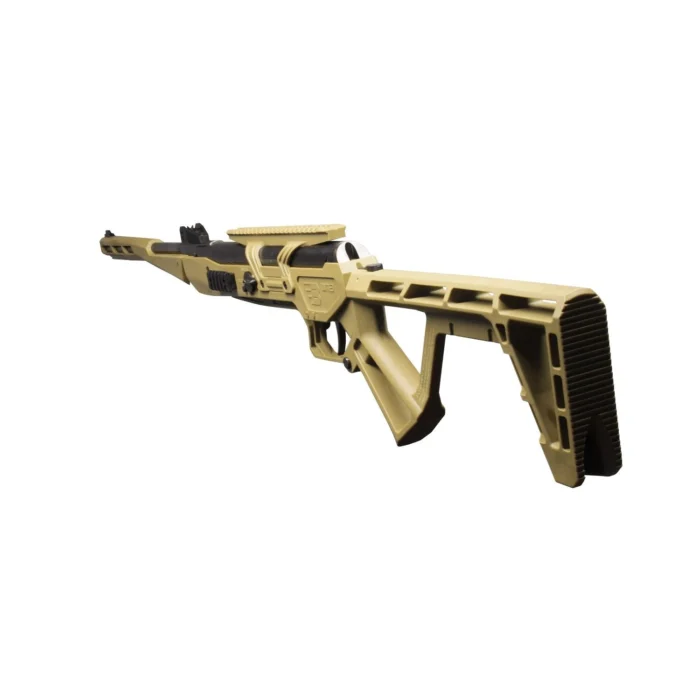
Black Bunker BM8 – Desert Tan – .177 Cal
€100.00
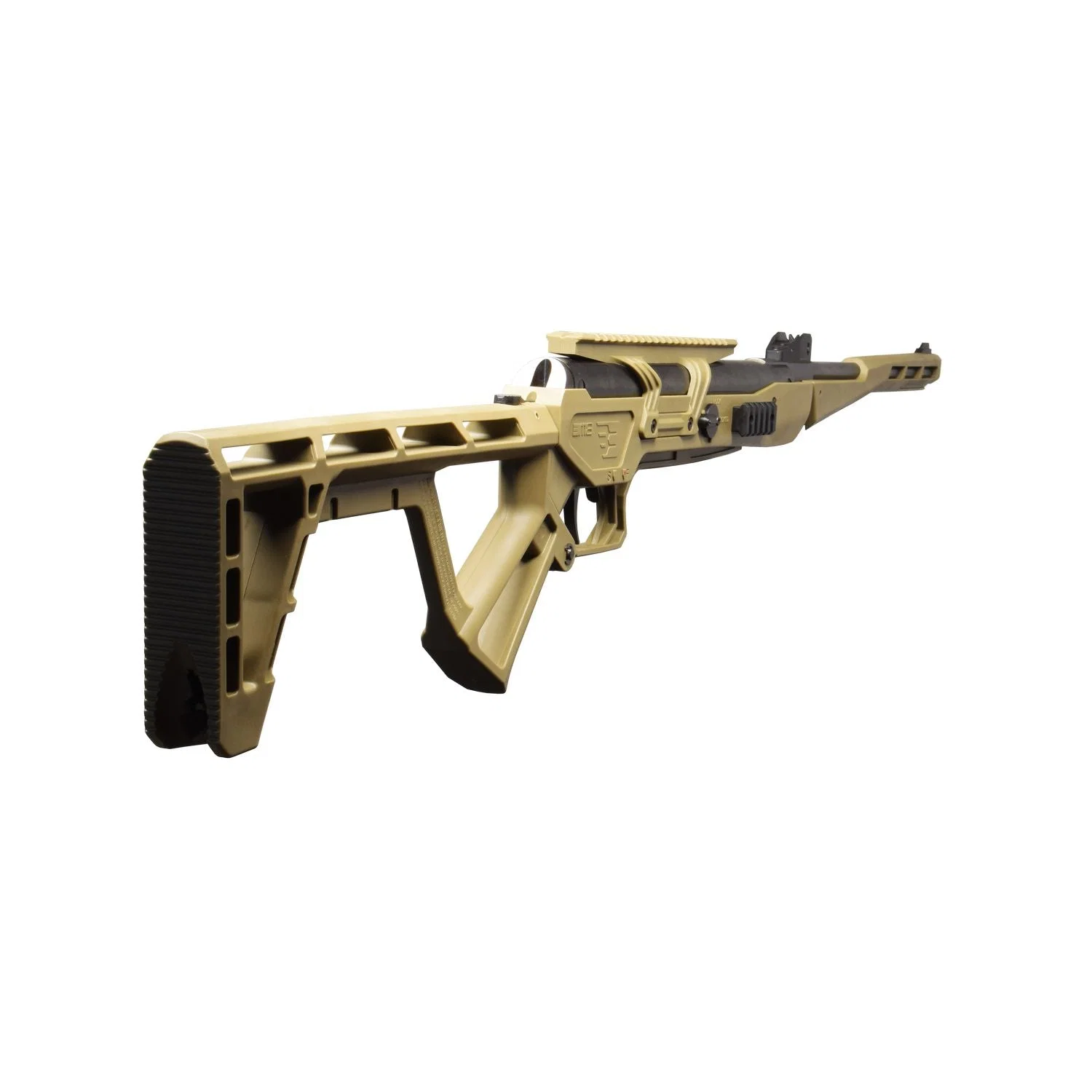
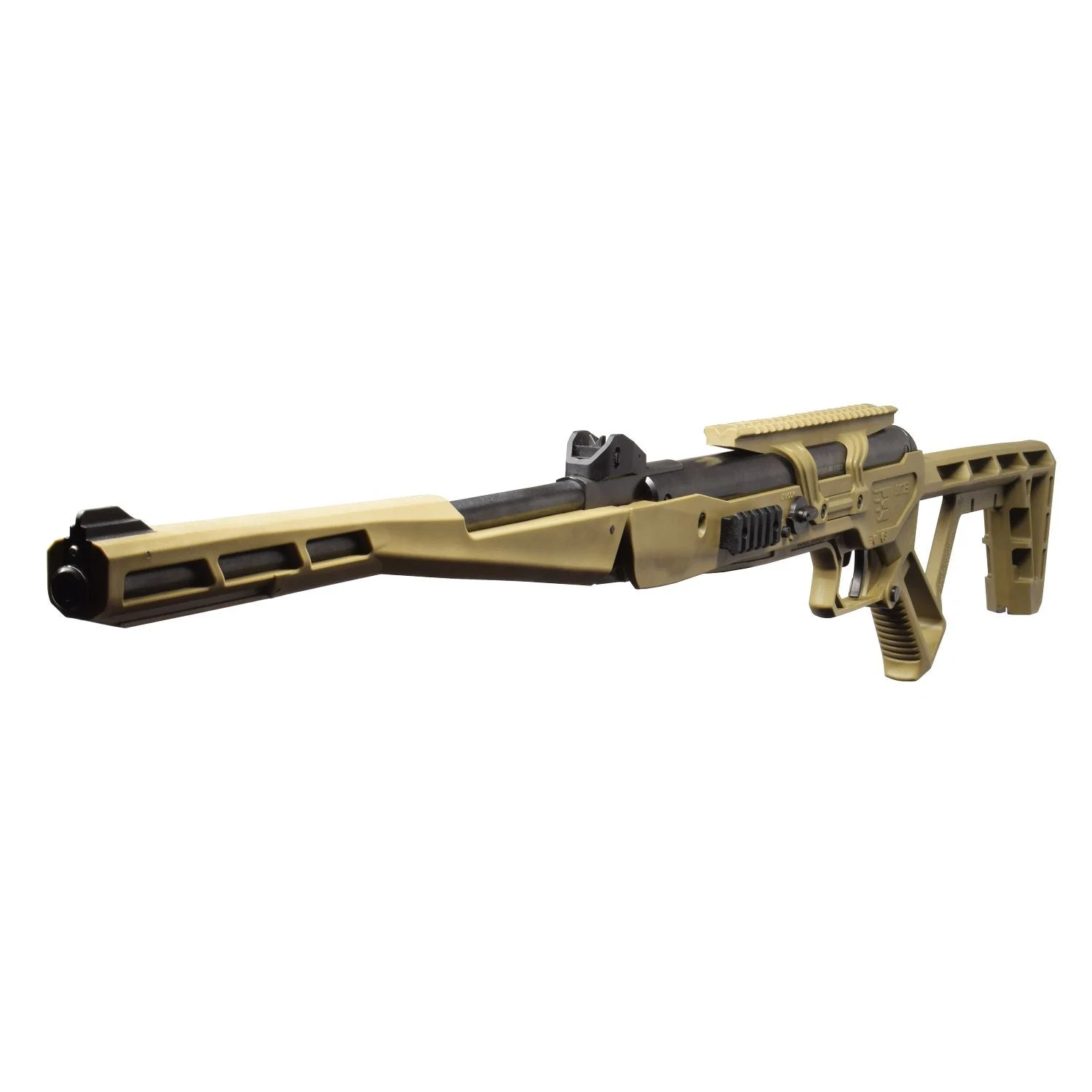
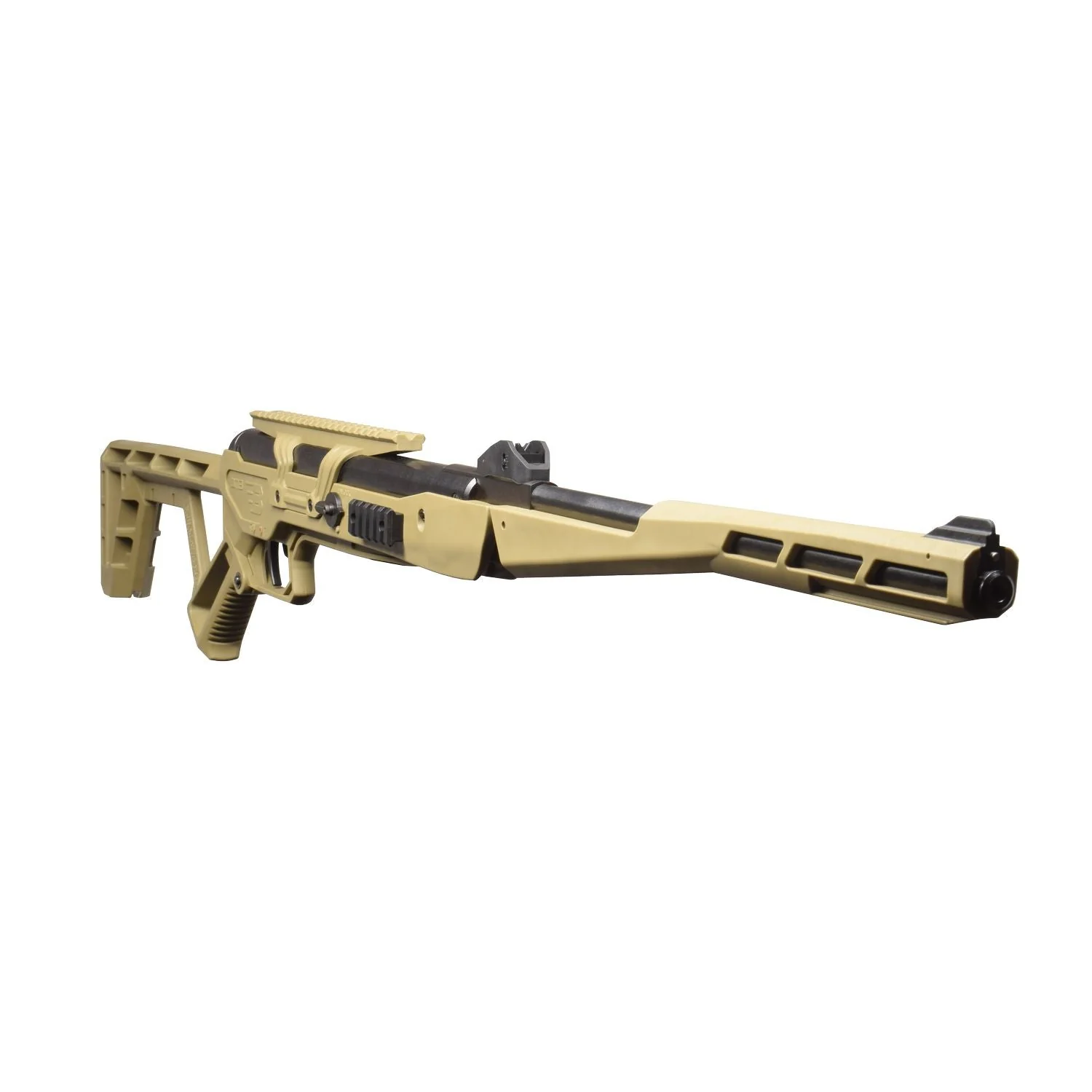
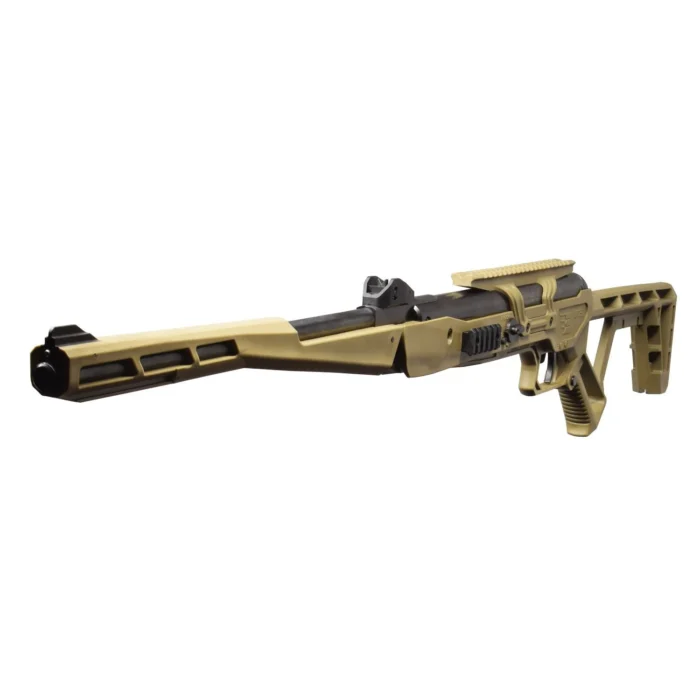
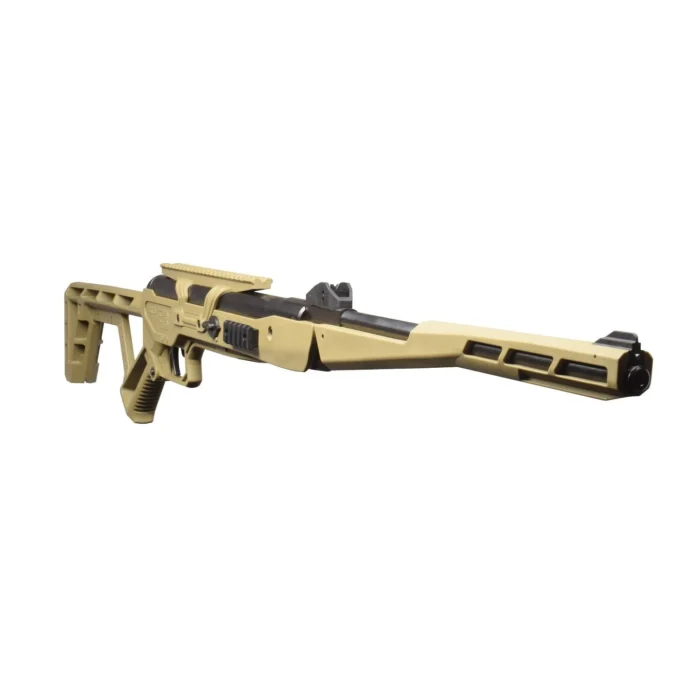
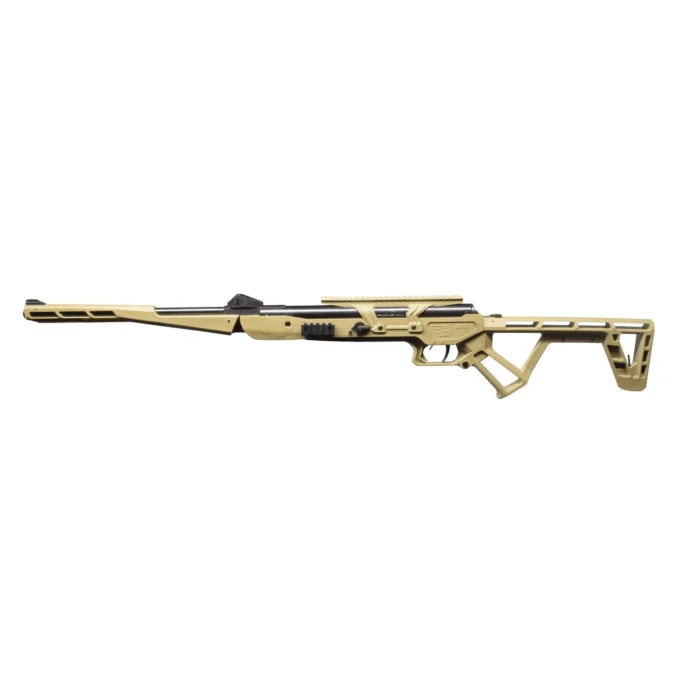
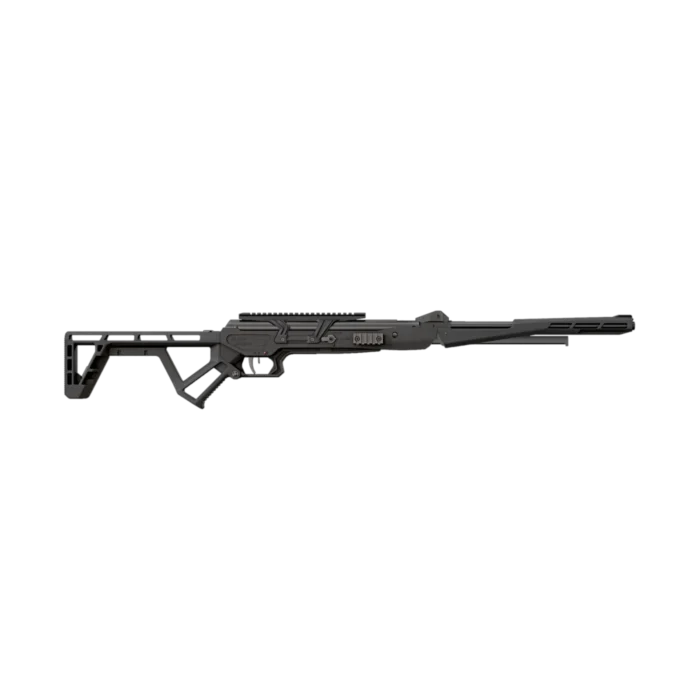
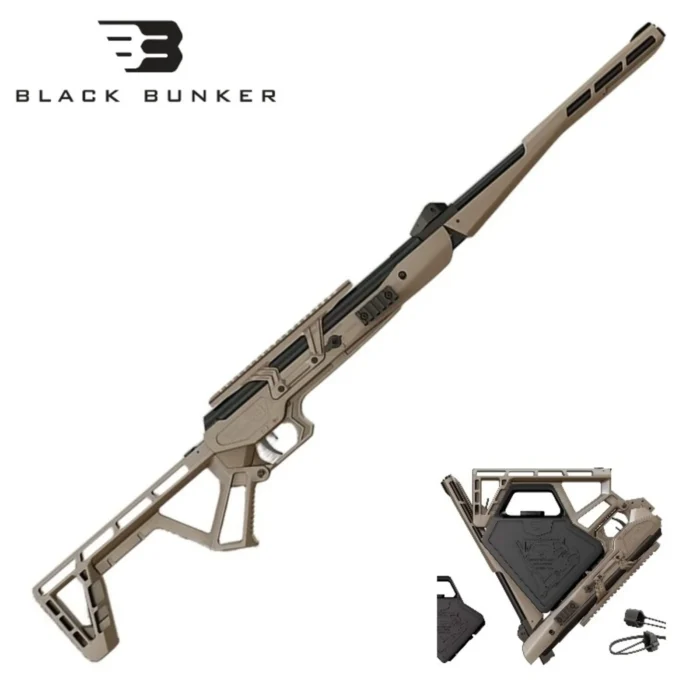
Black Bunker is committed to providing superior tactical survival gear for vigilant citizens in both urban and wilderness environments. Their latest product is the BM8, a foldable break barrel survival air rifle designed to be used indefinitely.
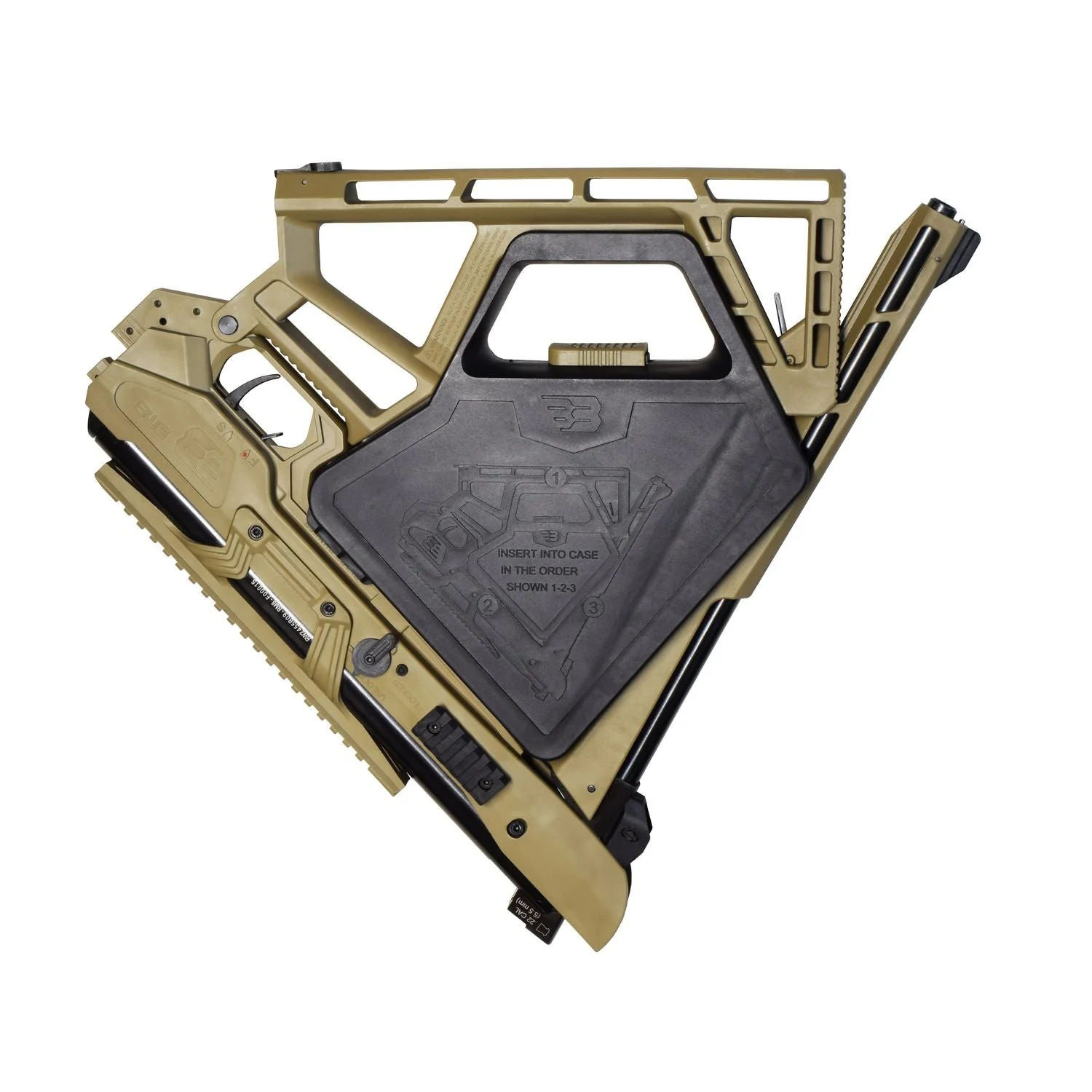
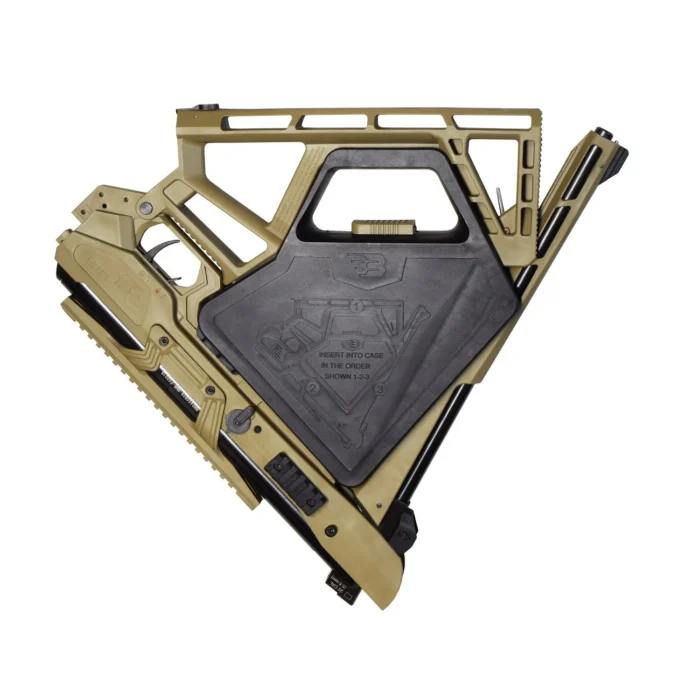
The BM8 stands out with its unique design and innovative features, making it an unprecedented concept. Its compact design allows for easy storage and transportation, fitting in a backpack, car trunk, motorbike storage box, shelf, or mounted on a wall. The triangular water-resistant case with foam provides ample space for a survival kit, knife, multi- tool, pellets, compact optics, and other tools.
The BM8 is powered by a gas ram system, offering several advantages over traditional spring systems, including consistent velocity, less recoil, increased accuracy, reduced noise, less maintenance (no lubrication of spring needed), no spring fatigue, easy cocking, and increased durability.
To ensure user safety and prevent potential damage to the gas ram system, the action of the air rifle can be disengaged by a rapid 2-stage process with a push button and a selector switch, rendering it non-functional.
The BM8 comes with a picatinny rail system for scope mounting and picatinny rails on the sides for attaching accessories such as flashlights, lasers, and bipods.
The Black Bunker team is already working on the development of complementary products and next-generation models, which will be introduced continuously. With the BM8, Black Bunker has set a new standard for survival air rifles, combining innovation, durability, and practicality in a single product.
Features:
- The first foldable Survival Air Rifle.
- Ultra compact and easy to store & carry.
- Break barrel technology.
- GAS ram powerplant for increased accuracy, noise reduction, reduced recoil, and increased durability.
- Velocity (full power versions)
- Cal. .177/ 4.5mm: Up to 1000 Fps with lead pellets / Up to 1200 fps with alloy pellets.
- Available in detuned versions for markets with limitations: 19.9J, • 16J / 12 ft/lbs, 10J, 7.5J.
- 2-stage safety lock system.
- Military grade reinforced polymer stock.
- Textured buttstock for better grip
- Picatinny rails for scope mount – high mount recommended.
- Picatinny rails on sides for additional accessories such as flashlight, laser and bipod.
- Open sights. Rear sight adjustable.
- Includes water resistant case for tools, pellets, and survival kit. (Tools not included)
- Bonus: Includes muzzle break- and breech protection cover.
- Color: Desert Tan
- Overall length: 42.7 inches/ 106cm
- Weight: 7.5Lbs/ 3.4kg
- Serial number will tell power level, caliber, color, and configuration.
- Patent pending
Black Bunker BM8 – Desert Tan – .177 Cal Technical Product Guide
BM8 Desert Tan Engineering, Folding Design, Gas-Ram Operation, and Product Context
Black Bunker BM8
The black bunker bm8 is defined primarily by its folding architecture. Rather than separating into loose components, the rifle folds into a compact triangular configuration intended to reduce the space required for storage and lawful transportation. Black Bunker also incorporates a two-stage safety-lock concept designed to prevent normal operation while the platform is folded.
Black Bunker
black bunker is a tactical and survival-oriented equipment brand associated with Kore Outdoor. Kore Outdoor introduced the BM8 as a foldable break-barrel platform designed and engineered in-house, with reinforced nylon-fiber/polymer components and carbon-steel structural parts.
BM8
The bm8 uses a gas-ram break-barrel mechanism rather than PCP, CO₂, or battery-powered operation. The gas-ram system is self-contained and does not require an external high-pressure charging cylinder for normal operation. Manufacturer materials describe reduced spring fatigue, smoother cycling characteristics, and lower maintenance relative to conventional coil-spring designs.
Collapsible Pellet Gun
The phrase collapsible pellet gun describes the BM8’s storage architecture, although “foldable break-barrel air rifle” is technically more precise.
Its folding design reduces stored dimensions while preserving the conventional break-barrel operating layout once returned to its normal configuration.
Foldable Airgun
As a foldable airgun, the BM8 introduces additional joints and locking interfaces that conventional fixed-stock designs do not have.
Those components should remain clean, secure, and free from significant looseness or deformation. The compact feature is intended primarily for storage and transportation rather than altering the underlying operating principle.
Black Bunker Foldable Airgun
The Black Bunker foldable airgun uses a triangular folded arrangement that Black Bunker specifically promotes as suitable for compact storage. Manufacturer literature references backpack, vehicle, shelf, and other compact-storage contexts.
Black Bunker Air Rifle
The Black Bunker air rifle remains a single-shot system.
Each shot requires an individual pellet, and the rifle does not use a rotary magazine or detachable pellet magazine. Current retailer specifications identify the action as break barrel and the mechanism as gas piston/gas ram.
Gas Ram Survival Rifle
The term gas ram survival rifle reflects the design positioning of the BM8.
Its self-contained gas-ram powerplant reduces dependence on external charging equipment, while the folding structure emphasizes compact storage. However, the internal power system should not be modified casually because it contains substantial mechanical energy.
BM8 .177
The BM8 .177 corresponds to the 4.5mm configuration.
Current manufacturer and retailer data list full-power performance at approximately 1,000 fps with lead pellets and up to 1,200 fps with alloy pellets. Regional versions may be configured at lower energy levels such as 19.9 J, 16 J, 10 J, or 7.5 J depending on legal requirements.
Black Bunker 4.5mm
The Black Bunker 4.5mm version is the same nominal caliber as .177.
Because regional energy settings vary, advertised velocity should always be interpreted in relation to the exact configuration and serial-numbered product rather than assumed universal.
BM8 .22 and Black Bunker 5.5mm
The BM8 .22 and Black Bunker 5.5mm refer to the larger-caliber sibling configuration.
Kore Outdoor lists the full-power .22 version at up to approximately 850 fps with lead pellets. These figures should not be transferred to the .177 version because caliber and energy configuration differ.
Black Bunker Coyote Tan
Black Bunker Coyote Tan and Desert Tan refer to the tan-colored version of the BM8 family.
The tan finish changes the exterior color rather than the fundamental gas-ram, break-barrel, folding, or single-shot architecture.
Backpack Air Rifle
The phrase backpack air rifle refers to the BM8’s ability to fold into a compact package suitable for space-efficient storage.
Black Bunker explicitly identifies backpack transport as part of the product concept. Local laws still govern how air rifles may be stored or transported.
Compact Survival Airgun
The compact survival airgun description reflects portability rather than miniature dimensions during normal use.
The rifle measures approximately 42.7 inches/106 cm when extended and weighs about 7.5 lb/3.4 kg according to current manufacturer material.
Backpack Hunting Rifle
The phrase backpack hunting rifle appears in commercial discussions of compact air rifles, but lawful hunting suitability depends on jurisdiction, energy configuration, caliber, target species, and local rules.
It should not be assumed that every .177 regional configuration is legally suitable for hunting.
Kore Outdoor Black Bunker
Kore Outdoor Black Bunker describes the corporate relationship behind the product. Kore Outdoor officially introduced the BM8 in 2024 and identifies Black Bunker as its survival-oriented equipment brand.
Picatinny Rails and Open Sights
The BM8 incorporates an upper optics rail plus side accessory rails. It also includes open sights, with an adjustable rear sight specified by the manufacturer.
These features allow the platform to remain usable with its factory sights while supporting compatible accessories where lawful and appropriate.
Battery Powered Air Gun
The BM8 is not a battery powered air gun.
Its firing mechanism depends on a mechanical gas-ram piston system and does not require a battery for ordinary operation.
Ambiguous Search Terms
Terms such as bunkrr.com, black bomb, plank gun, how to get the black hole sniper rifle, black gun big, blackberry gun, b c 8, bedbunker, inflatable gun, big black gun, banair, air bk, b 8 bomber, b & r guns & outdoor range, and blackgun do not establish verified BM8 specifications.
They should remain separate from technical product information unless an authoritative manufacturer source directly connects them to this platform.
Overall Technical Perspective
The BM8 Desert Tan .177 combines a foldable break-barrel architecture, gas-ram powerplant, reinforced polymer stock, two-stage folding safety system, single-shot loading, adjustable rear sight, Picatinny mounting surfaces, and compact storage concept. Current specifications place the full-length platform at roughly 106 cm and 3.4 kg, with full-power .177 performance around 1,000 fps using lead pellets and up to 1,200 fps using alloy pellets.
Its principal engineering distinction is compact storage rather than maximum output. For responsible recreational ownership, attention should remain on correct ammunition, secure storage, lawful transportation, routine inspection of the folding and locking mechanisms, and maintenance within the manufacturer-supported configuration.
Engineering Quality, Folding Architecture, Handling, Precision, and Practical Performance
The Desert Tan .177 configuration combines a self-contained mechanical power system with an unconventional folding architecture designed to reduce storage dimensions while retaining the familiar characteristics of a full-length break-barrel platform. Its engineering value should be assessed through structural stability, mechanical consistency, barrel alignment, material quality, ergonomics, sighting capability, and long-term durability rather than velocity figures alone. Because several structural sections move during folding and unfolding, proper lockup and routine inspection are particularly important. When maintained correctly, the design provides a practical balance between compact storage and conventional recreational target use.
Engineering Philosophy
The central engineering objective is portability without requiring the major structural components to be completely separated.
This approach provides an advantage over designs that must be partially dismantled whenever compact storage is required.
Once returned to its normal configuration, the major sections form a conventional shoulder-fired layout.
Consequently, the user benefits from compact storage while retaining a familiar operating format.
However, movable structural interfaces should always receive appropriate inspection.
Folding Architecture
The folding arrangement is the most distinctive engineering characteristic.
Major sections can be repositioned to create a substantially smaller stored profile. Because the components remain connected, there are fewer loose parts to organize during storage.
The mechanism should operate smoothly without excessive force.
If folding suddenly becomes difficult or noticeably loose, the cause should be investigated rather than overcome through force.
Dirt, damage, or developing mechanical wear may require attention.
Structural Lockup
A foldable platform depends on consistent structural lockup.
Once opened, the sections should remain correctly aligned in their intended operating positions.
This matters because mechanical consistency contributes to predictable handling and repeatable sight alignment.
Locking surfaces should therefore remain clean and undamaged.
Improvised adjustments should be avoided.
When abnormal movement develops, qualified inspection is preferable to modifying the locking components without appropriate technical information.
Gas-Ram Operation
The internal power system stores mechanical energy using a sealed gas strut.
Unlike an external compressed-air reservoir, the system remains contained within the platform.
This reduces dependence on separate charging equipment.
The gas-ram arrangement also eliminates the conventional coiled mainspring used in traditional spring-powered designs.
Nevertheless, substantial internal forces remain present, so unnecessary disassembly should not be attempted by inexperienced users.
Professional servicing is appropriate when internal problems develop.
Break-Barrel Simplicity
The break-barrel configuration combines mechanical preparation and access to the chamber within a straightforward system.
Its relatively simple architecture means there is no external air bottle, detachable magazine, or electronic firing system required for ordinary operation.
Fewer supporting systems can make long-term equipment management easier.
However, mechanical simplicity should not be confused with maintenance-free operation.
The breech, barrel pivot, locking surfaces, and other moving areas still require periodic observation.
Single-Shot Operation
A single-shot configuration encourages a deliberate recreational shooting routine.
Only one pellet is loaded for each cycle, eliminating the feeding complexity associated with multi-shot magazines.
This can reduce magazine-related maintenance and makes it easier to confirm what ammunition is being used.
Correct caliber ammunition remains essential.
Damaged or unsuitable projectiles should not be forced into the chamber because doing so can affect consistency or damage components.
Barrel Quality and Alignment
The barrel plays a major role in repeatability.
Its internal condition, crown, breech relationship, and alignment all influence practical performance.
Because the barrel also forms part of the mechanical operating system, consistent lockup is especially important.
The muzzle should be protected from unnecessary impacts.
Likewise, aggressive bore cleaning should be avoided unless required by the manufacturer.
Excessive cleaning can introduce problems rather than improve performance.
Understanding Precision
Precision should be understood as repeatability rather than simply high projectile speed.
A consistent mechanical system should produce predictable results when ammunition, environmental conditions, sight alignment, and user technique remain similar.
Velocity alone cannot guarantee tight grouping.
Pellet quality, barrel condition, stable positioning, and consistent lockup can have equally important effects.
For recreational target use, repeatable behavior is generally more meaningful than chasing the highest possible output.
Pellet Consistency
Different pellets can vary in weight, dimensions, shape, and manufacturing tolerances.
These differences can influence practical results.
Users should therefore follow manufacturer recommendations and use properly manufactured ammunition of the correct caliber.
Deformed pellets should be discarded rather than forced into the breech.
The goal should be reliable, repeatable operation rather than experimenting with incompatible ammunition.
Open Sight Configuration
Factory sights provide a straightforward aiming system without requiring additional optical equipment.
This preserves the platform’s relatively simple configuration and avoids adding unnecessary weight.
The sighting components should remain protected from impacts during storage and transportation.
If alignment changes unexpectedly, the mechanical condition should be checked before repeatedly adjusting the sights.
A loose component can sometimes appear to be an aiming problem.
Optics Mounting Capability
The upper mounting surface provides flexibility for compatible optical equipment where lawful.
However, any optic should be appropriate for the mechanical characteristics of the platform.
Mounting hardware must remain secure without being excessively tightened.
An unnecessarily large accessory can also alter balance and reduce the practical advantages of a compact design.
Accessory selection should therefore emphasize compatibility and purpose rather than appearance.
Balance and Handling
Overall balance affects comfort and stability.
A platform may have good technical specifications yet feel awkward if weight distribution does not suit the user.
The folding architecture concentrates several structural elements around movable interfaces, so correct assembly contributes to consistent handling.
A comfortable position should allow the user to align naturally with the sights without excessive tension in the wrists, shoulders, or neck.
Stock Ergonomics
The synthetic stock provides the primary contact surfaces for normal handling.
Texture and shaping can help establish a consistent grip, while the shoulder section supports repeatable positioning.
Because body dimensions vary, individual comfort will differ.
The most appropriate recreational setup is one that allows stable handling without requiring unusual posture.
Consistent positioning generally contributes to repeatability more effectively than unnecessary equipment modifications.
Material Durability
Reinforced synthetic construction provides resistance to ordinary handling and environmental exposure while helping control overall weight.
However, polymer components can still be damaged by extreme heat, aggressive chemicals, crushing forces, or significant impacts.
Metal components likewise require protection from moisture and corrosion.
Durability therefore depends on both material quality and responsible ownership.
No construction material eliminates the need for appropriate storage.
Environmental Performance
Outdoor use can expose equipment to dust, humidity, temperature variation, and occasional moisture.
After exposure, visible surfaces should be inspected and dried appropriately.
Sand and grit deserve particular attention around folding and locking interfaces because abrasive contamination can accelerate wear.
Strong solvents should not be applied casually.
Conservative cleaning generally provides better long-term preservation than aggressive treatment.
Compact Storage Benefits
The folding architecture provides its greatest practical advantage during storage.
Reducing the overall footprint can make it easier to place the equipment inside an appropriately sized secure cabinet or protective case.
However, smaller dimensions do not reduce storage responsibilities.
The platform should remain unloaded, secured against unauthorized access, and stored according to applicable regulations.
Compactness should improve organization rather than encourage casual storage.
Transportation Considerations
A reduced stored profile can simplify lawful transportation.
A protective case can help prevent impacts, contamination, and unwanted movement.
The folding joints should not carry heavy crushing loads during transit.
Likewise, tools, liquids, and other objects should not be packed directly against the equipment.
Local laws remain applicable regardless of whether the platform is transported folded or fully extended.
Routine Mechanical Inspection
Inspection should concentrate on the barrel, breech, folding joints, locking interfaces, stock, sights, mounting surfaces, fasteners, and visible hardware.
Developing looseness, corrosion, cracking, deformation, or unusual resistance should receive attention.
Becoming familiar with the normal mechanical feel makes gradual changes easier to recognize.
A problem should be investigated early rather than ignored until it becomes severe.
Overall Practical Performance
The design’s strongest qualities come from the relationship between mechanical independence, compact storage, structural engineering, and straightforward single-shot operation.
Its gas-ram power system removes dependence on external charging equipment, while the folding architecture significantly reduces storage dimensions.
For recreational target ownership, practical precision depends on mechanical consistency, correct ammunition, stable sight alignment, equipment condition, and responsible handling.
Ultimately, long-term performance is best preserved through routine inspection, secure storage, careful transportation, conservative maintenance, and avoidance of unauthorized modifications. These practices allow the platform’s compact engineering concept to remain useful without compromising the structural consistency expected from a properly maintained sporting airgun.
Maintenance, Inspection, Durability, Storage, and Long-Term Care
Proper maintenance plays an important role in preserving the mechanical condition and long-term reliability of the Desert Tan .177 configuration. Because the design combines a conventional break-barrel mechanism with multiple folding interfaces, maintenance should address more than the barrel and exterior surfaces. Locking points, joints, stock sections, sights, mounting surfaces, visible fasteners, and other accessible components should also receive periodic attention. Preventive care does not mean repeatedly dismantling the equipment. Instead, responsible maintenance focuses on inspection, conservative cleaning, protection from environmental damage, secure storage, and professional servicing whenever a significant mechanical concern develops.
Routine Condition Checks
Regular visual inspection is one of the simplest ways to identify developing problems.
Before and after periods of use, accessible components can be examined for corrosion, cracking, excessive wear, loose hardware, deformation, or contamination.
The owner should become familiar with the normal appearance and mechanical feel of the equipment.
Consequently, gradual changes become easier to recognize.
A component that suddenly feels loose, stiff, or incorrectly positioned deserves investigation rather than continued operation.
Folding Joint Inspection
The folding joints require particular attention because they experience repeated movement.
These areas should remain reasonably clean and free from sand, grit, mud, or other abrasive contamination.
Foreign material trapped between moving surfaces can increase wear.
Likewise, excessive force should never be required to move the folding sections through their intended range.
Unexpected binding may indicate contamination, misalignment, or damage that should be evaluated before further handling.
Locking Interface Care
Structural locking interfaces help maintain the correct configuration once the platform has been opened.
These surfaces should be checked for visible deformation, excessive wear, contamination, or unusual movement.
Owners should avoid filing, grinding, bending, or otherwise modifying locking components in an attempt to change their fit.
Such alterations can affect structural alignment.
When looseness develops, professional assessment provides a more appropriate solution than improvised adjustment.
Exterior Barrel Protection
The barrel exterior should remain clean and dry.
After exposure to fingerprints, moisture, or humid environments, the surface can be gently wiped using suitable materials.
Abrasive pads and aggressive polishing compounds should be avoided because they can damage protective finishes.
Likewise, ordinary household chemicals may not be compatible with metal coatings or surrounding synthetic components.
Maintenance products should therefore be selected according to manufacturer recommendations.
Internal Barrel Care
The internal bore generally benefits from conservative maintenance rather than constant cleaning.
Unnecessary cleaning can introduce wear if unsuitable rods, brushes, or chemicals are used.
When cleaning is required, appropriate equipment should be selected and excessive force avoided.
The muzzle and internal surfaces should remain protected from scratches.
The purpose of bore maintenance is to preserve condition, not to repeatedly polish the internal surface.
Breech Area Inspection
The breech undergoes repeated movement during normal mechanical cycling.
Visible surfaces should remain free from excessive dirt and obvious damage.
Sealing areas should also be observed for deterioration.
A sudden change in mechanical behavior should not automatically lead to internal adjustment.
Several factors can influence consistency, so professional diagnosis is preferable whenever the source of a problem cannot be confidently identified through normal inspection.
Power-System Maintenance
The internal powerplant is a contained mechanical assembly that operates under substantial force.
Routine owner maintenance should therefore concentrate on accessible external areas rather than unnecessary internal disassembly.
Unusual sounds, abnormal resistance, sudden changes in mechanical behavior, or obvious loss of normal function should receive qualified attention.
Attempting to dismantle high-force internal components without suitable training and equipment can create unnecessary hazards and may cause additional damage.
Synthetic Stock Care
Reinforced synthetic components provide good resistance to routine handling, but they still require sensible care.
The stock should be inspected for cracks, deep gouges, deformation, or impact damage.
Strong solvents and excessive heat should be avoided.
Likewise, the equipment should not remain underneath heavy objects during storage or transportation.
Crushing forces can place unnecessary stress on both the stock and folding interfaces.
Fastener Inspection
Visible screws and other fasteners should remain properly seated.
Repeated mechanical movement can sometimes contribute to gradual loosening.
However, overtightening should be avoided because damaged threads may create a more serious maintenance problem.
If the same fastener repeatedly becomes loose, the underlying cause should be investigated.
Unapproved adhesives or locking compounds should not be applied without appropriate technical guidance.
Sight Maintenance
Factory sights should remain clean, secure, and protected from accidental impacts.
Adjustable components should move normally and should never require excessive force.
A sight that becomes unexpectedly loose can create apparent accuracy problems even when the barrel and ammunition remain consistent.
Therefore, mechanical security should be checked before making repeated alignment changes.
During transportation, the sighting components should be protected from heavy objects.
Accessory Mount Inspection
Mounting surfaces should remain free from damage and excessive contamination.
If accessories are installed, their attachment points should be checked periodically according to the accessory manufacturer’s recommendations.
Overtightening can damage mounts or make future removal difficult.
Similarly, loose equipment can shift during normal handling.
Accessories that are no longer required should be removed carefully rather than left attached simply because mounting space is available.
Managing Dust and Sand
Dust is primarily a surface concern, whereas sand and grit can become abrasive when trapped between moving parts.
Folding joints and locking interfaces deserve particular attention after exposure to dusty environments.
Contamination should be removed conservatively rather than ground into the surfaces through repeated movement.
A clean protective case can significantly reduce environmental exposure during storage and transportation.
Moisture Protection
Moisture can contribute to corrosion and deterioration if equipment remains wet for extended periods.
After exposure to rain or high humidity, accessible surfaces should be appropriately dried before long-term storage.
A damp platform should not immediately be sealed inside an enclosed case.
Trapped moisture can remain around metal hardware, fasteners, and joints long after the exterior appears dry.
Temperature Management
Extreme heat should be avoided during storage.
A closed vehicle exposed to direct sunlight can reach temperatures significantly higher than the surrounding environment.
Prolonged heat may affect synthetic materials, seals, finishes, and other components.
Likewise, moving cold equipment into a warm, humid environment can encourage condensation.
Allowing gradual temperature stabilization can help reduce unnecessary moisture accumulation.
Chemical Contamination
Fuel, solvents, bleach, acids, strong detergents, and other aggressive chemicals should be kept away from structural components.
Some chemicals can affect polymers or protective finishes without immediately producing obvious damage.
If accidental contamination occurs, experimenting with additional chemicals should be avoided.
Manufacturer guidance or professional assessment provides a more reliable approach when the correct cleaning procedure is uncertain.
Secure Storage
Long-term storage should combine preservation with security.
The equipment should remain unloaded and inaccessible to unauthorized individuals in accordance with applicable regulations.
A clean, dry, temperature-controlled location is preferable.
The compact folding arrangement can reduce the amount of physical storage space required, but it should never reduce security standards.
A suitable locked storage arrangement remains important.
Protective Transportation
During lawful transportation, a protective case or appropriately padded bag can reduce impacts, scratches, moisture exposure, and contamination.
Sharp tools, leaking containers, batteries, and heavy objects should be kept separate.
The folded structure should not be subjected to unnecessary crushing loads.
After any significant impact during transportation, visible structural areas should be inspected before the equipment returns to ordinary use.
Avoiding Unnecessary Modification
Long-term reliability is generally easier to preserve when the equipment remains within its manufacturer-supported configuration.
Alterations to the power system, trigger components, barrel, locking mechanism, or folding structure can affect reliability, warranty coverage, and legal compliance.
A mechanical problem should therefore be repaired rather than disguised through modification.
Performance changes are better investigated systematically than addressed through experimental alterations.
Professional Servicing
Qualified servicing becomes appropriate when structural cracks, severe corrosion, damaged locking surfaces, abnormal looseness, unusual resistance, or internal mechanical problems develop.
Professional technicians can determine whether adjustment, repair, or replacement is required.
This approach also reduces the possibility of damaging unrelated components while attempting to correct a localized problem.
Maintenance Documentation
Basic records can provide considerable long-term value.
Owners can document purchase information, inspections, professional servicing, replacement components, environmental incidents, and significant repairs.
A clear maintenance history becomes particularly useful if ownership later changes.
Documentation also makes it easier to identify recurring mechanical issues instead of relying entirely on memory.
Long-Term Durability
Durability depends on the relationship between engineering quality and ownership practices.
Careful folding, clean locking surfaces, controlled storage, moisture protection, conservative cleaning, and routine inspection can substantially reduce avoidable deterioration.
Wear cannot be eliminated completely because moving mechanical components naturally change over time.
However, early identification can prevent minor issues from becoming more significant.
Overall Maintenance Perspective
Effective long-term care should remain systematic without becoming excessive. Frequent unnecessary disassembly provides little benefit, whereas regular visual inspection, careful handling, clean storage, environmental protection, and timely professional servicing directly support mechanical preservation.
Particular attention should remain focused on the folding joints and locking interfaces because they distinguish this design from conventional fixed configurations. Combined with responsible barrel care, moisture control, secure storage, and accurate maintenance records, these practices provide a strong foundation for preserving the equipment’s condition and dependable recreational function throughout its service life.
Practical Ownership, Responsible Use, Portability, Storage, and Long-Term Value
The Desert Tan .177 configuration combines compact engineering, self-contained mechanical operation, straightforward single-shot functionality, and an unusual folding structure. These characteristics can make the platform practical for lawful recreational ownership, particularly when storage space and transportation convenience matter. However, the folding capability should not be viewed simply as a novelty. It forms part of the structural design and therefore requires appropriate handling, inspection, and maintenance. Practical value ultimately depends on how effectively the equipment balances portability, mechanical reliability, comfortable handling, secure storage, and responsible long-term ownership.
Practical Everyday Ownership
Everyday ownership becomes easier when equipment can be stored efficiently without requiring extensive disassembly.
The folding arrangement significantly reduces the amount of space occupied while keeping the major structural components connected.
Consequently, there are fewer loose pieces to organize or potentially misplace.
Nevertheless, the equipment should always be stored unloaded and secured against unauthorized access.
Compact dimensions improve convenience, but they do not reduce the owner’s responsibility for safe storage and lawful possession.
Why Compactness Matters
Full-length sporting equipment can be difficult to accommodate in limited storage spaces.
A folding architecture addresses this issue by reducing overall dimensions when the equipment is not in normal use.
This can make organization inside an appropriate locked cabinet or protective case considerably easier.
Furthermore, reduced dimensions can simplify transportation.
However, the compact configuration does not change legal requirements, and applicable local rules should always determine how the equipment is transported and stored.
Self-Contained Operation
A major practical characteristic is the absence of an external charging requirement for ordinary operation.
The internal mechanical power system means owners do not need a separate high-pressure cylinder or disposable gas supply for the basic mechanism.
This reduces supporting equipment and simplifies long-term storage.
However, internal components operate under significant force.
Therefore, mechanical independence should not be interpreted as permission for unnecessary disassembly or unauthorized internal modification.
Recreational Target Applications
The platform is suitable for lawful recreational target use in an appropriate controlled environment.
The single-shot configuration naturally encourages a slower and more deliberate routine because each cycle is completed individually.
This simplicity can be useful for users who prefer straightforward mechanical equipment rather than magazine-fed systems.
A suitable backstop, eye protection, controlled firing area, and awareness of what lies around and beyond the target remain fundamental considerations.
Handling Characteristics
Comfortable handling contributes significantly to the overall experience.
The stock, grip, trigger reach, sight position, and weight distribution work together to determine how naturally the equipment can be held.
Because users differ in height, arm length, and preferred posture, comfort remains somewhat individual.
A stable position should be achieved without excessive muscular tension.
Consistent handling generally contributes more to repeatability than repeatedly changing accessories or equipment configuration.
Understanding Precision
Practical precision depends on consistency throughout the complete system.
Barrel condition, sight alignment, ammunition quality, mechanical lockup, environmental conditions, and user technique all influence results.
For this reason, maximum velocity should not be treated as a direct measure of precision.
A platform that produces repeatable behavior is generally more useful for recreational target shooting than one evaluated only according to its highest possible output.
Ammunition Considerations
Correctly sized, properly manufactured ammunition should always be selected.
Individual projectiles can vary in shape, dimensions, weight, and manufacturing quality.
Damaged or visibly deformed examples should be discarded rather than forced into the chamber.
Manufacturer recommendations provide the most appropriate starting point for compatibility.
Experimentation should remain within approved specifications rather than involving unsuitable calibers or improvised projectiles.
Factory Sight Use
Factory sights provide a simple aiming arrangement without adding additional equipment.
This helps preserve the relatively uncomplicated character of the platform.
They should remain clean, correctly secured, and protected from impacts.
If alignment changes unexpectedly, the physical condition of the sight and surrounding components should be examined before repeated adjustment.
A loose mounting point can sometimes produce symptoms that appear to be a precision problem.
Accessory Considerations
Available mounting surfaces provide flexibility, but accessories should be selected according to genuine need.
Adding excessive equipment can increase weight and change balance.
Moreover, unnecessary attachments may make the folded configuration less convenient.
Any accessory should be mechanically compatible, legally permitted, and installed according to its manufacturer’s instructions.
A simple configuration can often provide greater practical convenience than one carrying numerous unnecessary additions.
Outdoor Recreational Use
Outdoor conditions introduce variables that are not present in controlled indoor environments.
Wind, temperature, humidity, lighting, and surface conditions can influence practical performance and equipment care.
Dust and moisture should be removed after use before the platform enters long-term storage.
Special attention should be given to moving joints because grit can become trapped between mechanical surfaces.
Routine inspection after outdoor exposure can reduce unnecessary wear.
Storage Between Uses
Storage should protect both the equipment and surrounding people.
The platform should remain unloaded, secured, and inaccessible to unauthorized individuals.
A dry location away from extreme temperatures and corrosive chemicals is preferable.
Although the folding design reduces the required physical space, the storage location should still provide adequate structural protection.
Heavy objects should not be placed directly on top of the folded equipment.
Transportation
The compact configuration can simplify lawful transportation by allowing the equipment to fit inside a smaller protective case.
However, it should still be protected from impacts, contamination, and uncontrolled movement.
Tools, liquids, and heavy objects should remain separated from structural components.
Transportation laws can differ considerably between jurisdictions.
Therefore, owners should verify requirements whenever equipment is moved across regional or national boundaries.
Long-Term Mechanical Reliability
Mechanical reliability depends partly on manufacturing quality and partly on ownership habits.
Clean locking surfaces, careful folding, appropriate storage, moisture control, and regular inspection all help reduce unnecessary deterioration.
Owners should become familiar with the normal movement and feel of the mechanical components.
A gradual change can then be identified earlier.
Unusual resistance or looseness should be investigated instead of simply accepted as normal aging.
Protecting the Exterior
The tan exterior finish should be maintained conservatively.
Ordinary dust can generally be removed gently without aggressive cleaning products.
Strong solvents, abrasive compounds, and harsh brushes should be avoided unless specifically approved.
Cosmetic marks do not necessarily affect mechanical function, so attempts to restore a perfectly new appearance should never create additional material damage.
Preservation is more important than cosmetic perfection.
When Professional Inspection Makes Sense
Professional assessment becomes appropriate whenever structural or mechanical condition is uncertain.
Significant cracking, damaged joints, severe corrosion, persistent looseness, unusual resistance, or abnormal internal behavior should not be ignored.
A qualified technician can determine whether adjustment, replacement, or further inspection is required.
Professional servicing also reduces the risk of damaging unrelated components through unnecessary experimentation.
Previously Owned Equipment
Second-hand examples deserve careful assessment because their history may not be fully documented.
Previous storage conditions, environmental exposure, repairs, modifications, and mechanical use can influence present condition.
Exterior appearance alone does not provide a complete assessment.
The folding and locking interfaces deserve particular attention.
Where history or serviceability remains uncertain, professional inspection provides a stronger basis for continued ownership.
Avoiding Unauthorized Changes
Modifications to internal power components, structural joints, locking surfaces, trigger assemblies, or other critical mechanisms can affect reliability and potentially legal compliance.
Keeping the equipment within its manufacturer-supported configuration simplifies servicing and future condition assessment.
When performance changes unexpectedly, identifying the underlying cause is preferable to attempting modifications intended to compensate for the problem.
Record Keeping
Simple ownership records can become valuable over time.
Purchase information, professional inspections, repairs, replacement components, and significant environmental incidents can all be documented.
These records provide useful context if professional servicing becomes necessary.
Furthermore, documentation can help a future owner understand the equipment’s history if it is eventually transferred through lawful channels.
Long-Term Value
Long-term value should not be judged entirely by initial cost or cosmetic condition.
Mechanical reliability, structural integrity, maintenance history, secure storage, and availability of appropriate professional support all contribute.
Equipment that receives careful preventive maintenance may provide better long-term service than an apparently newer example that has been poorly stored or unnecessarily modified.
Responsible Ownership Perspective
The most meaningful advantage of the design is its ability to combine full-length recreational functionality with considerably more compact storage.
Its self-contained mechanical system further reduces dependence on external equipment, while the single-shot architecture keeps ordinary operation relatively straightforward.
Ultimately, responsible ownership determines how effectively these characteristics are preserved. Secure storage, lawful transportation, correct ammunition, routine inspection, environmental protection, conservative cleaning, and professional servicing when required provide the strongest foundation for long-term reliability. When these principles are followed consistently, the folding architecture remains a practical engineering advantage while the overall platform retains its intended mechanical condition and recreational usability.
Be the first to review “Black Bunker BM8 – Desert Tan – .177 Cal”
Related products
Black Bunker
Black Bunker
Reviews
There are no reviews yet.