




Beeman Commander PCP Air Rifle Combo
€155.00
Description
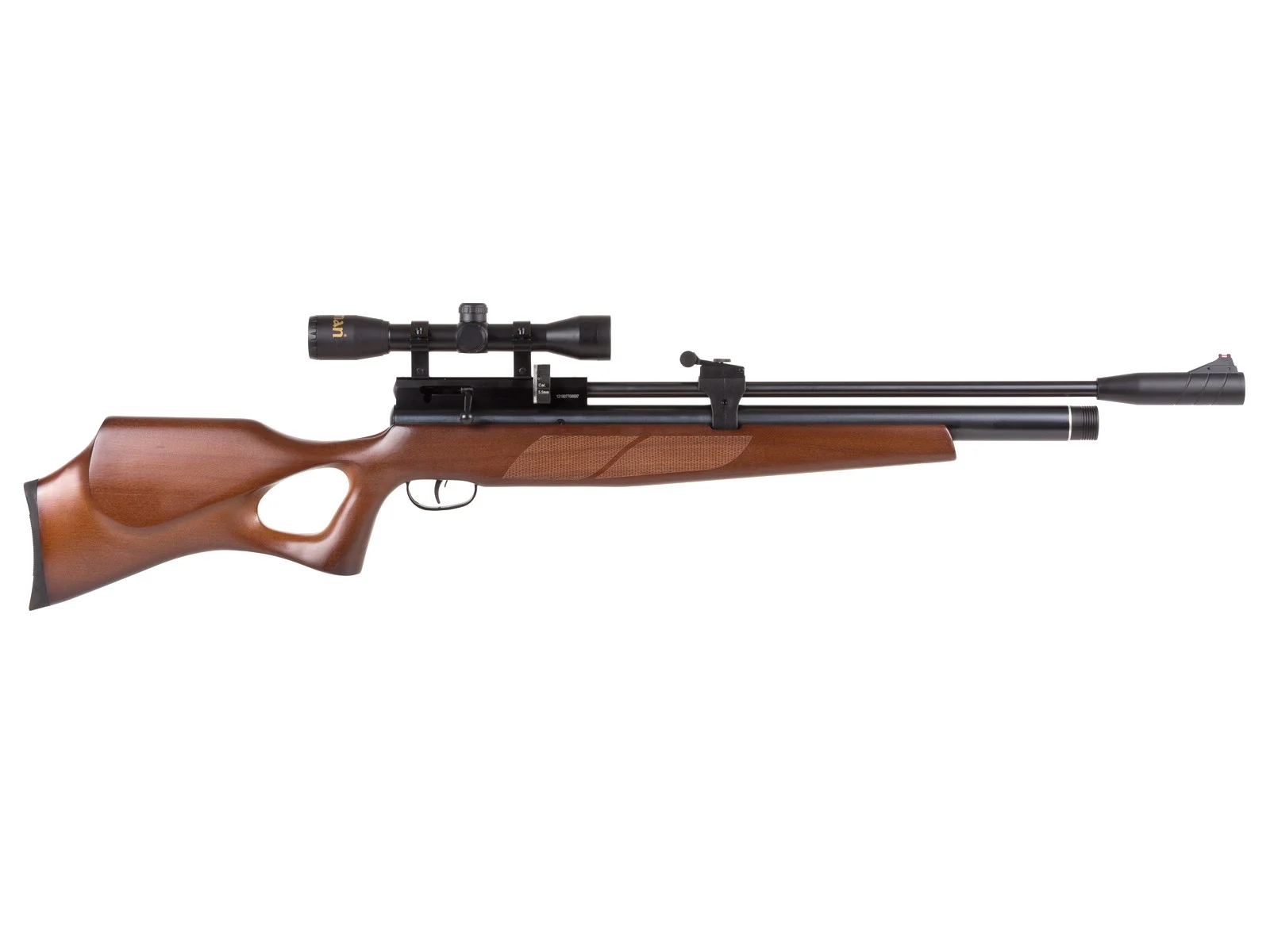
Enjoy up to 100 shots per fill in .177 cal. and up to 80 in .22 with this handsome PCP air rifle.
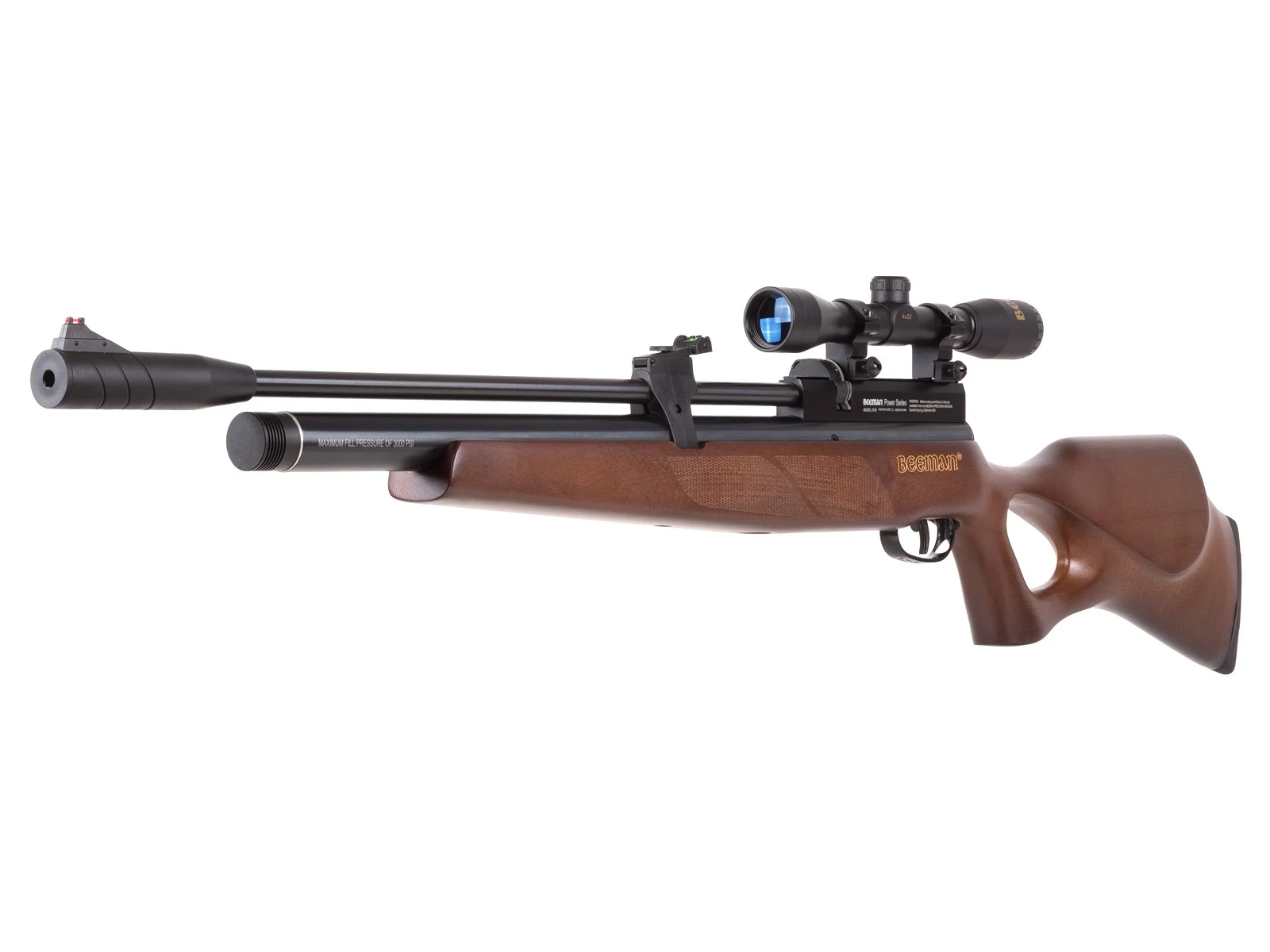
The Beeman Commander is a 10-shot, bolt-action repeater set into a rich, dark-brown European hardwood thumbhole stock. Its 24.5″ barrel features an integrated sound suppressor for backyard friendliness and it’s outfitted with fiber-optic open sights (rear sight is adjustable for windage and elevation.) The stock features a raised, Monte Carlo cheekpiece and checkering on the forestock for an enhanced grip.
Just fill up the 3,000 psi air cylinder, load a 10-shot magazine and send rounds downrange at reported velocities of up to 1,100 fps in .177 cal. and up to 1,000 fps in .22 caliber.
Shipped with an unmounted Beeman 4×32 1/4 MOA scope and mounts, add an air source, and this solid PCP is ready to go right out of the box.
Helpful resources:
- Learn about hunting with air rifles
- Tips for picking the right airgun for hunting game & pests
- Learn about airgun hunting laws in your state
- Shop related categories: pellet guns, pellet rifles
Beeman PCP Commander Air Rifle Repeater Combo
- PCP
- Bolt action
- Repeater
- European hardwood ambidextrous thumbhole stock
- Rifled steel barrel
- Integrated sound suppressor
- 10-shot rotary magazine
- Manual safety
- Rubber recoil pad
- Fiber-optic sights
- 3,000 psi reservoir
- Up to 100 shots per fill in .177 cal., 80 in .22
- Max velocity: 1,100 fps (.177), 1,000 fps (.22)
Beeman Model 5013 Scope Specs:
- 4x fixed magnification
- 32mm objective
- 1″ tube
- 1/4 MOA click value
- Dimensions: 2.7″W x 2.6″H x 14″L
- Includes two-piece mount
Specifications
BrandCaliber.177 (4.5mm)Max Velocity1100 fpsSuggested forPlinking & target practicePowerplantPre-charged pneumaticLoudness3-MediumWeight10.05 lbsFunctionRepeaterMax Shots per Fill100ActionBolt-actionShroudedYesScopeableYesFront SightsFiber OpticRear SightsFiber OpticSafetyManualBarrelRifledBarrel Length24.5″Overall Length43.0″Capacity10 round(s)Body TypeRifleStockHardwoodButtplateRubberColorBrownOperating Pressure3000 PSI / 206 BARGrip OrientationAmbidextrousRegulatedNoIs Safe To Dry FireYes
Beeman Commander PCP Air Rifle Combo – Technical Pre-Charged Pneumatic Overview
Beeman Commander Engineering, PCP Architecture, Caliber Options, Precision, and Related Beeman Terminology
Beeman
beeman represents a broad airgun manufacturer offering spring-piston, gas-ram, CO₂, and pre-charged pneumatic designs. The Commander belongs specifically to the company’s PCP category.
Beeman Company
The phrase beeman company generally refers to Beeman Precision Airguns and the wider Marksman-associated product catalog rather than one particular model.
Beeman Air Rifles
beeman air rifles cover multiple powerplants and mechanical architectures. Therefore, specifications from one model should not automatically be transferred to another.
Beeman Air Guns
The phrase beeman air guns includes rifles and pistols using several propulsion technologies.
Beeman Commander
The beeman commander is currently represented by models 1517 and 1518. Beeman identifies these as pre-charged pneumatic, pellet-firing, bolt-action rifles using a 10-shot magazine.
Precharged Pneumatic
precharged pneumatic describes the Commander’s operating system. Compressed air is stored in an onboard reservoir and released through the valve system rather than generated by a mainspring.
PCP Air Rifle
A pcp air rifle typically provides a smoother firing cycle than a spring-powered platform because it does not contain a heavy piston moving during discharge.
PCP Rifle
The term pcp rifle therefore accurately describes the Commander’s broader mechanical category.
3,000 PSI Pressure System
Beeman currently specifies a 3,000 PSI pressure system for the Commander. Pressure-vessel condition, compatible charging equipment, healthy seals, and manufacturer-defined operating limits are consequently important parts of maintenance.
10-Shot Magazine
The Commander uses a 10-shot magazine, distinguishing it from single-shot PCP platforms such as the original Chief.
.177 Configuration
The .177 version is identified as model 1517 and is manufacturer-rated at up to approximately 1,100 fps.
.22 Air Rifle
The .22 Commander is model 1518. Beeman currently lists this configuration at approximately 1,000 fps.
PCP Air Rifle 22 Cal
The phrase pcp air rifle 22 cal correctly describes the .22 version because it combines .22-caliber pellets with a reservoir-based pneumatic powerplant.
22 Caliber Pellet Gun
The phrase 22 caliber pellet gun is broader terminology and can apply to many different .22 airgun architectures.
22 Cal Air Rifle 1400 FPS
The search phrase 22 cal air rifle 1400 fps should not be presented as a Commander specification. Beeman currently lists the Commander .22 at approximately 1,000 fps.
High Power Pellet Gun
The phrase high power pellet gun is broad marketing terminology. Verified caliber, pressure, velocity, and mechanical specifications provide more useful technical information.
Beeman Repeater Rifle Sights Magazine
The phrase beeman repeater rifle sights magazine is relevant to repeating Beeman platforms because the Commander uses a 10-shot magazine. However, individual sight and accessory configurations should be verified from the exact package rather than assumed from the model name alone.
European Hardwood Stock
The Commander uses a European hardwood stock, giving the rifle a traditional appearance despite its modern pneumatic powerplant.
Manual Safety
Beeman specifies a manual safety on the Commander. As with any mechanical safeguard, responsible handling remains necessary regardless of safety position.
Up to 100 Shots Per Fill
Manufacturer literature states up to 100 shots per fill. Actual consistency can vary according to caliber, reservoir pressure, pellet characteristics, temperature, and mechanical condition.
Low-Recoil PCP Character
Because the Commander uses stored compressed air rather than a spring-driven piston, its firing cycle contains comparatively little mechanical recoil. Beeman describes its PCP rifles as practically recoilless relative to spring-powered platforms.
Air Rifle Marksmanship
air rifle marksmanship still depends on repeatable technique even with a low-recoil pneumatic platform. Stable sight alignment, consistent trigger control, ammunition uniformity, and controlled handling contribute to repeatable results.
Beeman 1521 Scope
The beeman 1521 scope is an accessory-related term rather than a defining Commander specification. A package described as a combo should be checked for the exact optic and mounting hardware actually included.
Beeman 66RL Scope
Similarly, the beeman 66rl scope belongs to optical-accessory terminology and should not automatically be presented as factory equipment on every Commander package.
Beeman PCP Underlever Air Rifle
A beeman pcp underlever air rifle belongs to a different current platform family. Beeman’s 1357 and 1358 underlever models use 3,000 PSI systems but have shorter 32-inch configurations and front underlever cocking rather than the Commander’s standard bolt-action arrangement.
Beeman Underlever
The phrase beeman underlever therefore describes another mechanical configuration rather than the Commander.
Beeman Chief 2
The phrase beeman chief 2 typically refers to the Chief II family.
Beeman Chief II
The Chief II is a separate PCP line. Beeman’s historical catalog identifies Chief II models with a 10-shot magazine, 2,000 PSI pressure system, and lower manufacturer-rated velocity than the Commander.
Beeman QB78
The beeman qb78 belongs to Beeman’s CO₂-powered family rather than the PCP category.
Beeman RS2
The beeman rs2 belongs to another air-rifle family and should not be used as another name for the Commander.
Sportsman RS2 Series
The sportsman rs2 series refers to a separate platform.
Sportsman RS2 Series Beeman
The phrase sportsman rs2 series beeman is simply another search variation for that separate family.
Beeman RS2 Sportsman Series
beeman rs2 sportsman series does not describe Commander engineering.
Beeman Sportsman RS2 Series
Likewise, the beeman sportsman rs2 series belongs to a different product architecture.
Sportsman RS2 Series Price
The phrase sportsman rs2 series price concerns commercial pricing for another platform rather than Commander specifications.
Beeman Sportsman RS2 Series Price
The phrase beeman sportsman rs2 series price likewise belongs to another model family.
10613
The term 10613 refers to a separate Beeman break-barrel platform. Beeman currently lists the 10613-22 as a .22-caliber, 46.3-inch, 7.2-pound design rated at approximately 950 fps rather than a PCP Commander.
1019X Gun
The phrase 1019x gun relates to another product/search term and should not be treated as a Commander specification without dedicated model documentation.
Beeman Jungle M16
The beeman jungle m16 is unrelated historical or search terminology and should not be used to describe the Commander.
Beeman Broward
The phrase beeman broward does not identify a defining Commander engineering feature and should remain contextual.
Beeman BP50
The beeman bp50 belongs to another airgun family and should not be presented as a Commander variant.
Beeman P17
The beeman p17 is an air-pistol platform rather than a PCP rifle.
.177 Air Pistol
A .177 air pistol belongs to a different equipment category from the shoulder-fired Commander.
Marksman
marksman is associated historically with Beeman/Marksman sporting products but does not identify the Commander model.
Marksman Rifle
The phrase marksman rifle is generic terminology rather than a Commander specification.
Marksman Pistol
A marksman pistol belongs to another equipment category.
Marksman Slingshot
A marksman slingshot uses elastic propulsion and has no mechanical relationship to a compressed-air rifle.
Marksman Folding Slingshot
The marksman folding slingshot likewise belongs to another sporting-equipment category.
Beeman Marksman Laserhawk III Slingshot
The beeman marksman laserhawk iii slingshot is not an airgun and should remain separate from Commander technical content.
Classic Slingshot
A classic slingshot is mechanically unrelated to pneumatic rifle systems.
Crosman Slingshot
A crosman slingshot belongs to another manufacturer and a different equipment category.
Why the Commander Pressure System Matters
The 3,000 PSI architecture gives the Commander a substantially different operating character from the original 2,000 PSI Chief. Reservoir integrity, pressure-gauge condition, seal health, and compatible charging hardware therefore become central maintenance considerations.
Why the Magazine Matters
A 10-shot magazine provides a repeating loading system rather than requiring a pellet to be placed individually before every shot. The magazine should remain clean, undamaged, and compatible with the correct caliber.
Why Precision Depends on More Than Velocity
Velocity alone does not determine precision. Barrel condition, pellet consistency, pressure behavior, sight stability, trigger control, environmental conditions, and mechanical health all contribute to real-world repeatability.
Why the Hardwood Stock Matters
The traditional wooden stock contributes to ergonomics, balance, and appearance. Its condition should be monitored for cracks, swelling, impact damage, or deterioration around mounting points.
Why Maintenance Matters
Compressed-air systems operate under substantial stored pressure. Reservoir damage, persistent leakage, damaged fittings, or suspected internal valve problems should receive qualified professional attention rather than improvised repair.
Overall Technical Perspective
The Beeman Commander PCP Air Rifle Combo is fundamentally a 10-shot, bolt-action, pre-charged pneumatic rifle offered in .177 and .22 caliber. Current Beeman information lists a 3,000 PSI operating system, European hardwood stock, manual safety, approximately 43-inch overall length, roughly 8-pound weight, noise suppressor, and up to approximately 100 shots per fill, with maximum manufacturer-rated velocities of about 1,100 fps in .177 and 1,000 fps in .22.
Its defining engineering characteristics are the reservoir-based pneumatic powerplant, repeating magazine, comparatively low-recoil firing cycle, traditional stock design, and higher pressure capacity than the original Chief. Any specific combo package should still be checked individually for the exact optic, mounts, filling equipment, or other accessories included, because those items are not established by the core Commander specifications alone.
Engineering Quality, Pneumatic Performance, Precision, Handling, Build Integrity, and Practical Ownership
A well-designed pre-charged pneumatic platform combines stored-air technology with a comparatively smooth firing cycle, traditional ergonomics, and a repeating loading system. Unlike spring-powered equipment, the propulsion system does not depend on a heavy piston accelerating during every discharge. Instead, energy is stored within an onboard reservoir and released through a controlled valve system. This architecture reduces mechanical movement and gives the platform a stable operating character. However, reliable performance still depends on pressure-system health, barrel condition, consistent ammunition, secure sights, trigger behavior, responsible maintenance, and correct handling.
Pre-Charged Pneumatic Engineering
The compressed-air system forms the heart of the platform.
Air is stored inside a dedicated pressure reservoir before operation. During use, the valve system releases a controlled quantity of stored air.
This design separates the charging process from the firing cycle and provides a distinctly smooth mechanical character.
Reservoir Construction
The reservoir is one of the most important structural components.
Because it contains compressed air, its physical condition deserves careful attention throughout the equipment’s service life.
Significant impact, corrosion, deformation, or unauthorized modification should never be ignored.
Pressure Management
The system should always remain within its manufacturer-defined pressure limits.
Higher pressure is not automatically better, and exceeding design specifications can create serious risks.
Compatible equipment and correct maintenance procedures are therefore essential.
Pressure Monitoring
A pressure indicator allows reservoir status to be observed.
This provides useful information during normal equipment management.
A damaged, unreadable, or apparently inaccurate indicator should receive professional attention.
Pressure Consistency
Consistent pneumatic behavior contributes to repeatable operation.
As reservoir pressure changes during use, performance characteristics can also change.
This is normal within the intended operating range, although substantial irregularities can indicate a maintenance issue.
Valve Performance
The valve controls how stored air is released.
Its operation has a direct influence on consistency.
Internal valve work should remain a professional maintenance task because pressure-system components require appropriate technical knowledge.
Seal Integrity
Seals help maintain pressure throughout the pneumatic system.
Age, repeated use, contamination, and environmental conditions can gradually affect them.
Persistent pressure loss can therefore indicate that servicing is required.
Low-Recoil Character
One major characteristic of pneumatic propulsion is the absence of a large spring-driven piston.
Consequently, the firing cycle produces relatively little mechanical movement compared with traditional spring-powered systems.
This contributes to a stable recreational shooting experience.
Practical Precision
Low recoil provides a useful foundation for precision, but it does not guarantee accuracy by itself.
Barrel condition, projectile consistency, trigger control, sight stability, pressure behavior, environmental conditions, and user technique all remain important.
Performance should therefore be judged through repeatability.
Rifled Barrel Design
Internal rifling provides rotational stabilization to the appropriate projectile.
A properly maintained barrel contributes to consistent aerodynamic behavior.
The bore, muzzle area, and external barrel structure should remain protected from physical damage and corrosion.
Barrel Condition
The barrel should remain securely mounted and structurally sound.
Significant impact can potentially affect alignment.
Any suspected deformation or unusual movement should receive professional assessment.
Ammunition Consistency
Correctly sized and consistently manufactured ammunition provides a better basis for evaluating performance.
Even within the correct caliber, variations in dimensions, weight, and physical condition can influence results.
Damaged projectiles should be avoided.
Repeating Magazine System
A repeating magazine adds convenience while introducing additional mechanical components compared with a single-shot system.
The magazine should remain clean, undamaged, and appropriate for the exact configuration.
It should move through its normal operating cycle without being forced.
Magazine Condition
Physical damage can interfere with reliable operation.
The magazine should therefore be inspected periodically for visible wear or deformation.
Questionable components should be replaced with properly compatible alternatives.
Loading Mechanism
The loading mechanism should operate smoothly and predictably.
Unexpected resistance, scraping, or abnormal looseness can indicate contamination, wear, or another mechanical concern.
Forcing the mechanism can potentially increase damage.
Breech Area
The breech forms an important connection between the loading and pneumatic systems.
Its surfaces should remain clean and physically sound.
Damaged sealing areas can influence consistency and pressure efficiency.
Trigger Characteristics
A predictable trigger contributes to controlled operation.
Consistent movement helps reduce unnecessary disturbance immediately before discharge.
Any adjustment should remain within manufacturer-approved specifications.
Trigger Consistency
Changes in trigger feel should receive attention.
Unexpected resistance, excessive movement, or irregular release behavior can indicate that inspection is appropriate.
Internal alteration should not be used to compensate for mechanical wear.
Safety System
A functioning safety provides an additional mechanical safeguard.
However, it should never replace disciplined handling.
The equipment should always be treated as capable of discharge regardless of safety position.
Hardwood Stock
Traditional wooden furniture gives the platform a classic appearance while providing the structural interface between the action and the user.
Wood grain naturally varies between individual examples.
The material also contributes to the substantial overall feel.
Stock Ergonomics
Stock dimensions influence shoulder placement, cheek position, grip comfort, and sight alignment.
A comfortable configuration can reduce unnecessary physical tension during recreational target sessions.
Individual proportions naturally affect perceived fit.
Grip Comfort
A properly shaped grip encourages a natural hand position.
Excessive gripping pressure is generally unnecessary.
Consistent and comfortable handling provides a better foundation for repeatability.
Fore-End Support
The forward section of the stock provides another major contact point.
Its shape contributes to overall stability and balance.
Comfortable support becomes especially useful during longer recreational sessions.
Weight Distribution
Balance can matter as much as total weight.
The relationship between the barrel, reservoir, action, and wooden stock determines how the platform settles when supported.
Personal preference remains an important factor.
Stability
A moderately substantial platform can feel stable during controlled target use.
However, greater weight does not automatically produce better results.
Ergonomics and weight distribution should be considered alongside overall mass.
Sight Stability
Any installed sighting equipment should remain secure.
Loose mounts can create apparent accuracy problems even when the barrel and pneumatic system are operating correctly.
Periodic inspection can help identify these straightforward issues.
Optical Equipment
Compatible optical equipment can be used when appropriate.
The mounting arrangement should fit correctly without damaging the available interface.
Secure installation is more important than unnecessary complexity.
Shot-to-Shot Consistency
A healthy pneumatic platform should behave predictably across repeated operation.
Significant unexplained changes in sound, pressure retention, loading behavior, or performance deserve investigation.
Recognizing unusual behavior early can simplify maintenance.
Noise Characteristics
Air-powered equipment still produces audible sound.
Its actual sound signature depends on the platform, surroundings, and other factors.
Appropriate facility requirements should always be respected.
Exterior Metal Care
Metal components should remain protected from prolonged moisture and corrosive contamination.
Routine exterior preservation can help maintain the original finish.
Harsh chemicals should not be used without suitable guidance.
Stock Care
Wood should be protected from excessive moisture, extreme heat, and aggressive cleaning products.
Minor cosmetic marks can develop naturally.
Structural cracks or significant swelling deserve closer attention.
Storage
Secure, dry, and reasonably temperature-stable storage supports long-term preservation.
The equipment should remain unloaded and protected from unauthorized access.
Pressure-system storage should follow manufacturer guidance.
Transportation
A protective case can reduce scratches and impact damage.
During transportation, the equipment should remain unloaded and appropriately secured.
Applicable regulations should always be followed.
Professional Servicing
Compressed-air equipment contains substantial stored energy.
Reservoir repairs, valve servicing, major seal work, and other internal pressure-system procedures should therefore be handled by appropriately qualified personnel.
Improvised repair can create unnecessary hazards.
Long-Term Reliability
Long-term reliability depends on the interaction between construction quality and responsible ownership.
Healthy seals, a structurally sound reservoir, consistent valve operation, stable sights, a protected barrel, and appropriate storage all contribute to continued serviceability.
Overall Engineering Assessment
The platform combines modern compressed-air propulsion with traditional stock construction and a repeating loading system. Its relatively low mechanical recoil provides a stable firing character, while the rifled barrel and predictable trigger system create a strong foundation for consistent recreational target performance.
The most meaningful measures of quality are not limited to velocity. Pressure stability, barrel integrity, loading reliability, trigger consistency, sight security, stock condition, maintenance history, and overall mechanical health provide a more complete assessment. With sensible pressure management, dry and secure storage, routine inspection, and professional servicing when necessary, the system can provide dependable and predictable operation throughout an extended service life.
Long-Term Reliability, Accuracy Consistency, Handling Comfort, Maintenance, Durability, and Everyday Performance
A quality pre-charged pneumatic platform should deliver more than strong specifications on paper. Long-term ownership depends on how consistently the complete system performs after repeated use, storage, transportation, and routine maintenance. The reservoir, valve system, seals, barrel, trigger, loading mechanism, magazine, stock, pressure indicator, and sighting components all contribute to the overall experience. When these elements remain in appropriate condition, the equipment can maintain the smooth, predictable character associated with pneumatic operation while providing a solid foundation for controlled recreational target use where legally permitted.
Long-Term Performance
Consistent performance develops from the complete mechanical and pneumatic system working correctly.
No individual component can determine long-term quality by itself. A good barrel requires stable pressure delivery, while a stable pressure system still depends on healthy seals and valves.
For this reason, the entire platform should be considered together.
Accuracy Consistency
Practical accuracy should be judged through repeatability rather than occasional exceptional results.
Barrel condition, ammunition uniformity, sight stability, pressure behavior, trigger control, and environmental conditions can all influence results.
A low-recoil firing cycle provides a useful foundation, but disciplined technique remains important.
Smooth Firing Cycle
Compressed-air propulsion creates relatively little internal mechanical movement during discharge.
This gives the equipment a smoother character than many spring-powered alternatives.
Reduced movement can make it easier to maintain a stable position throughout the firing cycle.
Pressure Stability
Reservoir pressure changes gradually as stored air is consumed.
Consequently, some variation can occur across an extended session.
A healthy system should nevertheless behave within its intended operating characteristics without unexplained irregularities.
Reservoir Integrity
The pressure reservoir deserves particular attention because it stores substantial energy.
Its exterior should remain free from significant corrosion, deformation, impact damage, or unauthorized modifications.
Questionable condition requires professional assessment.
Pressure Indicator Condition
A readable pressure indicator provides useful information about the stored-air system.
Damage to the indicator should not be dismissed as purely cosmetic.
Accurate pressure information is an important part of responsible equipment management.
Seal Performance
Seals help maintain pressure throughout the system.
Over time, age and use can influence their condition.
Persistent leakage, unusual pressure loss, or inconsistent behavior may indicate that maintenance is required.
Valve Consistency
The valve regulates the release of stored air.
Its condition therefore influences the overall operating character.
Internal valve problems should be diagnosed by someone familiar with high-pressure pneumatic equipment.
Magazine Reliability
A repeating magazine adds convenience but also introduces additional moving components.
It should remain clean, correctly aligned, and free from visible damage.
Abnormal resistance should never simply be overcome through excessive force.
Loading Mechanism
The loading system should operate with predictable movement.
A sudden change in resistance or mechanical feel deserves inspection.
Regular observation can help identify developing issues before they become more significant.
Breech Condition
The breech area supports both loading and sealing functions.
Its surfaces should remain clean and structurally sound.
Damage around critical sealing areas can potentially affect consistency.
Barrel Quality
A properly manufactured rifled barrel provides the foundation for stable projectile flight.
However, manufacturing quality alone cannot compensate for poor maintenance or physical damage.
The barrel should remain protected from impact and corrosion.
Muzzle Protection
The muzzle area deserves careful treatment.
Physical damage at the end of a rifled barrel can influence projectile behavior.
Transportation and storage practices should therefore minimize unnecessary contact.
Ammunition Uniformity
Consistently manufactured ammunition provides a better basis for evaluating mechanical performance.
Damaged, contaminated, or visibly irregular projectiles can introduce unnecessary variation.
Only the correct caliber should be used.
Trigger Predictability
A predictable trigger contributes to controlled operation.
Consistency is generally more important than an excessively light setting.
Changes in trigger behavior should receive attention rather than being compensated for through improvised adjustment.
Safety Function
The safety mechanism should remain operational throughout the service life of the equipment.
Nevertheless, it should always be considered a secondary safeguard.
Responsible handling remains essential regardless of mechanical safety position.
Stock Comfort
A traditional wooden stock provides both structural support and ergonomic contact.
Its dimensions influence shoulder position, grip placement, cheek contact, and general handling.
Individual users may experience the same stock differently.
Stock Stability
The stock should remain securely attached to the mechanical action.
Loose mounting points can influence handling and consistency.
Visible fasteners should therefore be observed periodically.
Wood Condition
Natural wood should remain protected from excessive moisture and heat.
Minor cosmetic marks can occur during normal ownership.
Cracks, significant swelling, or structural damage deserve greater attention.
Overall Balance
Balance affects how naturally the platform feels when supported.
The barrel, reservoir, action, and stock collectively determine weight distribution.
A well-balanced design can feel more manageable than total weight figures alone might suggest.
Extended Recreational Sessions
Comfort becomes increasingly important during longer sessions.
A stable stock, manageable balance, predictable trigger, and smooth pneumatic firing cycle can reduce unnecessary fatigue.
Users should still take appropriate breaks and maintain responsible handling practices.
Sight Stability
Sighting components should remain securely mounted.
A small amount of movement can produce inconsistent results.
Before assuming a more complicated mechanical problem, sight stability should be considered.
Optical Mounting
Compatible optical equipment should be installed using an appropriate mounting system.
Incorrect or damaged mounting components can affect alignment.
The mounting interface should also be protected from unnecessary modification.
Environmental Conditions
Wind, temperature, lighting, and other environmental factors influence real-world target performance.
Not every variation in results indicates equipment failure.
Mechanical evaluation should therefore consider the conditions under which performance was observed.
Temperature Effects
Temperature can influence compressed-air systems and surrounding materials.
Extreme conditions should be avoided where possible.
Stable storage temperatures are preferable for long-term preservation.
Moisture Protection
Moisture can contribute to corrosion and deterioration.
Equipment should be dried appropriately after exposure to damp conditions.
Long-term storage in a wet case or humid environment should be avoided.
Exterior Maintenance
Routine care should emphasize preservation rather than aggressive cleaning.
Metal surfaces can be protected from moisture and handling residue.
Products used on the exterior should be suitable for the relevant materials.
Avoiding Excessive Maintenance
More maintenance does not automatically produce greater reliability.
Unnecessary disassembly can introduce problems.
Internal work should only be performed when required and by someone with appropriate knowledge.
Pressure-System Servicing
Reservoirs, valves, seals, and other pressure-related components require specialist attention when problems develop.
High-pressure systems should not be casually dismantled or modified.
Professional servicing provides a more appropriate approach.
Replacement Components
Replacement parts should match the exact configuration.
Visual similarity does not establish compatibility.
Correct components help preserve mechanical integrity and intended operation.
Storage Preparation
Before extended storage, the equipment should be unloaded, clean, dry, and appropriately secured.
The surrounding environment should remain reasonably stable.
Manufacturer recommendations should guide pressure-related storage procedures.
Secure Storage
Responsible ownership requires protection from unauthorized access.
Storage arrangements should also protect the equipment from impact, moisture, and extreme temperatures.
Applicable local requirements should always be followed.
Transportation Protection
A suitable case helps protect the stock, barrel, reservoir, sights, and other external components.
The equipment should remain unloaded and secured during transportation.
Local transportation rules should always take priority.
Recognizing Wear
Developing problems often produce changes before complete failure occurs.
Pressure loss, abnormal sounds, rough loading behavior, trigger irregularity, loose components, or visible deterioration can all provide useful warning signs.
These changes should not be ignored.
Professional Inspection
Professional inspection becomes especially valuable when the equipment has experienced heavy use, extended storage, physical impact, or uncertain maintenance.
A qualified technician can assess areas that cannot be evaluated reliably from external appearance alone.
Long-Term Durability
Durability depends on both original engineering and subsequent ownership.
Good construction provides the foundation, while responsible care preserves that foundation.
Poor storage or neglected maintenance can shorten the service life of otherwise well-made equipment.
Practical Ownership
A pneumatic repeating platform combines smooth operation with the convenience of a magazine-fed system.
This makes its everyday character different from both traditional single-shot designs and spring-powered equipment.
However, the additional pressure and feeding components also require appropriate attention.
Overall Long-Term Assessment
A well-maintained pneumatic platform can provide consistent recreational performance over an extended service life. Its smooth firing cycle, repeating mechanism, traditional stock construction, rifled barrel, and pressure-based propulsion system create a balanced combination of modern pneumatic engineering and familiar rifle ergonomics.
Long-term reliability ultimately depends on reservoir integrity, healthy seals, consistent valve behavior, a sound barrel, reliable loading components, secure sights, stable stock mounting, and appropriate maintenance. Dry storage, careful transportation, periodic inspection, compatible replacement parts, and professional pressure-system servicing can help preserve these characteristics. When responsibly maintained and used only within lawful, controlled recreational environments, the equipment can continue providing predictable operation and a refined ownership experience for many years.
Practical Performance, Mechanical Confidence, Comfort, Reliability, Inspection, and Long-Term Care
A well-engineered pre-charged pneumatic platform should provide a balanced relationship between mechanical refinement, structural integrity, predictable operation, and practical ownership. Although compressed-air propulsion produces a comparatively smooth firing cycle, long-term performance still depends on numerous interconnected components. The pressure reservoir, valve, seals, barrel, loading assembly, trigger, safety mechanism, stock, magazine, sights, and mounting hardware must remain in appropriate condition. Therefore, understanding how these systems age and interact can help owners maintain consistent performance while avoiding unnecessary mechanical problems.
Practical Performance
Practical performance should be measured through consistency rather than one isolated specification.
Reliable equipment should behave predictably during repeated recreational use. Loading movement, trigger behavior, pressure retention, sight stability, and general mechanical feel should remain reasonably familiar.
Unexpected changes deserve attention.
Mechanical Confidence
Confidence develops when the equipment operates consistently.
The user gradually becomes familiar with normal sounds, movements, and control characteristics. Therefore, unusual resistance, unexpected noise, pressure loss, or component movement becomes easier to recognize.
Early identification can simplify maintenance.
Smooth Pneumatic Operation
Compressed-air propulsion eliminates the large moving piston associated with conventional spring-powered mechanisms.
Consequently, comparatively little mechanical movement occurs during discharge.
This produces a smooth operating character that can support repeatable recreational target performance.
Pressure-System Stability
The stored-air system should remain within its intended operating parameters.
Pressure behavior naturally changes as the reservoir is used, although dramatic or unexplained variations can indicate a maintenance concern.
Manufacturer guidance should always determine acceptable operating conditions.
Reservoir Protection
The pressure reservoir requires careful physical protection.
Corrosion, major impact, extreme heat, deformation, or unauthorized alteration can compromise its condition.
Any uncertainty regarding structural integrity should receive professional assessment.
Seal Performance
Seals maintain pressure at several important interfaces.
Their condition can gradually change because of age, use, contamination, or environmental exposure.
Persistent leakage can indicate deterioration requiring appropriate servicing.
Valve Reliability
The valve controls the release of stored air.
Consistent valve behavior contributes to predictable operation.
Because this component operates within a pressure-based system, internal servicing should be performed by someone with appropriate technical knowledge.
Pressure Indicator Reliability
The pressure indicator provides valuable information about reservoir status.
Its face should remain readable, while the surrounding assembly should remain free from obvious damage.
Suspected inaccurate readings should be professionally investigated.
Barrel Stability
The barrel should remain securely positioned and protected from unnecessary physical impact.
Stable alignment supports repeatable performance.
Any suspected deformation should receive professional attention rather than improvised correction.
Bore Preservation
Internal rifling contributes to projectile stabilization.
The bore should therefore remain free from obstruction, severe contamination, and corrosion.
Cleaning should be appropriate and purposeful rather than excessively frequent.
Muzzle Protection
The muzzle area is especially important because damage can influence projectile behavior.
A suitable protective case can reduce accidental impact during transportation.
Careful handling also helps preserve the original condition.
Ammunition Condition
Correctly sized and consistently manufactured ammunition provides a better foundation for recreational precision.
Damaged or contaminated projectiles can introduce unnecessary variation.
Storage conditions should therefore protect ammunition from moisture and deformation.
Magazine Reliability
A repeating magazine introduces additional convenience while also adding moving components.
The magazine should remain clean, undamaged, and correctly aligned.
A damaged unit should not be forced through the loading cycle.
Loading-System Smoothness
The loading mechanism should move predictably.
Changes in resistance, scraping, or excessive looseness may indicate wear or contamination.
Recognizing these changes early can prevent further deterioration.
Breech Condition
The breech supports loading and sealing functions.
Its surfaces should remain clean and physically sound.
Damage around critical sealing areas can influence pneumatic efficiency and consistency.
Trigger Predictability
A predictable trigger contributes to controlled recreational operation.
Consistent movement allows the user to become familiar with the normal mechanical sequence.
Unexpected changes can indicate that inspection is necessary.
Safety-System Condition
The safety mechanism should operate normally.
However, mechanical safeguards should always be considered secondary to disciplined handling.
Any suspected malfunction should be corrected before continued use.
Stock Strength
Traditional wooden furniture provides structural support as well as ergonomic comfort.
The stock should remain free from significant cracks, splitting, or major swelling.
Mounting areas deserve particular attention because they support the mechanical action.
Stock Finish
A protective finish helps preserve the wood.
Minor handling marks may develop through normal ownership and generally differ from structural damage.
Harsh chemicals should be avoided when maintaining finished wooden surfaces.
Grip Comfort
Comfortable grip geometry can reduce unnecessary hand tension.
The user should be able to maintain a natural position without excessive pressure.
Individual hand size and preference will influence perceived ergonomics.
Shoulder Position
Stock dimensions affect how naturally the equipment settles against the shoulder.
A comfortable position contributes to stability during controlled recreational use.
However, fit remains subjective because body proportions vary.
Weight Distribution
Good balance can make a substantial platform feel manageable.
The relationship between the barrel, reservoir, action, and stock determines overall weight distribution.
Balance should therefore be considered separately from total weight.
Sight Stability
Sights should remain securely mounted.
Loose sighting equipment can create inconsistent results even when the underlying mechanical system remains healthy.
Sight security should therefore be checked during routine inspection.
Accessory Mounting
Any additional sighting equipment should use compatible mounting hardware.
Incorrect installation can damage mounting surfaces or create alignment problems.
Secure and appropriate installation supports long-term reliability.
Environmental Influence
Environmental conditions can affect real-world performance.
Wind, temperature, humidity, and lighting may change the recreational experience from one session to another.
Not every performance variation indicates mechanical deterioration.
Temperature Management
Extreme heat should be avoided, especially around pressure-containing components.
Equipment should not remain unnecessarily exposed to intense sunlight inside enclosed vehicles.
Stable storage temperatures are preferable.
Humidity Protection
Persistent humidity can contribute to corrosion and wood deterioration.
Equipment should be dry before long-term storage.
A damp protective case can trap moisture against surfaces.
Routine Inspection
Periodic inspection should focus on visible components and changes in normal behavior.
The barrel, stock, magazine, loading system, sights, pressure indicator, fasteners, and accessible pressure connections can all be observed.
The purpose is prevention rather than unnecessary intervention.
Cleaning Practices
Routine cleaning should remain simple.
Exterior surfaces can be maintained using products compatible with the materials involved.
Aggressive solvents and excessive internal cleaning should be avoided unless specifically recommended.
Metal Preservation
Metal surfaces should remain protected from moisture and corrosive contamination.
Light preventive care can help preserve the original finish.
Developing corrosion should receive early attention.
Wood Preservation
Wood responds naturally to changes in moisture and temperature.
Stable indoor conditions help preserve dimensions and finish.
Extreme environmental exposure should therefore be minimized.
Extended Storage
Before extended storage, the equipment should be unloaded, clean, dry, and secured.
Pressure-system storage should follow manufacturer recommendations.
Unauthorized access should also be prevented.
Transportation Protection
A properly fitted case can protect external components during transportation.
The equipment should remain unloaded and appropriately secured.
Local transportation requirements should always be respected.
Maintenance Records
Simple maintenance records can improve long-term ownership.
Professional inspections, seal replacements, repairs, and other significant servicing can be documented.
This information becomes increasingly valuable as equipment ages.
Recognizing Wear
Mechanical wear does not always appear suddenly.
Changes in pressure retention, loading movement, trigger behavior, component fit, or sound may develop gradually.
Regular familiarity with normal operation makes these changes easier to identify.
Professional Servicing
High-pressure pneumatic components require specialized knowledge.
Reservoir repairs, valve servicing, significant seal work, and internal pressure-system procedures should therefore be handled by appropriately qualified personnel.
Improvised repairs can introduce unnecessary hazards.
Replacement Parts
Replacement components should correspond to the exact configuration.
Physical resemblance does not guarantee engineering compatibility.
Using correct components helps preserve original operating characteristics.
Avoiding Unnecessary Alteration
A pneumatic system represents a carefully coordinated relationship between pressure, valve operation, component dimensions, and structural materials.
Unnecessary modification can alter this balance.
Maintaining the intended configuration generally supports reliability and easier future servicing.
Service Life
A well-maintained platform can remain serviceable for an extended period.
Original manufacturing quality provides the foundation, while appropriate care protects that foundation.
Storage conditions and maintenance practices become increasingly important as the equipment ages.
Responsible Recreational Use
Operation should remain within lawful and controlled recreational environments.
Responsible handling, secure storage, suitable transportation, and appropriate maintenance are all parts of ownership.
Facility requirements and applicable regulations should always be followed.
Overall Long-Term Perspective
The most valuable characteristic of a mature pneumatic platform is predictable operation. Smooth pressure delivery, reliable loading, stable sights, consistent trigger behavior, sound stock construction, and healthy seals collectively provide greater practical value than a single performance number.
Long-term reliability ultimately comes from combining good engineering with responsible ownership. Protecting the reservoir from impact and extreme temperatures, keeping the equipment dry, monitoring changes in mechanical behavior, preserving the barrel and stock, using compatible components, maintaining service records, and obtaining professional assistance when pressure-system problems arise can help preserve the original operating characteristics. With appropriate care and lawful recreational use, a well-maintained pneumatic system can remain mechanically consistent and serviceable for many years.
Be the first to review “Beeman Commander PCP Air Rifle Combo”
Related products


Beeman Air Rifle


Beeman Air Rifle


Beeman Air Rifle


Beeman Air Rifle
Reviews
There are no reviews yet.