
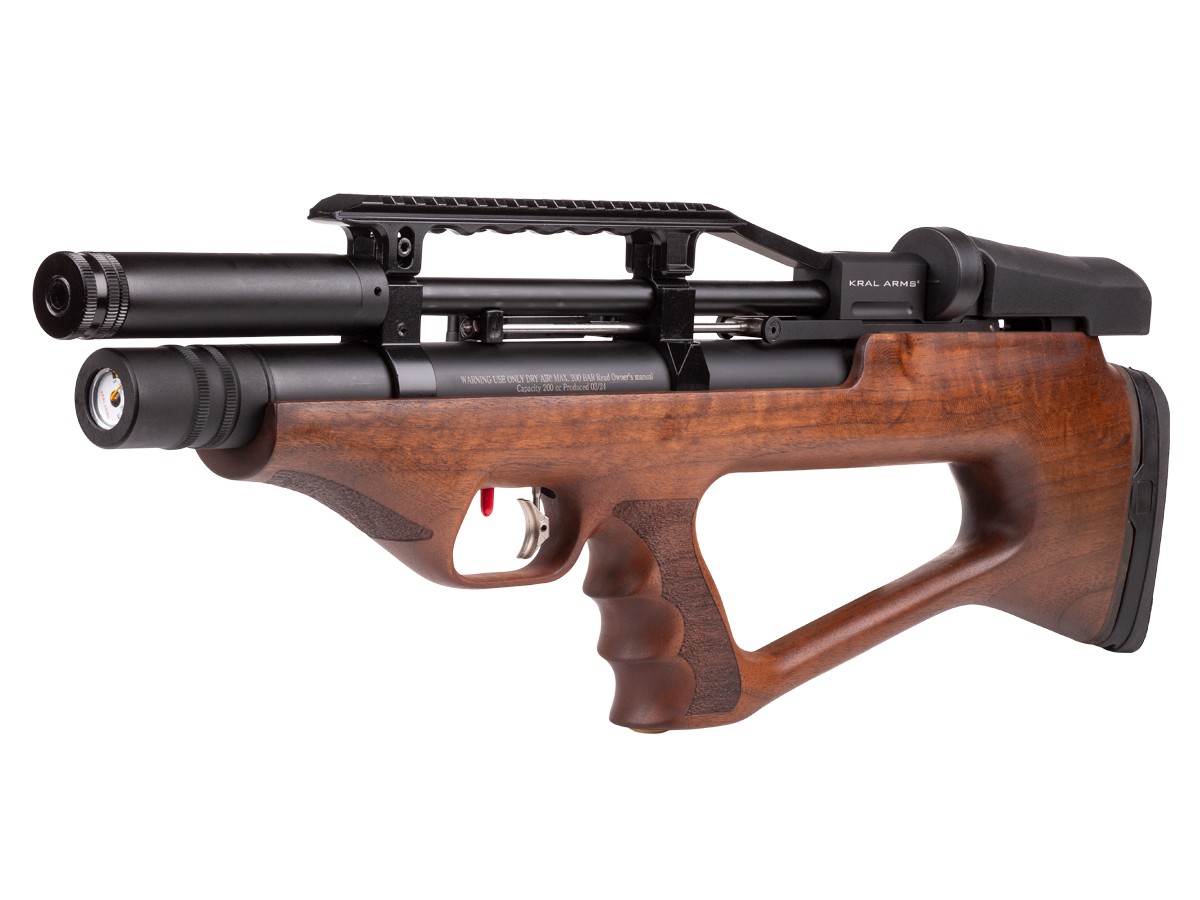
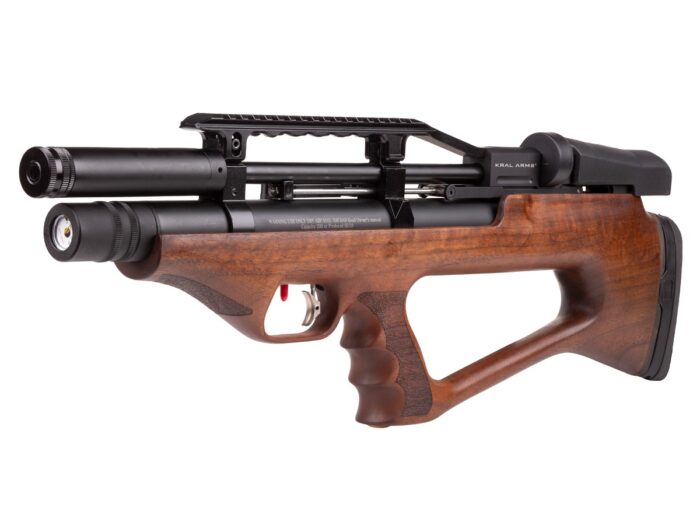
Kral Arms Puncher Empire XS PCP Air Rifle
€400.00
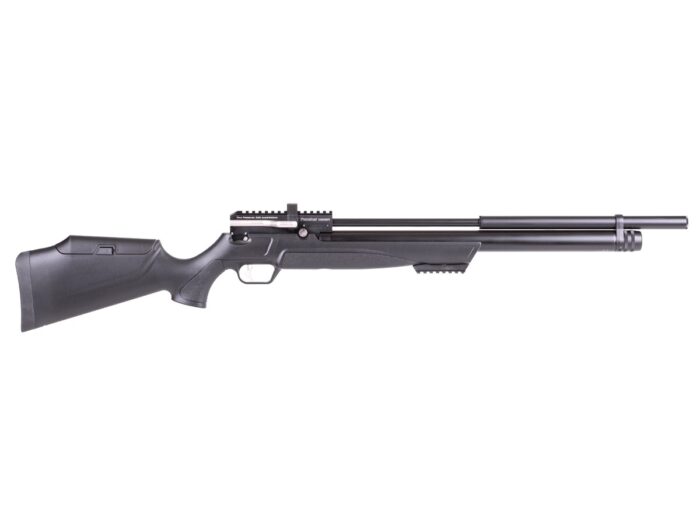
The Kral Arms Puncher Empire XS is a Turkish walnut-stocked PCP that brings real wood aesthetics to a capable, regulated platform. Available in .22 cal at 750 fps or .25 cal at 680 fps, it’s tuned for pellet efficiency and consistent accuracy rather than raw top-end speed — the kind of rifle that rewards a shooter who values shot placement over velocity claims. Turkish walnut stocks on both caliber options give it a classic look that punches above its price point.
- Available in .22 cal at up to 750 fps or .25 cal at up to 680 fps
- Turkish walnut stock on both variants — quality wood at an accessible price
- PCP platform — regulated for consistent shot-to-shot performance
- Regulated action tuned for pellet efficiency across the power curve
For a shooter who wants a wood-stocked PCP with genuine build quality, the Puncher Empire XS is worth a serious look — give our team a call and we’ll walk you through it.
| Caliber | .22 Caliber, Turkish Walnut, Kral Arms Puncher Empire XSPCP Air Rifle, .25Caliber, Turkish Walnut |
|---|---|
| Brand | Kral Arms |
Kral Arms Puncher Empire XS PCP Air Rifle – Detailed Technical Product Guide
Kral Arms Puncher Empire XS Design, PCP Engineering, and Model Context
Kral and Kral Arms Background
Kral and Kral Arms identify the Turkish manufacturer behind a broad collection of pneumatic sporting rifles and separate firearm products. Variations such as krale, kiral, and krale airguns may appear in online searches, although they should not be treated as separate manufacturers.
Kral’s current air-rifle catalog places the Empire XS within its extensive Kral Puncher Series, alongside platforms including the Empire, Empire X, Shadow, Bighorn, NP-500, Auto, Mega, Breaker, NP-01, NP-02, and several newer configurations.
Therefore, searches involving Kral NP 02, Kral Puncher, Puncher Mega, Puncher Auto, NP500, shadow puncher, Empire X, Bigmax, and Kral Puncherk often appear around the same manufacturer even though these models should not automatically share specifications.
Compact Empire XS Engineering
The Empire XS is notable for fitting its operating system into a very short overall package. Kral officially lists the rifle at approximately 24 inches overall while retaining a 14.3-inch length of pull.
This configuration concentrates the action and pneumatic system into a compact structure while maintaining a conventional shoulder interface.
Compact dimensions can influence practical handling by reducing the amount of equipment extending forward from the user. However, balance remains dependent on the complete distribution of the reservoir, action, stock, barrel assembly, and accessories.
For that reason, overall length alone should not be used to judge comfort or suitability.
Understanding PCP Air Gun Technology
The Empire XS operates as a pcp air gun, meaning compressed air is stored in a reservoir before operation.
Kral specifies a 200 cc reservoir with a maximum listed fill pressure of 200 bar, equivalent to approximately 3000 psi.
Unlike a traditional spring-powered system, the pneumatic architecture does not rely on a large spring moving through the action during each cycle. This can produce a comparatively smooth mechanical response and provides a useful foundation for repeatability.
Nevertheless, consistent performance still depends on reservoir condition, seals, pressure management, compatible ammunition, and proper maintenance.
Pressure-bearing components should always remain within manufacturer specifications.
Caliber Options and Manufacturer Performance
Kral currently offers the Empire XS in three common pellet calibers.
The .177 version is listed at approximately 850 fps and 19 joules, while the .22 version is rated at approximately 750 fps and 31 joules. The .25 configuration is listed at approximately 680 fps and 36 joules.
These are manufacturer ratings rather than guaranteed real-world results for every individual rifle. Projectile weight, environmental conditions, mechanical condition, and regional configuration can affect measured velocity and output.
Searches for rifles pcp 5.5 relate naturally to the 5.5 mm/.22 configuration, but caliber terminology should remain separate from firearm cartridge terms.
Barrel and Overall Dimensions
Kral’s current Empire XS page lists the barrel at 33 cm, while the complete rifle measures approximately 61 cm overall. The manufacturer gives an average weight of approximately 3.20 kg.
These compact dimensions distinguish the XS from longer traditional configurations.
However, manufacturer data should always take priority when evaluating a particular production example because model specifications can evolve.
Turkish Walnut Stock
One of the most distinctive physical characteristics of the Empire XS is its high-quality Turkish walnut stock, as described by Kral.
Walnut provides a traditional appearance while forming an important structural and ergonomic component.
Wood requires suitable care because moisture, extreme temperature changes, and physical impacts can affect its condition. Surface appearance should therefore be preserved through appropriate storage rather than aggressive cleaning or unnecessary chemical treatment.
Magazine Capacity
Magazine capacity varies according to caliber.
Kral specifies 14 rounds for the .177 configuration, 12 rounds for .22, and 10 rounds for .25.
This multi-shot arrangement provides repeated operation within the magazine’s capacity. Magazine condition still matters because deformation, dirt, or damage may interfere with reliable cycling.
Components should be maintained according to manufacturer guidance rather than forced when unusual resistance is encountered.
Shot Count Per Fill
The official manufacturer specification lists approximately 56 shots per fill for .177, 48 for .22, and 40 for .25.
These figures demonstrate the relationship between caliber and air consumption within the 200 cc system.
However, maximum shot count is not necessarily the same as the number of shots that will produce identical performance characteristics. Pressure behavior throughout a fill should therefore be considered when evaluating consistency.
Kral Puncher Breaker and Related Models
Searches surrounding Kral equipment commonly produce Kral Puncher Breaker Air Rifle, Kral Breaker Puncher, Kral Puncher Breaker, Kral Arms Puncher Breaker PCP Air Rifle, Kral Puncher Breaker Synthetic, Kral Puncher Breaker Walnut, and Kral Arms Puncher Breaker review.
The Breaker is a separate model within the wider Puncher PCP catalog and should not be treated as another name for the Empire XS. Kral currently lists the Empire XS, Empire, Empire X, Shadow, Breaker, and numerous other configurations as distinct products.
Similarly, Kral Arms PCP Rifle, Kral Puncher PCP, Kral Air Rifle, and Kral Arms Airguns are broad product-category terms rather than exact Empire XS specifications.
Separating Firearm Search Terms from PCP Terminology
Kral also produces firearms, which explains why airgun research may produce unrelated terms such as A12 shotgun, A12 gun, XM shotgun, shotgun xm, KP12, K12 shotgun, ST-500, KR9, KR9 rifle, KR-101, and kr 101.
Kral’s own support area separately lists manuals for products such as the ST500, KP12, K12, and multiple PCP systems, reinforcing the distinction between product categories.
Likewise, search phrases including rifle 223, 223 arma, 223 rifles, arma 223, .223 guns, rifle cal 22 semiautomatico, and 410 shotgun semi auto magazine fed refer to firearm-related categories rather than the pellet-based Empire XS PCP system.
Other terms such as n_01, AKR gun, kalibre pistol, tabancalar, tactical tundra, rutundra, air rifle pop, and kar gun should also be verified independently rather than assumed to represent compatible Empire XS equipment.
Accessories and Maintenance Context
Kral currently lists PCP-related accessories including filling probes, pressure gauges, air tanks, regulators, magazines, bipods, scopes, single-shot magazines, and other air-rifle components.
Compatibility should be checked for the exact rifle rather than assumed across the complete Puncher family.
Kral also maintains dedicated PCP user manuals, which should take priority over generalized online instructions when operating or maintaining pressure-bearing systems.
Precision and Overall Technical Character
The Empire XS combines compact dimensions, Turkish walnut construction, three caliber options, multi-shot magazines, and a 200 cc pneumatic system into one of the shorter configurations within Kral’s current Puncher lineup.
Practical precision depends on more than manufacturer velocity figures. Barrel condition, ammunition consistency, pneumatic behavior, sighting equipment, environmental conditions, and individual technique all influence repeatable performance.
Consequently, its engineering quality is better evaluated through consistency, equipment condition, ergonomic fit, and proper maintenance than through maximum output alone.
Secure storage, suitable eye protection, a dependable backstop, compliance with applicable laws, and respect for manufacturer pressure limits remain essential throughout lawful recreational use.
Handling Characteristics, Practical Performance, Precision, and User Experience
The Kral Arms Puncher Empire XS is built around a compact pneumatic layout that emphasizes efficient packaging, balanced construction, and predictable operation. While its specifications provide an important technical foundation, real-world quality is shaped by how the equipment feels during use, how consistently the system behaves, and how effectively the design supports comfort and control. For this reason, practical performance should be evaluated through a combination of ergonomics, reliability, balance, maintenance condition, and environmental awareness.
Compact Design and Handling
The compact format is one of the most distinctive aspects of the platform. Shorter overall dimensions can make the equipment easier to manage in confined spaces and simpler to carry between controlled recreational areas.
However, compact size does not automatically mean lightweight handling. The way mass is distributed between the stock, barrel assembly, receiver, reservoir, and other components plays a major role in how the system feels.
A well-balanced configuration can make a substantial platform feel manageable, while poor weight distribution can create unnecessary fatigue. Therefore, handling quality should always be considered together with total weight and dimensions.
Ergonomic Fit and Comfort
Ergonomics influence how naturally the user can support the equipment. Stock geometry, grip position, length of pull, and overall balance all contribute to the experience.
A comfortable position reduces unnecessary muscle tension and allows the user to maintain a more consistent posture during legitimate recreational sessions.
Individual body proportions also matter. The same platform can feel different to users with different arm lengths, shoulder width, and preferred posture.
For this reason, comfort should be evaluated through proper fit rather than assumed from specifications alone.
Pneumatic Consistency
A pre-charged pneumatic system can provide a relatively smooth operating cycle because it does not rely on a large moving spring assembly.
This characteristic provides a useful foundation for consistent recreational target performance. However, the pneumatic system must remain in good condition.
Seals, pressure-bearing components, reservoir condition, and mechanical interfaces all contribute to overall consistency.
Persistent pressure loss or unusual changes in operation should be evaluated rather than ignored. Specialized servicing should be completed by qualified personnel when pressure-related components are involved.
Practical Precision
Precision depends on repeatability. A platform that behaves consistently from one cycle to another provides the user with a more stable basis for evaluating practical performance.
Equipment condition, compatible ammunition, sighting equipment, user technique, and environmental conditions all influence results.
Therefore, one unusually good or poor result does not provide a complete assessment. Repeated evaluation under controlled conditions is more meaningful.
Consistency also helps users recognize when equipment behavior begins to change over time.
Barrel Condition and Performance
The barrel plays a central role in practical accuracy because it controls the projectile during the final stage before it leaves the system.
Internal condition should therefore be preserved carefully. Dirt, physical damage, or unsuitable maintenance methods can affect consistency.
Cleaning should follow manufacturer recommendations and should not be more aggressive than necessary.
If persistent performance changes appear, professional assessment can help determine whether barrel condition or another mechanical factor is responsible.
Magazine System and Convenience
A multi-shot magazine can improve convenience during controlled recreational sessions by reducing the need for repeated manual loading.
Reliable operation depends on keeping the magazine clean and free from deformation or contamination.
If the mechanism begins to feel unusual, forcing it should be avoided. Additional pressure can damage components or create feeding problems.
Inspection and appropriate maintenance provide a better response when performance becomes inconsistent.
Balance During Extended Use
Longer sessions can reveal handling characteristics that may not be obvious during brief use.
Weight distribution influences fatigue, and an uncomfortable balance point can make the platform feel heavier than the specification suggests.
Users may naturally develop a preferred position that allows the equipment to rest more comfortably.
A balanced setup supports concentration because less effort is required to maintain control.
Environmental Influence
Temperature, humidity, and wind can all influence the ownership experience.
Temperature changes may affect pneumatic behavior, while wind can alter projectile movement. Moisture can also contribute to material deterioration when equipment is stored without proper care.
These environmental factors should be considered when comparing performance across different sessions.
Persistent mechanical irregularities, however, should not automatically be blamed on weather conditions.
Reliability Through Maintenance
Reliability is closely connected to maintenance quality.
Routine observation helps identify minor changes before they develop into larger problems. External surfaces should be protected from moisture and contamination, while specialized internal servicing should be handled appropriately.
A well-maintained platform is easier to evaluate because its condition and maintenance history are understood.
Preventive care generally supports better long-term reliability than waiting until a significant problem develops.
Responsible Recreational Use
Practical performance should always be assessed in a controlled environment.
A suitable backstop, appropriate eye protection, and complete awareness of the surrounding area are essential.
The equipment should always be treated as capable of causing serious injury. It should never be directed toward a person or handled casually.
Local rules governing pneumatic sporting equipment should also be followed because ownership, transport, storage, and permitted use can vary by jurisdiction.
Storage and Equipment Protection
After use, the system should be returned to a clean and secure storage environment.
Protection from excessive humidity, dust, chemicals, and accidental impacts helps preserve long-term condition.
Secure storage also prevents unauthorized handling, which is particularly important where children or inexperienced individuals may be present.
Applicable legal requirements should determine the final storage arrangement.
Building Familiarity Over Time
Repeated responsible use allows the owner to understand how the platform normally feels and operates.
This familiarity makes unusual changes easier to identify. Differences in pressure retention, mechanical feel, or visible condition can provide early indications that attention is required.
However, familiarity should not lead to complacency. Basic safety and inspection practices should remain consistent regardless of experience.
Overall Performance Perspective
The Puncher Empire XS combines compact dimensions, pneumatic operation, traditional stock construction, and multi-shot convenience into a technically sophisticated sporting platform.
Its practical strengths are best understood through balance, comfort, mechanical consistency, and responsible maintenance rather than maximum performance figures alone.
When properly maintained and operated within manufacturer requirements, the system can provide predictable and refined performance for lawful recreational activities.
Ultimately, the quality of the ownership experience depends on the relationship between engineering and responsible use. Careful maintenance, secure storage, professional servicing when necessary, and disciplined handling help preserve the characteristics intended by the original design.
Build Quality, Durability, Maintenance, and Long-Term Equipment Care
The Kral Arms Puncher Empire XS is designed as a compact pneumatic sporting platform where construction quality, material selection, and responsible maintenance contribute directly to long-term reliability. Although performance often receives the greatest attention during initial evaluation, durability becomes increasingly important as ownership continues. The condition of the stock, metal components, seals, pressure-bearing system, controls, and external hardware can influence how well the equipment retains its intended characteristics. Therefore, long-term quality depends on both original engineering and the standard of care provided throughout ownership.
Overall Construction Quality
Construction quality begins with the relationship between the major components. The receiver, barrel assembly, stock, reservoir, operating mechanism, and supporting hardware must remain correctly integrated.
Good manufacturing tolerances help preserve alignment and reduce unnecessary movement between components. As a result, predictable mechanical behavior can be maintained more effectively.
Owners should become familiar with how the equipment normally looks and feels. This provides a useful reference point for identifying unusual changes.
Any significant looseness, deformation, or visible structural damage should receive appropriate attention before continued operation.
Traditional Stock Construction
The stock contributes significantly to both appearance and ergonomics. Natural material also gives each example individual visual characteristics because grain patterns and subtle tonal variations can differ.
However, wood requires appropriate environmental protection.
Prolonged exposure to excessive moisture can influence its condition, while extreme heat or rapid temperature changes may also be undesirable.
The surface should therefore be cared for according to manufacturer recommendations rather than treated with aggressive chemicals or unsuitable household products.
Protecting Wood During Ownership
Routine care helps preserve the stock throughout its service life.
After exposure to damp conditions, the equipment should not simply be placed into long-term storage without appropriate attention. Moisture should be addressed carefully, and the system should be kept in a suitable environment.
Direct contact with harsh solvents should generally be avoided unless the manufacturer specifically identifies them as compatible.
Physical impacts are another consideration. Deep cracks or structural damage require more attention than ordinary cosmetic marks.
Metal Components and Surface Condition
Metal components provide structural strength and dimensional stability throughout the system.
Protective finishes help reduce environmental exposure, but they should still be inspected periodically. Scratches, contamination, and moisture can gradually affect external surfaces when left unattended.
Routine care makes deterioration easier to identify.
Significant corrosion deserves particular attention because it may indicate prolonged environmental exposure. When corrosion appears around an important mechanical or pressure-bearing area, professional assessment is appropriate.
Pneumatic System Durability
The compressed-air system is one of the most technically important parts of the platform.
Pressure-bearing components must remain within their intended operating limits. Because compressed air stores substantial energy, damage to these components should never be treated as a minor cosmetic issue.
Visible deformation, significant corrosion, persistent leakage, or unusual pressure behavior should be investigated promptly.
Specialized repairs should be performed by qualified personnel rather than through improvised methods.
Seal Condition and Pressure Retention
Seals help maintain pressure throughout the pneumatic system and therefore contribute directly to reliable operation.
Over time, sealing materials can be influenced by age, contamination, temperature changes, and ordinary service.
Persistent pressure loss may indicate that maintenance is necessary. However, the underlying cause should be properly diagnosed rather than assumed.
Repeated adjustments without understanding the problem can potentially disturb components that were otherwise functioning correctly.
Routine Inspection
Regular observation provides one of the simplest methods of preserving long-term condition.
Before legitimate recreational use, visible components can be checked for obvious damage, unusual movement, or signs of deterioration.
This does not replace professional servicing. Instead, it creates an additional opportunity to recognize concerns early.
Equipment that has experienced a significant impact or poor storage conditions deserves additional inspection before returning to normal use.
Cleaning and General Maintenance
Cleaning should focus on preservation rather than unnecessary disassembly.
External dirt and moisture can be removed using methods compatible with the materials involved. However, specialized internal assemblies should not be dismantled simply as part of routine cleaning.
Excessive intervention can introduce problems that would otherwise not exist.
Manufacturer guidance should determine the appropriate maintenance approach, while technical internal servicing should be assigned to qualified professionals when required.
Storage Conditions
Proper storage is essential for preserving both mechanical and cosmetic condition.
A clean and dry environment helps reduce exposure to humidity, dust, corrosive substances, and extreme temperature fluctuations.
Equipment should also be protected from accidental impacts.
Secure storage provides an additional safety benefit by preventing unauthorized handling. This is especially important in households where children or inexperienced individuals could potentially gain access.
Local storage requirements should always be followed.
Transportation and Physical Protection
Transportation exposes equipment to vibration, impacts, contamination, and environmental changes.
A suitable protective case can reduce these risks. Nevertheless, the system should still be positioned carefully so that heavy objects cannot place unnecessary pressure on it.
After a significant transportation incident, inspection should occur before further operation.
Transportation regulations may differ considerably between jurisdictions, so applicable requirements should be understood before travel.
Maintaining Service Records
Basic maintenance records can provide valuable information as ownership continues.
Professional servicing dates, component replacements, inspections, and significant incidents can all be documented.
These records create a clearer history of the equipment and can assist technicians during future evaluations.
Documentation becomes especially useful if ownership changes because the next user gains additional context about previous maintenance.
Recognizing Long-Term Changes
Familiarity makes gradual changes easier to recognize.
Persistent differences in pressure retention, mechanical feel, sound, or visible condition can indicate that maintenance is required.
Such changes should not automatically be dismissed as normal aging.
Early professional attention may prevent a relatively minor concern from developing into a larger repair requirement.
Overall Durability Perspective
The Puncher Empire XS combines compact engineering, traditional materials, pneumatic technology, and precision-oriented construction within a sophisticated sporting platform.
Its durability depends on more than the strength of individual components. Environmental protection, careful transportation, secure storage, routine observation, and appropriate servicing all influence long-term condition.
Ultimately, original engineering establishes the foundation, while responsible ownership determines how effectively that foundation is preserved. By protecting materials, respecting pressure-system limits, addressing unusual changes promptly, and relying on qualified servicing when necessary, owners can maintain a clearer understanding of equipment condition and support predictable, lawful, and responsible recreational use throughout its appropriate service life.
Practical Usability, Comfort, Reliability, and Everyday Ownership Experience
The Kral Arms Puncher Empire XS brings together compact construction, pneumatic operation, traditional materials, and carefully considered ergonomics in a format intended to remain manageable during lawful recreational use. While technical specifications explain dimensions and mechanical characteristics, everyday ownership reveals qualities that cannot always be represented by numbers. Comfort, balance, reliability, environmental resistance, maintenance requirements, and ease of storage all contribute to the practical experience. Understanding these factors helps provide a more complete assessment of how the platform fits into long-term sporting use.
Everyday Handling Characteristics
Compact dimensions can provide noticeable benefits during transportation, storage, and general handling.
A shorter platform requires less space inside an appropriate protective case and may feel less cumbersome when moved between controlled recreational environments.
Nevertheless, compact dimensions should not automatically be interpreted as effortless handling. Weight distribution remains important.
The location of the receiver, reservoir, barrel assembly, and stock influences the center of balance. When these elements work together effectively, the equipment can feel controlled despite its substantial construction.
Comfort During Recreational Sessions
Comfort becomes increasingly important during longer periods of use.
Stock geometry establishes the main physical relationship between the user and the equipment. Grip shape, length of pull, balance, and overall dimensions can influence how naturally a comfortable position is maintained.
An uncomfortable setup may create unnecessary muscle tension. Over time, that fatigue can reduce consistency and make the equipment feel heavier than expected.
Individual body proportions also matter, so practical comfort should be assessed personally rather than predicted entirely from specifications.
Understanding Weight Distribution
Total weight provides only part of the handling picture.
Two pieces of equipment with similar overall weight can feel very different when their mass is distributed differently. A concentrated center of balance can create a compact feeling, while excessive forward or rearward weight may require greater effort to control.
Accessories can also alter balance.
Consequently, users should consider how the complete setup feels rather than evaluating the basic platform independently from everything attached to it.
Smooth Mechanical Operation
Predictable mechanical behavior contributes strongly to the impression of quality.
Operating components should function consistently without unexpected resistance or unusual movement. Over time, owners naturally become familiar with the normal mechanical feel of their equipment.
This familiarity can be useful because persistent changes become easier to recognize.
If a component suddenly becomes unusually difficult to operate, forcing it is generally inappropriate. Inspection provides a better response, while professional servicing may be necessary when the underlying cause is unclear.
Pneumatic Consistency in Everyday Use
A properly maintained compressed-air system can provide a smooth and predictable operating experience.
However, pressure behavior is influenced by equipment condition and environmental factors. Seals and other pneumatic components must continue performing correctly for the system to maintain reliable characteristics.
Minor variations can occur, particularly when environmental conditions change substantially.
Persistent leakage or unusual pressure loss deserves greater attention. Pressure-bearing systems should be professionally evaluated whenever their condition becomes uncertain.
Environmental Considerations
Outdoor recreational activities expose equipment to changing environmental conditions.
Temperature, humidity, dust, and moisture can all affect the ownership experience. Wind may influence practical results, while moisture can gradually affect materials if appropriate care is neglected.
After exposure to damp conditions, the equipment should receive suitable attention before long-term storage.
Environmental awareness therefore supports both performance evaluation and material preservation.
Reliability Over Repeated Sessions
Reliability becomes easier to judge after repeated use.
A dependable system should maintain predictable characteristics when properly cared for. Gradual changes may still occur as components experience normal service, which makes routine observation valuable.
Maintenance should not begin only after a significant failure develops.
Preventive care provides opportunities to identify minor concerns early, potentially reducing the likelihood of more substantial repairs later.
Ease of Maintenance
Everyday maintenance should remain straightforward and purposeful.
External surfaces can be kept clean and protected using methods recommended by the manufacturer. Dirt, excessive moisture, and contamination should not be allowed to accumulate unnecessarily.
However, routine care should not become unnecessary internal disassembly.
Specialized components require appropriate technical knowledge. When servicing extends beyond normal owner maintenance, qualified professional assistance provides the more suitable approach shadowf.
Storage Convenience
Compact construction can provide practical advantages during storage because less overall space may be required.
Nevertheless, the storage environment itself remains more important than convenience alone.
The equipment should be kept in a clean, dry, and secure location where unauthorized individuals cannot gain access.
Humidity, corrosive substances, excessive heat, and accidental impacts should be avoided.
Where children or inexperienced individuals are present, access control becomes especially important.
Transportation Experience
Moving equipment between appropriate locations introduces additional practical considerations.
A suitable protective case helps reduce exposure to scratches, impacts, contamination, and unnecessary movement during transportation.
The equipment should also be positioned carefully so that other objects cannot damage it.
Local transportation requirements should always be checked because regulations can differ significantly between jurisdictions.
After a serious impact during travel, inspection should occur before further operation.
Responsible Recreational Environment
Everyday usability must always be considered alongside responsible operation.
An appropriate environment should provide reliable containment and remain clear of unintended people, animals, vehicles, or property.
A dependable backstop is fundamental. Users should also remain aware of the area beyond the intended target.
Suitable eye protection and disciplined handling practices contribute to a controlled recreational environment.
Local regulations should determine where and under what circumstances the equipment can legally be used.
Developing Familiarity Responsibly
Repeated ownership creates familiarity with balance, controls, mechanical feel, and normal equipment behavior.
This familiarity can improve confidence and make unusual changes easier to detect.
However, experience should never result in reduced attention to safe handling. The equipment remains capable of causing serious injury regardless of how familiar the owner becomes with it tundra tactical.
Consistent habits provide the strongest foundation for responsible long-term use.
Overall Everyday Ownership Perspective
The Puncher Empire XS combines compact dimensions, traditional construction, pneumatic technology, and practical ergonomics into a distinctive sporting platform.
Its everyday strengths are best understood through comfortable handling, predictable mechanical behavior, manageable storage requirements, and consistent operation rather than through maximum specifications alone .223 guns.
Ultimately, the ownership experience depends on the relationship between engineering quality and responsible equipment management. Routine observation, appropriate maintenance, environmental protection, secure storage, careful transportation, and professional servicing when required help preserve the platform’s intended characteristics.
When these responsibilities are maintained consistently, the system can provide a refined, manageable, and dependable experience for lawful recreational activities throughout its appropriate service life.
Be the first to review “Kral Arms Puncher Empire XS PCP Air Rifle”
Related products
Kral Arms
Kral Arms
Kral Arms
Kral Arms
Kral Arms
Kral Arms
Kral Arms

Kral Arms
Reviews
There are no reviews yet.