
| ower source: | Pre compressed pneumatic (PCP) |
| Caliber: | 5.5mm (.22) |
| Muzzle energy: | 22~28 joule depening on ammunition |
| Fill pressure: | 250 bar |
| Air capacity: | 65cc |
| Regulator: | Yes |
| Operating system: | Sidelever |
| Magazine: | 7 shots |
| Max. projectile length: | 10mm |
| Optic mounting: | 22mm Picatinny/Weaver |
| Weight: | 1.8kg |
| Length: | 795mm (min stock) | 865 (max stock) |
| Barrel length: | 299 |
| Muzzle: | Fixed silencer |
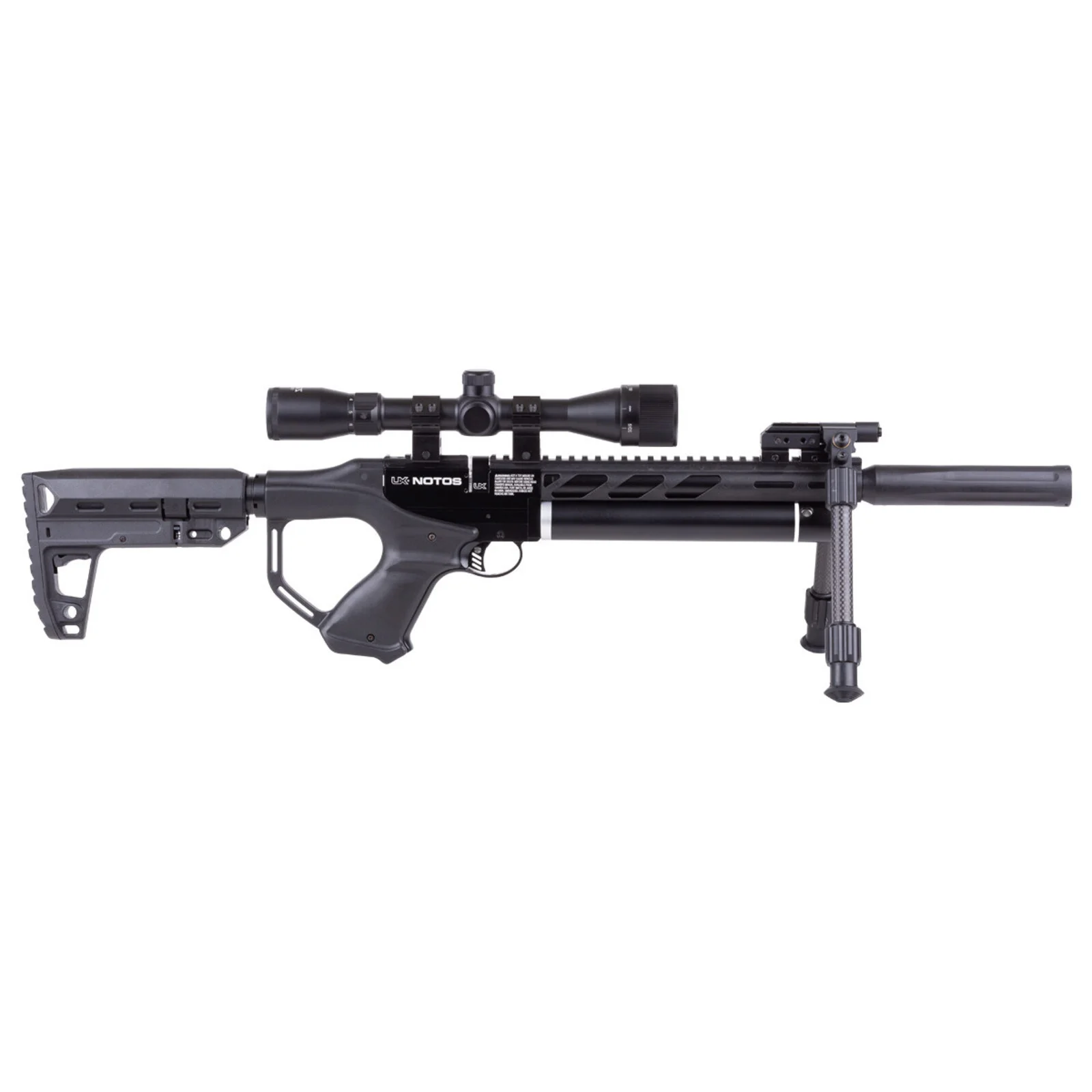
| Accessories: | Magazine, fill probe, single shot tray, 3-9×40 scope and bipod |
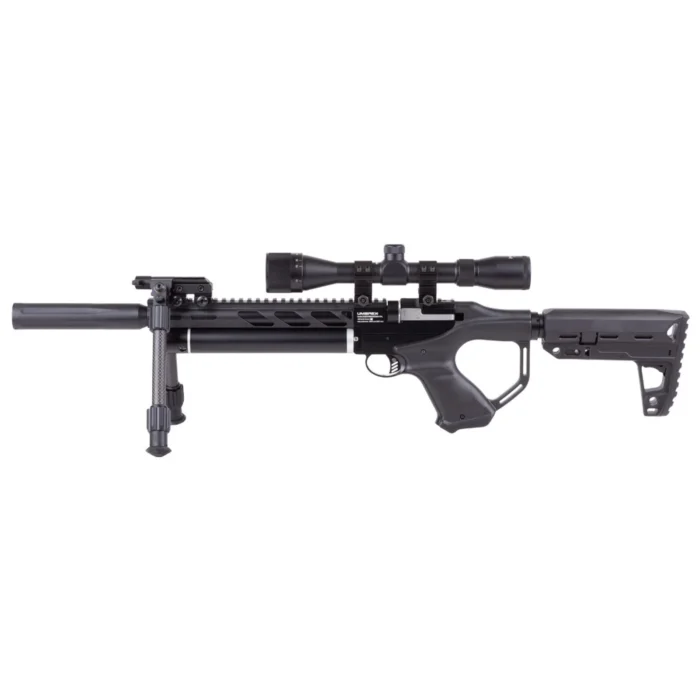
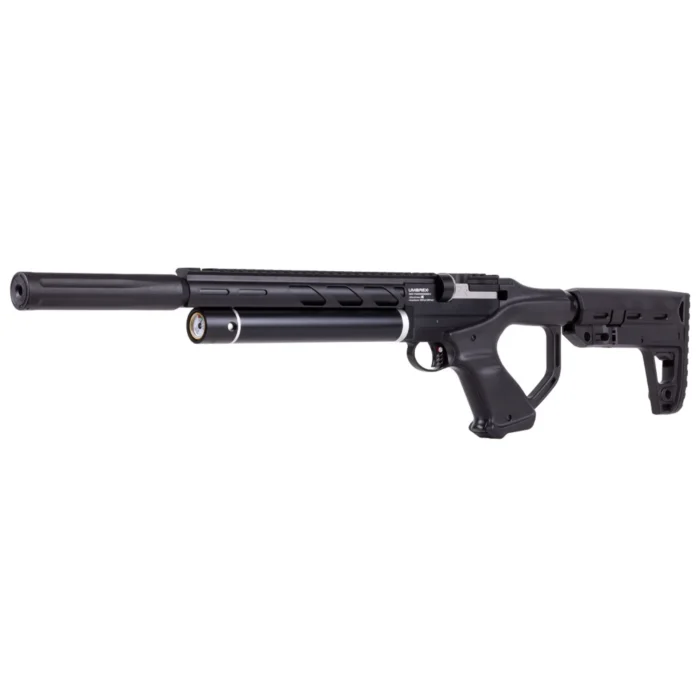
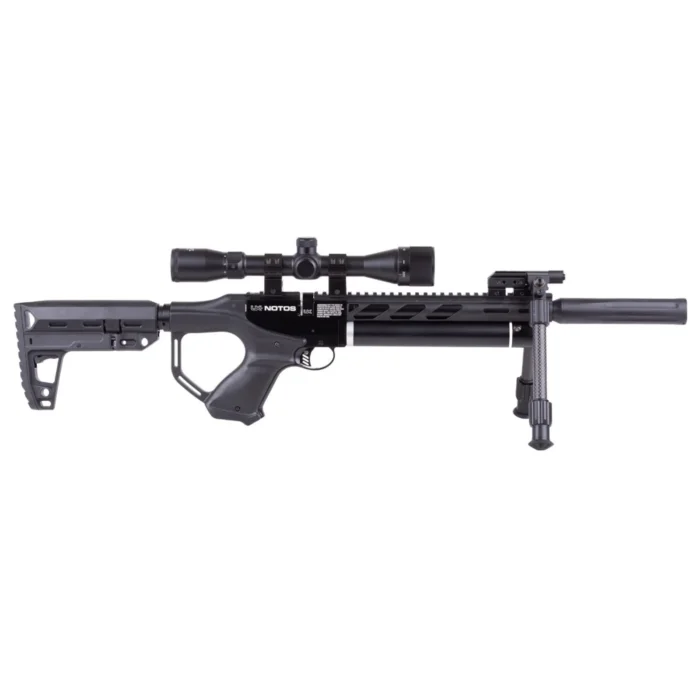
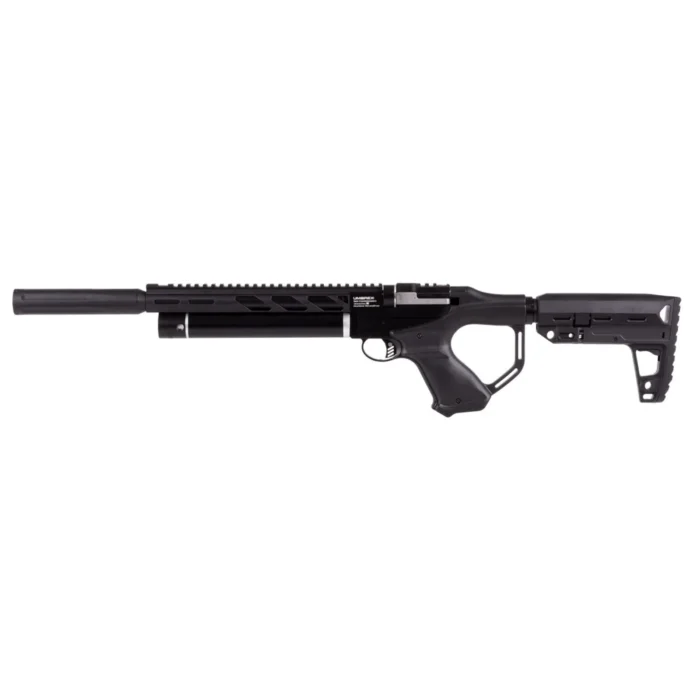
Umarex Notos PCP Carbine | 5.5mm (.22)
€250.00
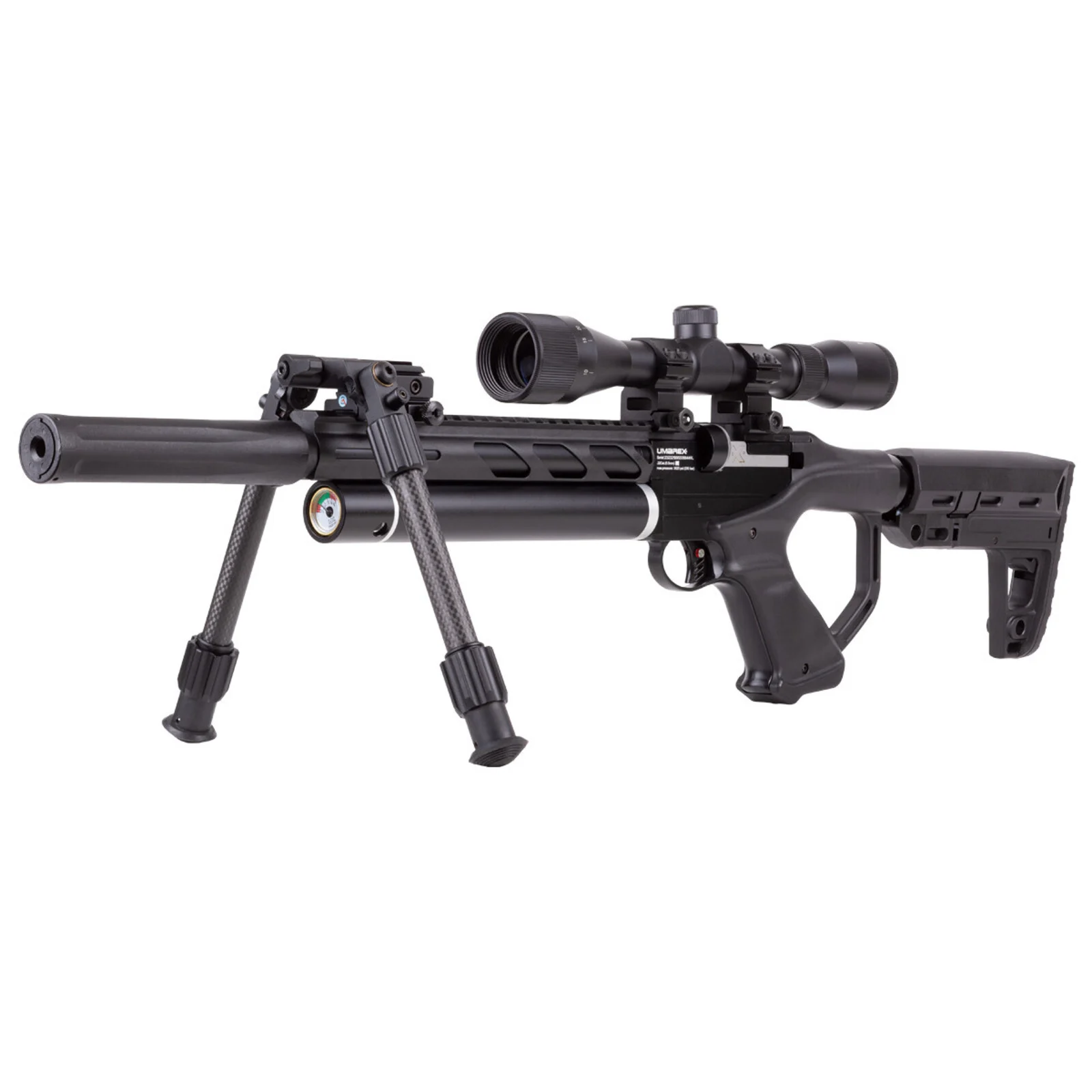
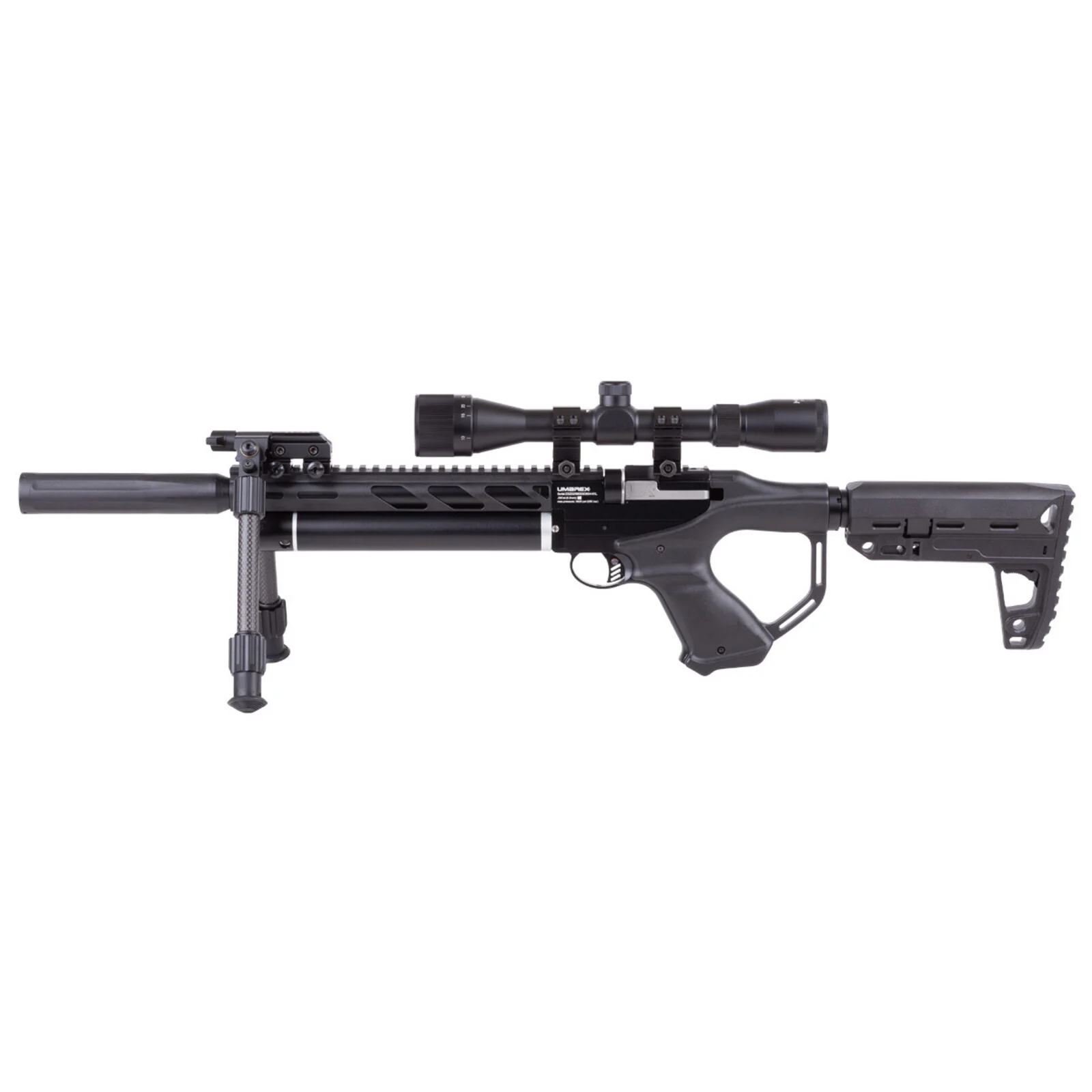
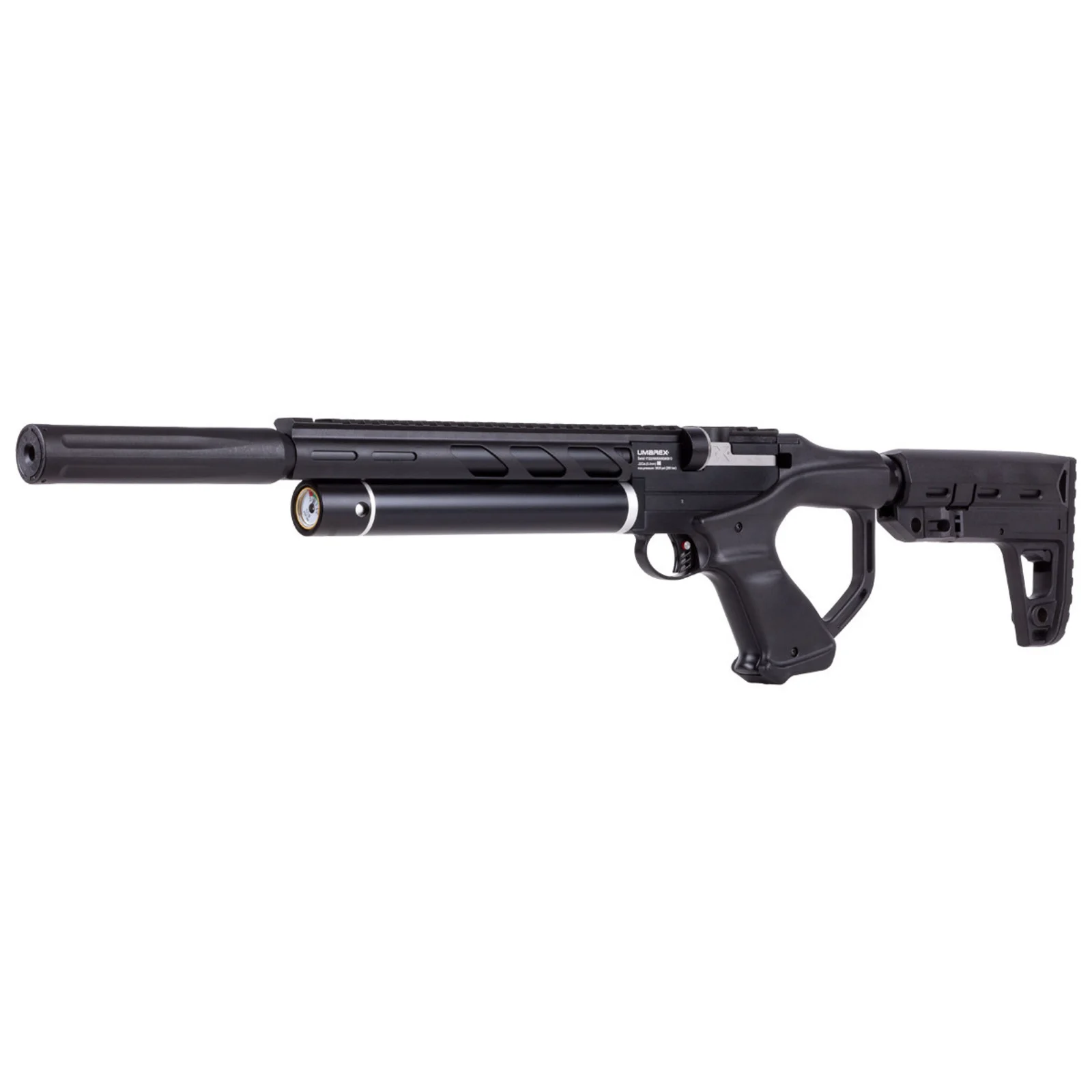
The Umarex Notos is a light and agile rifle that is easy to use.
Because it is equipped with an internal regulator, the pressure behind each shot is constant. With very good accuracy as a result.
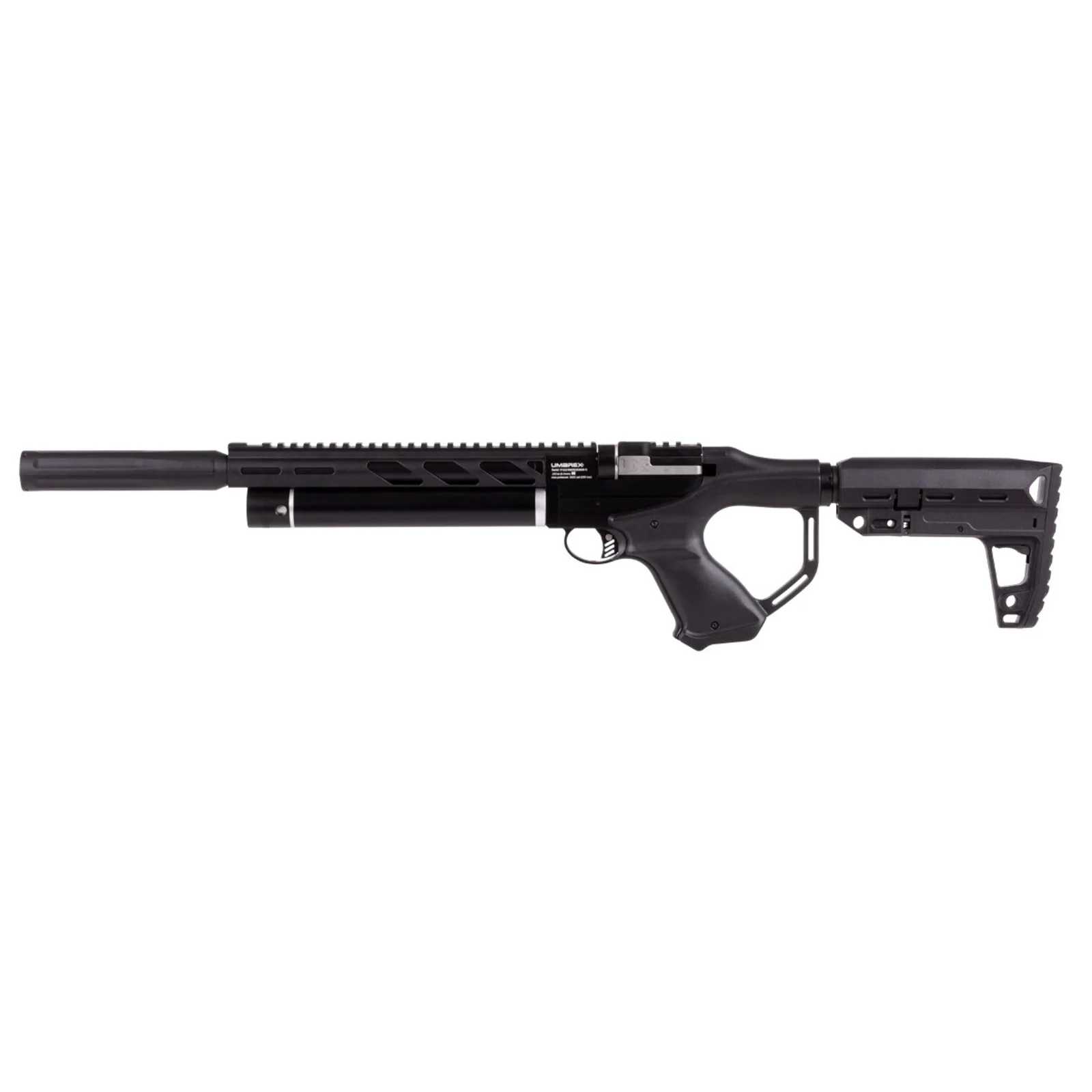
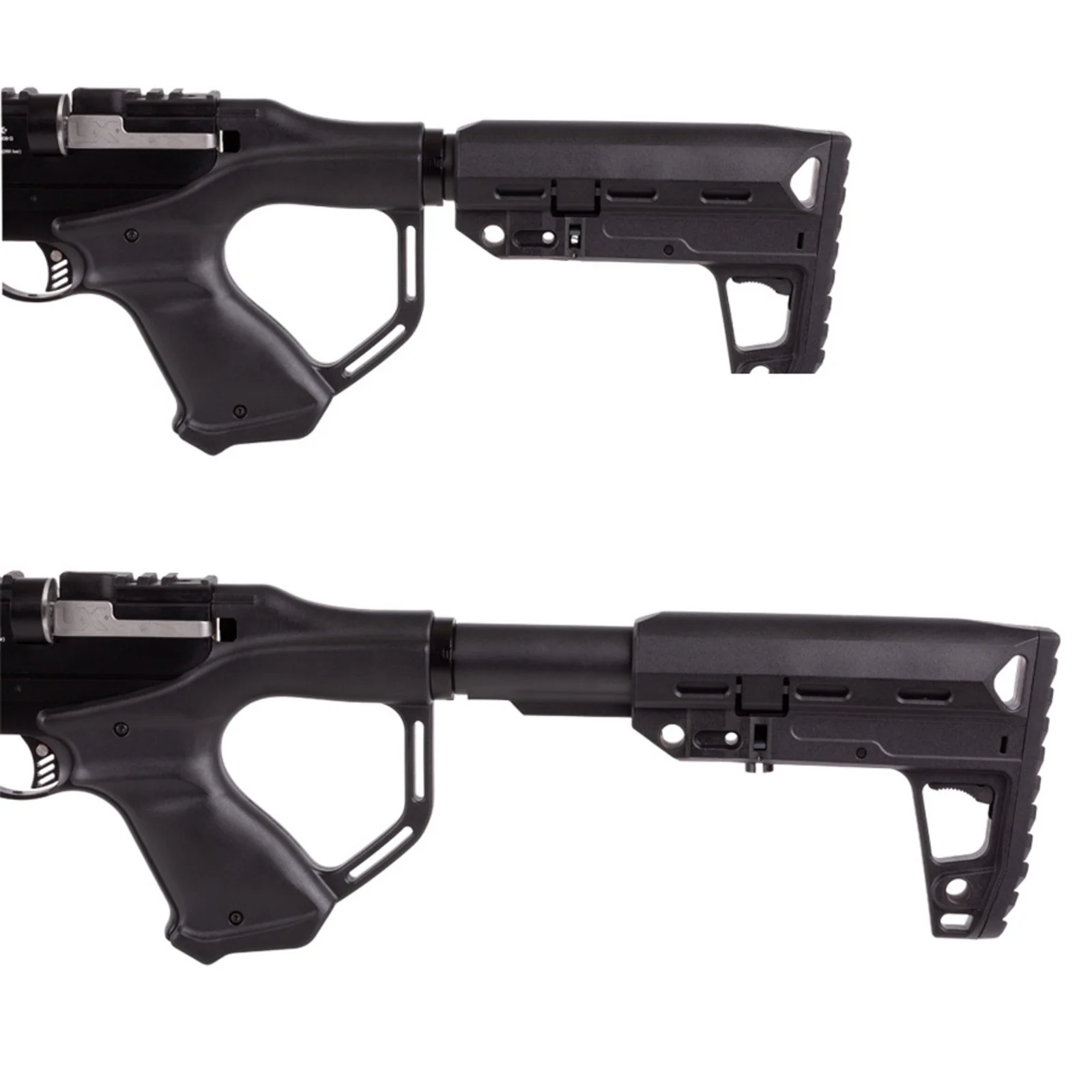
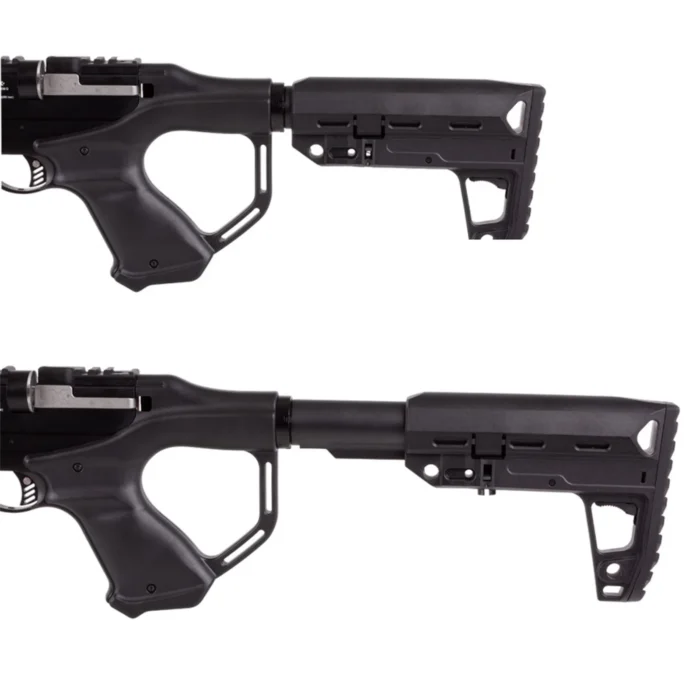
The Notos has a “tactical” look thanks to the AR15 style sliding stock (with 5 positions!) and 22mm full length picatinny.
In addition, a jacket is installed that continues on a fixed silencer. This not only looks good, but is also very effective in making this relatively powerful rifle backyard friendly.
The Notos is also very easy to use.
Thanks to the side lever on the left side, this rifle can be cocked quickly and smoothly.
Included with the rifle you get a single shot tray and a 7 rounds magazine.
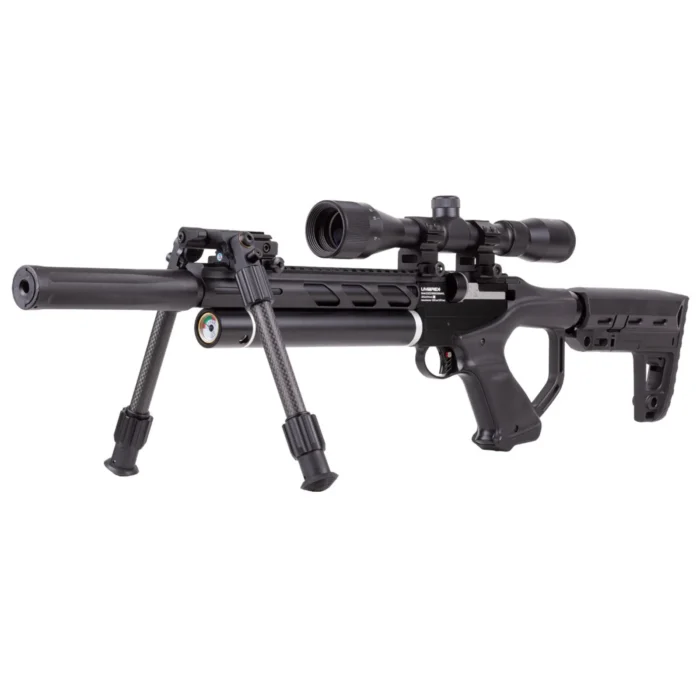
Also the kit comes with a 3-9×40 scope with illuminated reticle and adjustable objective and a very nice bipod.
Filling is easy with the supplied filling probe. This probe has a connection for a foster quick connect (see images).
Test
We ran the Umarex Notos in store over the chronometer with several popular pellets to see what the power class of this little plinker is.
To our surprise, this device put out a solid 22 to 28 joules of muzzle energy. That makes this rifle a very interesting option for its size and purpose.
Umarex Notos PCP Carbine | 5.5mm (.22) – Technical Product Guide
Notos Engineering, PCP Architecture, Umarex Platform Context, and Related Product Terms
Umarex
umarex is the manufacturer behind the Notos platform and a broad catalog of pellet rifles, BB guns, PCP systems, air pistols, replicas, and accessories. The company’s current U.S. catalog includes the original Notos as well as the newer Notos Gen 2.
Umarex USA
umarex usa is the company’s U.S. operation and currently lists the Notos under its PCP air-rifle catalog.
UmarexUSA
The term umarexusa is simply a common search variation for Umarex USA and does not identify a different product line.
Umerex
umerex is a spelling variation of Umarex rather than a separate manufacturer.
Umarex Notos
The umarex notos is a compact .22-caliber PCP carbine using a regulated air system, side-lever action, removable rotary magazine, and collapsible stock.
Umarex Notos Carbine
The phrase umarex notos carbine accurately describes the original compact configuration. Umarex lists the platform at approximately 31.5–34 inches overall with its stock adjusted and roughly 4.15 pounds without an optic.
5.5mm (.22) Configuration
The platform is chambered for .22-caliber pellets, equivalent to approximately 5.5mm. Its compact barrel, regulated pressure system, and multi-shot magazine distinguish it from larger PCP rifles designed around substantially larger air reservoirs.
PCP Pressure System
The original model uses a 66cc fixed air tank, a maximum fill pressure of 3,625 psi, and internal regulation to approximately 1,900 psi.
Regulation helps provide a more controlled pressure supply through an appropriate portion of the reservoir’s usable range, although actual consistency still depends on ammunition, temperature, seals, barrel condition, and mechanical maintenance.
Side-Lever Action
The side-lever design allows the action to be cycled without a traditional rear bolt arrangement. Umarex specifically identifies the Notos as a side-lever PCP platform.
Seven-Shot Rotary Magazine
The original model uses a 7-shot auto-indexing rotary magazine. Umarex also lists a dedicated spare magazine under the Notos accessory catalog.
Single-Shot Tray
Umarex also offers a dedicated .22-caliber single-shot tray for the original Notos.
Picatinny Rail
The integrated top Picatinny rail provides a standardized sight-mounting interface.
Any sighting equipment should remain securely mounted because loose hardware can produce apparent changes in precision.
SilencAir Muzzle Device
The original configuration uses a three-baffle SilencAir muzzle device.
Any alteration to muzzle components should remain consistent with manufacturer guidance and applicable local regulations.
Adjustable Stock
The collapsible stock changes overall length between approximately 31.5 and 34 inches.
This allows the carbine’s external dimensions to be adapted to different recreational target positions without changing its basic pneumatic architecture.
Umarex Airguns
umarex airguns describes the manufacturer’s wider air-powered product family, which includes PCP rifles, CO₂ models, pellet rifles, BB guns, replicas, and accessories.
Umarex Air Rifles
The term umarex air rifles covers several distinct platforms, including small-bore PCP rifles and other air-powered long guns. The Notos belongs specifically to the PCP segment.
Umarex Air Rifle
The singular phrase umarex air rifle is broad and should not be treated as an exact product designation.
Air Guns
The term air guns includes PCP rifles, spring-powered equipment, CO₂ platforms, BB guns, and pellet guns. The Notos is specifically a pre-charged pneumatic .22-caliber pellet carbine.
Umarex Gauntlet
The umarex gauntlet is a separate PCP family. It uses a substantially larger air reservoir and a different full-length architecture.
Umarex Gauntlet 2
The umarex gauntlet 2 is a newer version of that separate family and should not be confused with the compact Notos. Umarex lists the .22 Gauntlet 2 with a 24-cubic-inch tank and 4,500 psi fill pressure.
Umarex Gauntlet 30
The phrase umarex gauntlet 30 concerns the .30-caliber Gauntlet family rather than the .22 Notos.
Umarex Origin
The umarex origin is another separate PCP platform. Umarex currently lists the Origin as a .22-caliber rifle kit supplied with a 4,500 psi-rated hand pump.
Umarex Zelos
umarex zelos refers to another Umarex product family and should not be treated as an alternate designation for the Notos.
Umarex Komplete
The umarex komplete belongs to a different pneumatic architecture using removable NitroAir cartridges rather than the Notos’s fixed rechargeable air reservoir.
Umarex Komplete NCR .22
The umarex komplete ncr .22 uses a 10-shot magazine and removable nitrogen cartridge system, making it mechanically distinct from the 66cc fixed-tank Notos.
Umarex Hammer
The umarex hammer belongs to a separate large-bore air-rifle family and should not be confused with the compact .22-caliber carbine.
Umarex Hammer .50 Caliber
The phrase umarex hammer .50 caliber concerns a much larger-caliber platform with an entirely different application and pressure architecture.
Umarex Hammer Carbine
Likewise, umarex hammer carbine refers to the Hammer product family rather than the Notos.
50 Cal Air Rifle
The phrase 50 cal air rifle has no direct technical relationship to this 5.5mm platform.
Umarex Primal 20
umarex primal 20 refers to another large-bore air-powered product category and is unrelated to the Notos’s .22-caliber configuration.
Umarex Air Saber
The umarex air saber is an air-powered archery platform rather than a pellet carbine.
Umarex Air Javelin
Similarly, umarex air javelin refers to an air-powered arrow launcher rather than a .22-caliber PCP pellet system.
Umarex Fusion 2
The umarex fusion 2 is a different Umarex air-rifle platform and should not be treated as another Notos model.
Umarex Synergis Elite
The umarex synergis elite belongs to another air-rifle architecture and does not share the Notos’s compact regulated PCP layout.
Umarex Trevox
The umarex trevox is a break-barrel air pistol rather than a PCP carbine.
Loading Umarex Trevox Break Barrel .177
The phrase loading umarex trevox break barrel .177 concerns a different mechanism and caliber. It should not be used as operational guidance for the Notos.
Umarex Pistol Break Barrel
Likewise, umarex pistol break barrel describes a different type of airgun powerplant from the Notos’s pre-charged pneumatic design.
Pellet Pistol
A pellet pistol is a broad category that does not accurately describe the Notos in its standard carbine configuration.
Umarex DX17
The umarex dx17 is another separate pistol-class product and should not be confused with this PCP carbine.
BB Gun Air Pistol
The term bb gun air pistol concerns a different projectile and equipment category.
Metal BB Gun
A metal bb gun typically refers to equipment firing spherical steel BBs, whereas the Notos is designed around .22-caliber pellets.
Umarex BB Gun
The phrase umarex bb gun broadly covers Umarex’s steel-BB products but does not accurately identify the Notos.
Legends M3 Grease Gun S
The phrase Legends M3 Grease Gun S relates to the Umarex Legends M3 Grease Gun, a CO₂-powered full-auto .177 BB replica with a 60-round magazine. It is mechanically and functionally separate from the Notos PCP carbine.
Umarex Legends
umarex legends is Umarex’s replica-oriented product family. Current products include the M3 Grease Gun and other historically styled BB platforms.
Umarex MP40
The umarex mp40 belongs to the Legends-style replica category rather than the PCP-carbine category.
Umarex MP5
The phrase umarex mp5 refers to another replica-oriented platform and should not be treated as an alternate Notos designation.
Umarex HK Heckler
The phrase umarex hk heckler concerns Heckler & Koch-branded replica equipment rather than the Notos.
Umarex T4E
umarex t4e refers to Umarex’s training and paint/marker-oriented product family rather than the Notos PCP system.
Umarex TR50
The umarex tr50 is part of the T4E category and does not share the Notos’s pellet-rifle architecture.
Umarex HDR 50
The phrase umarex hdr 50 is associated with a separate T4E-style revolver platform.
Umarex P2P DR50 How Many Joules
The phrase umarex p2p dr50 how many joules concerns another platform and is not a Notos specification.
Umarex T4E Smith
umarex t4e smith concerns a separate training/marker category.
Umarex Smith
Likewise, umarex smith is not a Notos model designation.
Umarex Shotgun
The phrase umarex shotgun concerns another category and does not describe this .22-caliber PCP carbine.
Glock BB Gun
The phrase glock bb gun refers to licensed Glock replica airguns rather than the Notos.
Umarex Glock
umarex glock is the broader licensed replica range.
Umarex Glock 17
The umarex glock 17 is a pistol-format replica platform rather than a PCP carbine.
Umarex Glock 17 Gen 5
Likewise, umarex glock 17 gen 5 concerns a Glock-pattern airgun replica.
Umarex Glock 19
The umarex glock 19 is another pistol-style replica product.
Glock 19 BB Gun
The phrase glock 19 bb gun concerns a BB-firing handgun-style platform, not a pellet carbine.
Umarex Glock 19 Gen3 .177 Caliber
The phrase umarex glock 19 gen3 .177 caliber refers to a .177-caliber replica pistol rather than the 5.5mm carbine.
Umarex Glock 19X
umarex glock 19x likewise belongs to the licensed Glock replica category.
Airsoft Glock
The phrase airsoft glock refers to airsoft replicas rather than pellet-firing PCP equipment.
Glock 19 Airsoft
Similarly, glock 19 airsoft concerns an airsoft handgun category.
BB Gun Glock
The phrase bb gun glock is another search variation for Glock-pattern BB pistols rather than the Notos.
Umarex Airsoft
umarex airsoft is a separate product category based around airsoft projectiles rather than .22-caliber pellets.
Why the Compact Notos Architecture Matters
The original Notos combines a 66cc regulated air system, 11.75-inch barrel, 7-shot magazine, adjustable stock, side-lever action, Picatinny rail, and approximately 4.15-pound weight in a relatively compact package.
That architecture makes it fundamentally different from larger Umarex PCP platforms such as the Gauntlet family, which use substantially larger reservoirs and longer full-length layouts.
Practical Precision
The regulator, rifled barrel, rigid sighting rail, side-lever mechanism, and compact stock configuration provide a technical foundation for repeatable recreational target performance. Umarex describes the original Notos as suitable for precision target shooting and identifies the system as internally regulated.
Actual precision still depends on ammunition consistency, pressure behavior, optic stability, barrel condition, environmental conditions, and user technique.
Original Notos Versus Notos Gen 2
The original and second-generation versions should not be mixed when publishing specifications. The original uses a 7-shot magazine, 66cc tank, and 11.75-inch barrel, whereas the current Gen 2 uses a 15-shot magazine, 118cc tank, 13.5-inch barrel, Foster fitting, and approximately 30 regulated shots per fill.
Overall Technical Perspective
The Umarex Notos PCP Carbine in 5.5mm (.22) is best understood as a compact, regulated pneumatic platform built around a 66cc fixed tank, 3,625 psi maximum fill pressure, approximately 1,900 psi regulation, 11.75-inch barrel, 7-shot rotary magazine, side-lever action, adjustable stock, Picatinny rail, and SilencAir muzzle device.
For responsible ownership, the important considerations remain correct .22-caliber ammunition, compatible pressure-rated charging equipment, adherence to the manufacturer’s pressure limits, secure storage, appropriate eye protection, controlled recreational use, and qualified servicing whenever pressure retention or mechanical condition becomes uncertain.
Engineering Design, Ergonomics, Pressure Management, Precision Factors, and Practical Performance
A compact pre-charged pneumatic carbine should be evaluated as a complete mechanical system rather than through velocity figures alone. Reservoir condition, pressure regulation, barrel construction, trigger behavior, stock geometry, sight stability, ammunition consistency, and environmental conditions all influence practical performance. Because compressed-air equipment operates under substantial pressure, responsible ownership also requires careful inspection and adherence to manufacturer limits. When these elements are considered together, the platform becomes easier to evaluate for recreational target shooting, routine handling, maintenance requirements, and long-term reliability.
Compact Carbine Architecture
The compact configuration reduces overall bulk compared with many conventional full-length pneumatic rifles.
A shorter platform can feel easier to handle and transport, particularly when storage space is limited. However, compact dimensions do not eliminate the need for disciplined handling, appropriate range procedures, or secure storage.
Balance should always be evaluated with any installed sighting equipment included.
Lightweight Handling
Lower overall weight can reduce fatigue during extended recreational sessions.
Nevertheless, extremely light equipment can respond more noticeably to inconsistent support or body movement. Therefore, stable positioning remains important when evaluating mechanical precision.
Individual comfort will also depend on height, arm length, shoulder position, and preferred shooting posture.
Adjustable Stock
An adjustable rear stock allows the overall fit to accommodate different body dimensions and sighting positions.
The objective should be a comfortable shoulder position that does not require excessive stretching or compression of the upper body.
Once an appropriate position has been established, keeping the adjustment consistent can support repeatable alignment.
Shoulder Position
Consistent shoulder placement contributes to a predictable relationship between the user and the sighting system.
The rear portion should sit naturally without requiring excessive pressure.
If the position becomes uncomfortable during longer sessions, posture should be reassessed rather than forcing the equipment into an unnatural position.
Grip Ergonomics
Grip geometry influences wrist angle, trigger-hand comfort, and overall control.
A relaxed hand generally produces less unnecessary movement than an excessively tight grip.
Comfort should remain the priority because muscular tension can make repeatable recreational target work more difficult.
Supporting-Hand Placement
The supporting hand provides stability beneath the forward portion of the platform.
Consistent placement can reduce unnecessary changes in balance.
However, pressure-bearing components and charging connections should never be used as improvised gripping points when doing so could interfere with safe handling or damage external fittings.
Regulated Pressure Delivery
An internal regulator manages pressure supplied from the main reservoir through an appropriate portion of its operating range.
This controlled delivery can support more consistent pneumatic behavior as stored pressure decreases.
Nevertheless, regulation cannot compensate for every variable. Temperature, seal condition, ammunition variation, and mechanical wear can still influence performance.
Reservoir Integrity
The air reservoir is a critical pressure-bearing component.
Its exterior should remain free from serious dents, deep scratches, substantial corrosion, or visible deformation.
Any significant impact damage deserves qualified assessment before the equipment is returned to service.
A reservoir retaining pressure should not automatically be assumed structurally sound after severe damage.
Pressure Gauge Awareness
A pressure gauge provides useful information about reservoir condition.
The gauge should remain readable, securely mounted, and physically undamaged.
Unexpected readings, condensation, cracking, or unexplained pressure loss should be investigated rather than ignored.
Filling Connection
The charging interface should remain clean and protected from contamination.
Dust, moisture, grit, or damaged sealing surfaces can interfere with proper connection.
Only compatible pressure-rated charging equipment should be used, and manufacturer-approved pressure limits should always control the process.
Pressure Management
High-pressure pneumatic systems require careful management.
The reservoir should never intentionally be filled beyond its approved limit.
Likewise, damaged hoses, fittings, gauges, or connectors should be removed from service instead of being temporarily repaired with improvised materials.
Barrel Design
The rifled barrel is a central component in mechanical consistency.
Its alignment, internal condition, crown integrity, and relationship with the sighting system all influence repeatability.
External impacts should therefore be avoided, particularly around the muzzle.
Muzzle Assembly
The factory muzzle assembly forms part of the original configuration.
It should remain undamaged and securely installed according to manufacturer specifications.
Unauthorized modification should be avoided, especially where local laws regulate sound-moderating components or alterations.
Understanding Precision
Precision results from several variables operating simultaneously.
Barrel condition, ammunition consistency, pressure behavior, sight stability, environmental conditions, support position, and user technique all contribute.
Consequently, one unexpected result should not immediately be interpreted as evidence of mechanical failure.
Ammunition Consistency
Only ammunition of the correct caliber and suitable specification should be used.
Visible deformation, contamination, or substantial dimensional inconsistency can influence results.
Anything that does not fit normally should never be forced into the mechanism.
Magazine Condition
The rotary magazine should remain clean and physically undamaged.
Contamination or deformation can interfere with normal indexing.
Magazines should be protected during transportation rather than stored loose alongside heavy tools or charging equipment.
Side-Lever Operation
The cycling mechanism should move smoothly through its intended travel.
Grinding, scraping, binding, or unusually heavy resistance may indicate contamination or mechanical wear.
Greater force should not be used to overcome abnormal resistance.
If the cause remains unclear, professional servicing is appropriate.
Trigger Consistency
A predictable trigger contributes to repeatable recreational target performance.
Unexpected changes in movement, resistance, or engagement should receive attention.
Internal adjustments should remain within manufacturer-supported specifications, while abnormal behavior should be evaluated by qualified personnel.
Sight-Mounting Stability
Optical mounting hardware can strongly influence apparent accuracy.
Loose rings or bases may cause changes in point of impact even when the pneumatic system remains mechanically healthy.
Therefore, mounting stability should be included whenever unexplained performance changes are investigated.
Environmental Influence
Wind can noticeably affect lightweight projectiles.
Temperature can also influence compressed gases and pressure readings.
Meaningful comparisons should therefore account for environmental differences rather than assuming every change originates within the equipment.
Recreational Target Evaluation
A controlled range environment provides the clearest setting for evaluating consistency.
A suitable backstop, appropriate eye protection, stable equipment support, and disciplined handling are fundamental.
Local range rules and applicable regulations should always be followed.
Pre-Use Inspection
Before each recreational session, inspect the equipment for obvious damage.
Check the reservoir, gauge, charging interface, barrel, stock, sights, controls, and visible fasteners.
Unexpected pressure loss or abnormal mechanical behavior should be investigated before continued use.
Post-Use Inspection
After use, another brief inspection can identify moisture, contamination, loose hardware, impact damage, or unexpected pressure changes.
This is particularly important following outdoor sessions or transportation.
Early detection can prevent minor problems from developing further.
Transportation Considerations
A padded case can protect the platform from impact and abrasion.
Heavy charging equipment should be kept separate so it cannot strike the reservoir, gauge, barrel, or sighting system.
Transportation should always comply with applicable local requirements.
Storage Environment
A clean, dry, temperature-stable environment provides favorable long-term storage conditions.
Wet equipment should not remain sealed inside a case because trapped moisture can encourage corrosion.
Prolonged exposure to extreme heat should also be avoided.
Secure Storage
When not in use, the equipment should remain unloaded and secured against unauthorized access.
Children and unauthorized individuals should not be able to reach it.
Applicable storage regulations should always be observed.
Long-Term Reliability
Reliable operation depends more heavily on preventive care than frequent internal modification.
Clean storage, careful transportation, appropriate pressure management, compatible ammunition, stable sight mounting, and timely professional servicing can preserve mechanical condition.
Overall Engineering Perspective
The practical value of a compact regulated pneumatic carbine comes from the interaction between its pressure system, barrel, action, stock, controls, magazine, and sighting arrangement. No individual feature guarantees precision or reliability by itself.
Instead, dependable recreational performance develops when the entire system remains mechanically sound and properly maintained. Significant pressure loss, severe corrosion, damaged pressure-bearing components, unusual trigger behavior, or unexplained mechanical resistance should always prompt inspection. Conservative maintenance, secure storage, appropriate range practices, and adherence to manufacturer specifications provide the strongest foundation for safe and reliable long-term ownership.
Maintenance, Inspection, Cleaning, Storage, Reliability, and Long-Term Care
Long-term reliability depends heavily on routine inspection and sensible preventive care. A compact pneumatic platform combines pressure-bearing components, seals, mechanical controls, a rifled barrel, a magazine system, adjustable furniture, and sight-mounting hardware. Each component can experience wear differently. Therefore, maintenance should focus on preserving the original condition, identifying changes early, and avoiding unnecessary internal modification. A consistent care routine also makes it easier to distinguish ordinary cosmetic wear from problems that require professional attention.
Routine Inspection
A brief visual inspection should be completed regularly.
Look for corrosion, cracks, loose hardware, impact marks, damaged fittings, or anything that appears different from the equipment’s normal condition.
Becoming familiar with its usual appearance makes developing problems easier to recognize.
Reservoir Condition
The pressure reservoir deserves particular attention because it stores compressed air at substantial pressure.
Inspect accessible surfaces for deep scratches, significant dents, corrosion, or deformation.
If substantial physical damage is discovered, the equipment should remain out of service until the reservoir has been professionally evaluated.
Monitoring Pressure Retention
Normal pressure behavior becomes easier to recognize with experience.
If stored equipment suddenly begins losing pressure significantly faster than usual, a seal, valve, fitting, or another pneumatic component may require inspection.
Persistent leakage should be diagnosed rather than repeatedly compensated for.
Gauge Condition
The pressure gauge should remain readable, securely mounted, and free from obvious damage.
A cracked face, corrosion, condensation, loose mounting, or unexpectedly unusual readings should receive attention.
A questionable gauge should not be relied upon until its condition has been established.
Seal Longevity
Internal seals are wear components.
Age, temperature changes, contamination, moisture, and repeated use can gradually affect their condition.
A developing leak does not necessarily indicate a major mechanical failure, but persistent pressure loss should still be properly assessed.
Filling Interface Care
The charging connection should remain clean and protected.
Dust, moisture, grit, and other contaminants can interfere with sealing surfaces.
Before connecting compatible pressure-rated equipment, inspect the accessible fitting for contamination or visible damage.
External Surface Cleaning
Routine exterior cleaning should remain simple.
A clean, soft cloth can remove ordinary dust and handling marks.
Strong solvents, abrasive materials, and unknown chemicals should be avoided because they may damage finishes, polymers, seals, or markings.
Barrel Exterior Protection
The barrel should be protected from physical impact and prolonged moisture exposure.
After outdoor use, accessible surfaces should be checked for water, dirt, or other contamination.
Particular attention should be given to the muzzle area because physical damage there can affect mechanical consistency.
Conservative Bore Maintenance
Internal barrel cleaning should follow manufacturer-supported procedures.
More cleaning is not automatically better.
Aggressive tools, unsuitable chemicals, or unnecessary repeated cleaning can introduce wear where no meaningful problem previously existed.
Magazine Maintenance
The removable magazine should remain clean and protected from deformation.
Dust or physical damage can interfere with normal indexing.
During storage and transportation, magazines should not be placed loose alongside heavy tools or other objects that could crush or distort them.
Cycling Mechanism Inspection
The operating mechanism should retain a smooth and predictable feel.
Binding, scraping, grinding, or unusually heavy resistance may indicate contamination or wear.
The mechanism should not be forced when its behavior changes significantly.
Professional assessment is appropriate when the cause cannot be identified externally.
Trigger-System Condition
The trigger should retain predictable mechanical behavior.
Unexpected changes in movement, resistance, or engagement should be treated as a reason for inspection.
Routine ownership does not require unnecessary internal trigger disassembly or modification.
Safety Mechanism
The mechanical safety should function normally without excessive looseness or binding.
However, mechanical safeguards should never replace responsible handling.
The equipment should always be treated according to appropriate range and storage procedures regardless of safety position.
Adjustable Stock Inspection
Adjustment hardware should move through its intended range and lock securely.
Excessive movement, damaged locking components, or repeated loosening can affect comfort and consistency.
Problems should be corrected with compatible components rather than improvised hardware.
Grip and Furniture Care
Synthetic furniture generally requires limited maintenance.
Nevertheless, prolonged exposure to aggressive chemicals, extreme heat, and severe impact should be avoided.
Periodic inspection around mounting points can reveal cracks or developing movement before they become more significant.
Sight Rail Inspection
The mounting rail should remain straight, secure, and free from significant impact damage.
Any installed sighting equipment should also be checked for movement.
Loose mounting hardware can create apparent performance changes even when the underlying pneumatic system remains healthy.
Fastener Condition
Visible screws and attachment points should occasionally be checked for unexpected looseness.
Overtightening should be avoided because damaged threads can create additional problems.
A fastener that repeatedly loosens may indicate an underlying issue requiring inspection.
Moisture Management
Moisture is a major consideration during long-term storage.
Equipment exposed to rain or high humidity should be dried before being placed inside a closed case.
The case itself should also be allowed to dry because trapped moisture can encourage corrosion.
Corrosion Prevention
Clean and reasonably dry storage conditions provide effective protection against corrosion.
Salt, persistent humidity, and aggressive chemicals should be kept away from metal components.
Recessed areas deserve occasional attention because deterioration can begin where it is not immediately visible.
Temperature Protection
Extreme temperatures should be avoided whenever practical.
A closed vehicle exposed to direct sunlight can become significantly hotter than the surrounding environment.
Excessive heat can negatively affect seals, polymers, optics, adhesives, and other materials.
Transportation Care
A suitable padded case can protect equipment from impact, abrasion, and contamination.
Heavy charging equipment and tools should be transported separately so they cannot strike the barrel, pressure reservoir, gauge, or sighting components.
Storage Security
When not in recreational use, the equipment should remain unloaded and secured against unauthorized access.
Children and unauthorized individuals should not be able to reach it.
Applicable local storage and transportation requirements should always be followed.
Long-Term Storage
Equipment stored for extended periods should still be inspected occasionally.
Look for corrosion, unexpected pressure changes, loose hardware, environmental deterioration, or damaged components.
Manufacturer guidance should determine appropriate long-term pressure and storage conditions.
Keeping Maintenance Records
A basic maintenance history can be useful.
Professional inspections, seal replacements, repairs, pressure-related problems, and significant incidents can be documented.
These records help identify recurring problems and provide useful information during future servicing.
Avoiding Improvised Repairs
Pressure-bearing and critical mechanical components should not be repaired using random seals, adhesives, makeshift fittings, or hardware of uncertain specification.
Improvised repairs can create additional faults.
Compatible components and qualified servicing provide a more dependable approach.
Recognizing Warning Signs
Persistent pressure loss, substantial corrosion, damaged pressure components, abnormal trigger behavior, severe mechanical resistance, or structural damage should never be ignored.
Continuing recreational use while a significant fault remains unresolved can worsen the problem.
Professional Servicing.
Some maintenance belongs with qualified technicians.
Pressure-system faults, structural damage, regulator problems, persistent leaks, and unexplained mechanical abnormalities should receive appropriate professional assessment rather than experimental disassembly.
Overall Long-Term Care
Reliable ownership is primarily the result of consistent preventive care. Clean storage, moisture protection, careful transportation, conservative cleaning, routine inspection, secure storage, and timely professional servicing can preserve mechanical condition for years.
The objective should not be constant adjustment. Instead, the equipment should remain as close as practical to its intended mechanical condition. When substantial leakage, corrosion, structural damage, abnormal resistance, or unexplained changes appear, recreational use should stop until the cause has been properly assessed.
Real-World Usability, Ownership Experience, Performance Evaluation, and Important Considerations
A compact pneumatic carbine should be judged by more than specifications printed on a product page. Everyday usability depends on ergonomics, mechanical condition, pressure stability, sight alignment, ammunition consistency, environmental conditions, maintenance habits, and responsible storage. Consequently, a practical evaluation should consider how the complete system behaves throughout ordinary recreational ownership. Compact dimensions can improve portability and handling, while a regulated pneumatic system can support consistent operation. However, neither characteristic eliminates the importance of proper inspection, conservative maintenance, or compliance with manufacturer instructions.
Everyday Handling
Compact dimensions can make the platform relatively manageable during ordinary handling and transportation.
A shorter overall configuration may also require less storage space than a conventional full-length design.
However, compactness should never encourage casual handling. The same responsible procedures remain necessary regardless of overall dimensions.
Lightweight Characteristics
Lower weight can reduce fatigue during longer recreational target sessions.
At the same time, lighter equipment may respond more noticeably to inconsistent body movement.
Therefore, stable positioning and repeatable support remain important when evaluating mechanical consistency.
Adjustable Fit
An adjustable rear section allows the overall configuration to accommodate different body proportions.
The objective should be comfortable shoulder contact combined with natural head placement.
Once a suitable position has been established, keeping that adjustment consistent can make recreational target evaluation more repeatable.
Shoulder Comfort
The rear section should contact the shoulder without requiring excessive pressure.
An awkward position can create unnecessary muscular tension.
During longer sessions, discomfort can gradually influence posture, which may then affect sight alignment and consistency.
Grip Position
A comfortable grip allows the wrist to remain relatively relaxed.
Excessive hand pressure can introduce unnecessary movement.
Individual hand size differs, so comfort should be evaluated personally rather than assumed from specifications alone.
Supporting-Hand Position
The supporting hand contributes significantly to overall stability.
Consistent placement helps maintain similar balance between attempts.
However, pressure fittings, gauges, and other sensitive components should never be treated as convenient gripping points.
Balance
Balance describes how weight is distributed rather than simply how much the complete platform weighs.
Accessories can change that distribution noticeably.
For example, adding optical equipment can shift the center of gravity and alter how the platform feels during prolonged recreational use.
Practical Precision
Precision should be understood as the combined result of mechanical and external variables.
Barrel condition, pressure consistency, sight stability, ammunition uniformity, environmental conditions, equipment support, and user technique can all influence results.
Therefore, a single unusual result provides limited diagnostic information.
Evaluating Consistency
Meaningful evaluation requires repeated observations under reasonably similar conditions.
A stable support and controlled environment can reduce unnecessary variables.
If a substantial performance change persists across several sessions, equipment condition should be examined systematically.
Environmental Influence
Wind can influence lightweight projectiles significantly.
Temperature can also affect compressed gases and pressure readings.
Consequently, results obtained on different days may vary even when the equipment itself has not changed.
Sight Alignment
Consistent head placement supports repeatable sight alignment.
If the user continually changes cheek or shoulder position, the visual relationship with an installed optic can also change.
Comfortable ergonomics therefore contribute indirectly to practical consistency.
Mounting Stability
Optical mounting hardware should remain secure.
Loose mounting components can create apparent changes in performance even when the pneumatic system and barrel remain mechanically healthy.
Mounting stability should therefore be checked whenever unexplained changes appear.
Pressure Awareness
Understanding normal pressure behavior is an important part of ownership.
Unexpectedly rapid pressure loss or abnormal gauge readings should be investigated.
Manufacturer-approved limits should always remain the controlling reference for pressure management.
Charging Routine
Pressure replenishment should be approached carefully and without unnecessary haste.
Compatible pressure-rated equipment should be used, while connections should remain clean and undamaged.
Manufacturer instructions should determine appropriate procedures and limits.
Pre-Session Inspection
Before recreational use, complete a brief external inspection.
Look for significant corrosion, physical damage, loose components, abnormal pressure behavior, or anything substantially different from normal.
This routine can reveal problems that developed during storage or transportation.
Post-Session Inspection
After use, inspect the equipment again.
Check for moisture, contamination, new impact marks, loosened hardware, or unexpected pressure changes.
Post-session inspection is particularly useful after outdoor use.
Outdoor Conditions
Outdoor environments can introduce dust, moisture, vegetation, and temperature changes.
Accessible surfaces should be inspected after exposure.
Equipment that becomes wet should be dried appropriately before enclosed storage.
Transportation Experience
A compact configuration can simplify transportation, but protection remains important.
A padded case can reduce impact and abrasion.
Heavy tools and charging equipment should be separated so they cannot strike pressure-bearing or precision components.
Storage Environment
A dry and reasonably temperature-stable environment provides favorable storage conditions.
Persistent humidity can encourage corrosion, while excessive heat may accelerate deterioration of seals and other materials.
Wet equipment should not remain sealed inside a case.
Secure Storage
Responsible ownership requires preventing unauthorized access.
The equipment should remain unloaded and appropriately secured when not in use.
Children and unauthorized individuals should not be able to reach it.
Applicable local regulations should always be observed.
Recognizing Normal Wear
Minor cosmetic marks can occur through ordinary handling.
However, cosmetic wear should be distinguished from structural damage.
Deep dents, severe corrosion, cracks, deformation, or damage to pressure-bearing components deserve considerably greater attention.
Recognizing Mechanical Problems
Operating controls should maintain a reasonably consistent feel.
Binding, grinding, scraping, excessive looseness, or unexpectedly heavy resistance may indicate contamination or wear.
Applying greater force rarely addresses the actual cause.
Recognizing Pneumatic Problems
Persistent pressure loss is an important warning sign.
Potential causes can range from ordinary seal deterioration to more substantial pneumatic faults.
When leakage continues, qualified diagnosis is preferable to repeated refilling or experimental disassembly.
Cleaning Expectations
Routine ownership does not require aggressive cleaning after every session.
Accessible exterior contamination can usually be removed conservatively.
Internal maintenance should follow manufacturer guidance to avoid introducing unnecessary wear.
Avoiding Excessive Modification
Mechanical equipment is not automatically improved through modification.
Changes outside manufacturer-supported specifications can introduce reliability problems or complicate future servicing.
Maintaining the intended configuration generally provides the more predictable long-term approach.
Long-Term Durability
Durability depends heavily on treatment.
Protection from impact, moisture, contamination, excessive heat, and improper storage can extend service life.
Routine inspection also helps identify deterioration before it becomes a larger maintenance problem.
Maintenance Records
A simple service history can provide useful long-term information.
Professional inspections, seal replacement, repairs, unusual pressure behavior, and significant incidents can be documented.
These records become increasingly useful as equipment ages.
When Professional Attention Is Appropriate
Significant pressure loss, structural damage, severe corrosion, abnormal trigger behavior, damaged pressure components, or unexplained mechanical resistance should receive qualified assessment.
Improvised repairs to critical pressure-bearing components should be avoided.
Responsible Recreational Use
Controlled recreational target use requires an appropriate environment, a suitable backstop, appropriate eye protection, and disciplined handling.
Applicable range requirements and local regulations should always be followed.
Mechanical safeguards should complement responsible behavior rather than replace it.
Overall Practical Perspective
The strongest ownership experience comes from combining comfortable ergonomics with disciplined equipment care. Compact dimensions, adjustable fit, manageable weight, regulated pressure behavior, and stable sight mounting can contribute to convenient recreational use, but their value depends on the condition of the complete system.
Consistent inspection, appropriate pressure management, conservative cleaning, careful transportation, secure storage, and timely professional servicing remain the foundation of long-term reliability. When substantial leakage, severe corrosion, structural damage, or unexplained mechanical behavior appears, the equipment should remain out of use until its condition has been properly assessed.
Be the first to review “Umarex Notos PCP Carbine | 5.5mm (.22)”
Related products
umarex AirRifle
€500.00
Reviews
There are no reviews yet.