




AIRMAKS KATRAN LB
€900.00
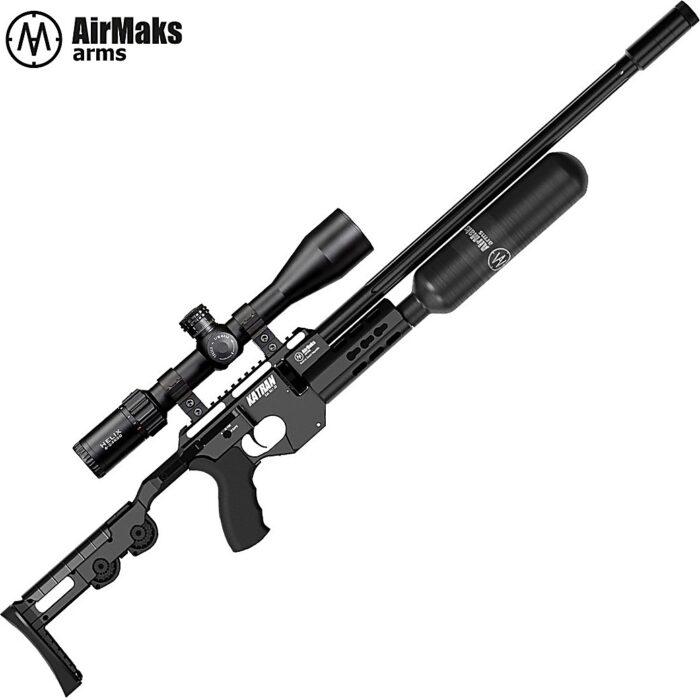
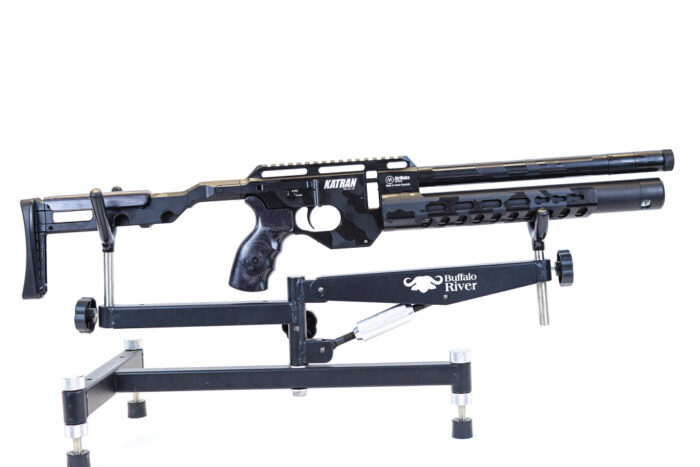
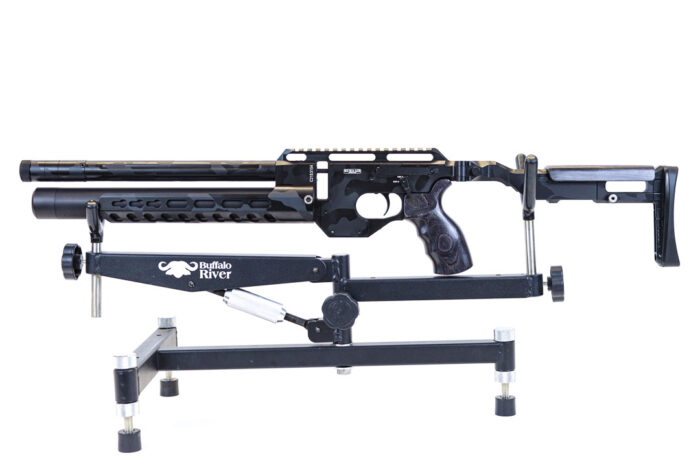
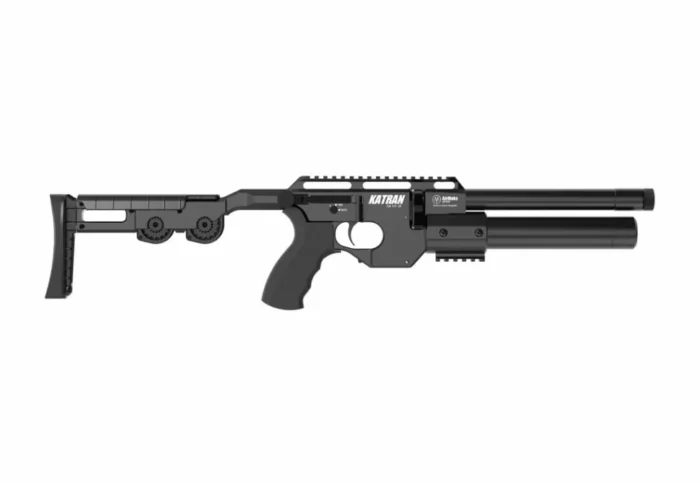
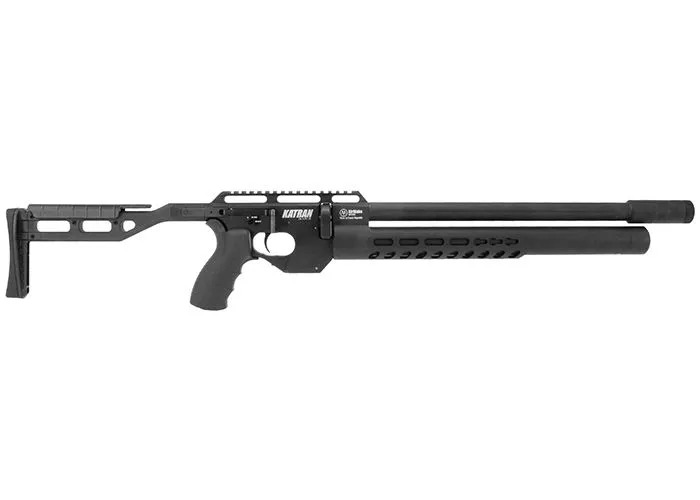
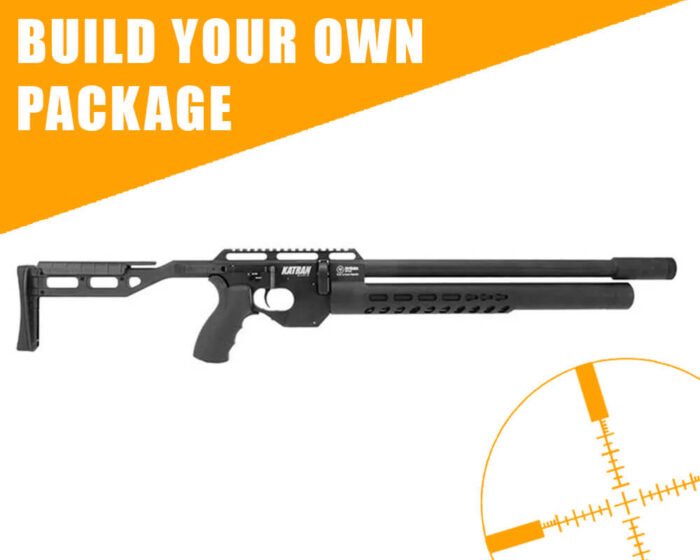
AirMaks Katran is a lightweight PCP air rifle with folding aluminium buttstock. The action is simply amazing. You can cock the rifle with one finger and without having to take your eyes off the target. LB version (long barrel).
AirMaks Katran LB — Long Bottle Regulated PCP Air Rifle with 580cc Air Capacity, 520mm CZ Barrel, Folding Stock, and Precision-Oriented Design
AirMaks Katran LB Design, 580cc Bottle, CZ Barrel, Regulation, Accuracy, Ergonomics, and Practical Performance
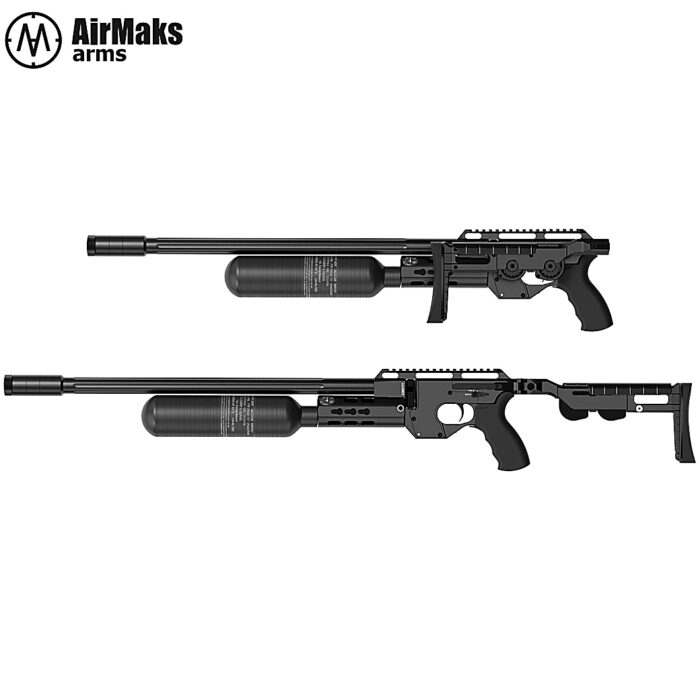
The AirMaks Katran LB is the Long Bottle version of the Katran platform, combining a 520mm choked CZ barrel with a large 580cc air bottle and a regulated PCP action. According to AirMaks Arms, the rifle is available in .177, .22, and .25 calibres, measures approximately 1030mm with the stock extended and 785mm folded, and weighs around 2.82kg. Its reservoir is rated to a maximum 300-bar pressure, giving the LB substantially greater stored-air capacity than the standard long-cylinder configuration.
The rifle also includes an adjustable aluminium folding stock, height-adjustable cheek piece and butt pad, AR15-style grip, reversible side-lever action, ambidextrous safety, two-stage externally adjustable trigger, pressure regulator, external hammer-spring velocity adjustment, and a 20 MOA Picatinny optics rail. These features create a versatile precision platform for lawful recreational and target applications.
AirMaks Katran
The airmaks katran family covers several compact, standard, long, bottle-fed, wooden-stock, and higher-output configurations.
The LB stands out because it combines the longer barrel configuration with significantly greater air capacity.
AirMaks
airmaks is the manufacturer behind the Katran platform and several other precision PCP designs.
Its current product range emphasizes regulated air delivery, modular ergonomics, and multiple configuration choices.
Airmarks
The term airmarks is commonly encountered as a spelling variation when users are actually searching for AirMaks products.
For technical specifications, the AirMaks Arms manufacturer name should be used.
Katran AirMaks
katran airmaks generally refers to the wider modular rifle platform.
Within that family, the LB model prioritizes extended shooting sessions through its large-capacity bottle while retaining the long-barrel format.
Air Marks
The phrase air marks can also appear in search results, although it should not be confused with the correct AirMaks Arms brand name.
Katran
The katran platform is built around lightweight aluminium construction, regulated PCP operation, adjustable ergonomics, and multiple lengths.
The LB version adds increased reservoir capacity to the long configuration.
Air Max Krait
The phrase air max krait normally refers to another AirMaks rifle family.
The Krait and Katran use different chassis concepts and should be evaluated independently.
AirMaks Krait
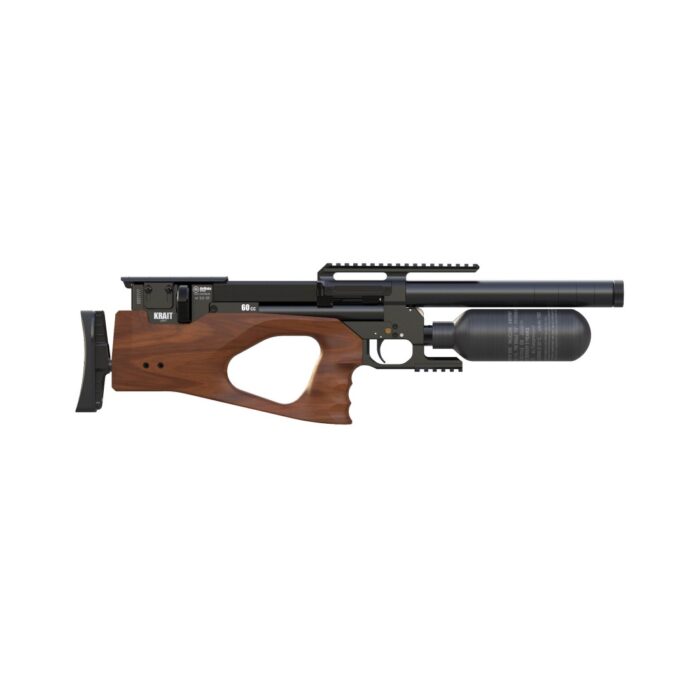
The airmaks krait belongs to the same manufacturer but represents a separate platform.
Buyers comparing the two should consider handling, stock layout, bottle arrangement, overall length, and intended shooting style.
Hamster With Gun
The phrase hamster with gun has no technical relationship to this PCP rifle or its intended sporting applications.
Hamster With a Gun
Likewise, hamster with a gun does not describe any component or feature of the rifle.
Air Marks
A repeated air marks search should still be directed toward verified AirMaks product specifications rather than similarly spelled names.
AirMaks
The airmaks Katran range currently includes compact through extra-long versions, with conventional cylinder and bottle-fed configurations.
Ar Max
ar max is not the formal name of this rifle.
The correct model designation is AirMaks Katran LB.
Best Pellet Gun for Pest Control
Someone searching for the best pellet gun for pest control should consider local laws, safe backstops, legal power limits, projectile suitability, and humane pest-management requirements.
Where lawful, regulated velocity and repeatable accuracy can be useful characteristics.
Arm Max
The phrase arm max may be another spelling variation encountered when searching for AirMaks Arms.
Pellet Gun for Pest Control
A pellet gun for pest control should only be used where legal and appropriate.
Precision, reliable air delivery, and safe handling are more important than simply selecting the highest available power.
AirMaks Katran
The AirMaks Katran LB combines a long 520mm choked barrel with a 580cc bottle, producing a configuration aimed at extended shooting sessions.
Hamster Holding Gun
The phrase hamster holding gun is unrelated to legitimate sporting-airgun use.
Javelin Pro Hunt Tac Bipod
A javelin pro hunt tac bipod or similar compatible support may appeal to shooters using the rifle from supported positions.
The front handguard provides an accessory interface, but mounting compatibility should always be confirmed before purchase.
Air Rifle for Pest Control
An air rifle for pest control needs adequate precision, reliable shot placement, legal power, and suitable ammunition.
Where pest control is lawful, the rifle’s regulated PCP action can help provide repeatable performance.
What Does PCP Air Rifle Mean
For users asking what does pcp air rifle mean, PCP stands for pre-charged pneumatic.
Compressed air is stored inside the rifle’s reservoir and released in controlled quantities to propel each projectile.
The LB uses a regulated 580cc reservoir rated to a maximum 300 bar.
Max Arms
max arms is not the official manufacturer name.
Buyers should verify listings carefully to ensure they are looking at genuine AirMaks Arms products.
Uramax
uramax is unrelated to the formal model designation and should not be confused with the Katran series.
Air Max Krait
The repeated air max krait term refers to the Krait platform rather than the LB.
Komprimiran Zrak
komprimiran zrak translates to compressed air in several South Slavic languages.
Compressed air is the energy source used by this type of pre-charged pneumatic rifle.
AirMaks Arms Air Rifles
AirMaks Arms air rifles cover multiple precision-focused PCP platforms.
The Katran family is notable for offering a wide range of lengths, reservoir capacities, and stock configurations.
AirMaks Arms PCP Air Rifles
AirMaks Arms PCP air rifles use compressed-air reservoirs rather than spring-piston mechanisms.
This generally allows reduced firing-cycle movement and supports repeatable shot delivery when the air system is functioning properly.
AirMaks Arms PCP Rifles
Among AirMaks Arms PCP rifles, the LB is distinguished by its combination of long barrel and large bottle while retaining the foldable Katran chassis.
AirMaks Arms for Sale
When searching for AirMaks Arms for sale, buyers should confirm the precise model suffix.
An LB, L, LB HP, and Pro model may look similar while having important differences in barrel design, calibre availability, reservoir capacity, and intended performance.
AirMaks Katran
The current AirMaks Katran LB supports .177, .22, and .25 calibres. Magazine capacities are listed as 18 rounds in .177, 16 in .22, and 14 in .25.
AirMaks Arms Shop
An AirMaks Arms shop listing should clearly identify calibre, regional power specification, barrel configuration, included magazines, fill equipment, and warranty information.
AirMaks Arms USA
Buyers searching for AirMaks Arms USA should verify current dealer availability and local airgun laws because restrictions can vary by state, municipality, calibre, power level, and intended use.
Why the Long Bottle Configuration Matters
The main engineering advantage of this version is its 580cc air capacity.
For comparison, the standard long configuration uses a 285cc cylinder, while the LB more than doubles that nominal capacity without changing the 520mm barrel length.
Greater stored-air volume can reduce the frequency of refilling during extended shooting sessions.
Actual shot count still varies with calibre, power setting, regulator setup, projectile weight, and regional specification.
How Good Is the Barrel?
The rifle uses a 520mm choked CZ barrel.
A choked barrel has a slightly constricted muzzle section intended to support consistent projectile release.
CZ barrels are an important part of the Katran architecture, although practical accuracy still depends on ammunition compatibility, air consistency, optic quality, and shooter technique.
Why the Regulator Is Important
The pressure regulator helps isolate the firing system from continuously changing reservoir pressure.
As the bottle pressure falls, the regulator aims to provide a more stable operating pressure to the firing valve.
That stability can reduce shot-to-shot velocity variation and contribute to more predictable vertical point of impact.
How Precise Is the Rifle?
Mechanical precision is supported by the regulated action, CZ barrel, externally adjustable trigger, stable optics rail, adjustable stock, and consistent side-lever loading system.
However, no rifle delivers its full accuracy potential automatically.
Suitable pellets, correct scope setup, consistent pressure, stable shooting support, and good technique all contribute to real-world grouping performance.
Why the 20 MOA Rail Matters
The 20 MOA Picatinny rail introduces built-in elevation bias to the optics mounting system.
This can provide additional usable elevation adjustment for shooters using suitable scopes over extended distances.
It also provides a standardized mounting interface for compatible optics.
How the Side Lever Improves Practical Handling
The side lever can be configured for operation from either side.
This makes the system more adaptable for right- and left-handed shooters.
Smooth cycling can also support quick magazine-fed operation without requiring the shooter to fundamentally change the shoulder position between shots.
Why the Folding Stock Matters
The aluminium stock folds to reduce overall length from approximately 1030mm to 785mm.
That difference can make storage and transport more convenient.
The stock is also length-adjustable, while the cheek piece and butt pad can be adjusted vertically.
Why the Adjustable Cheek Piece Matters
Correct cheek height can improve alignment between the eye and optic.
A shooter who achieves the same head position repeatedly can maintain a more consistent sight picture.
This becomes especially useful when larger scopes or elevated mounts are installed.
Why the Adjustable Butt Pad Matters
The butt pad can be adjusted vertically to improve shoulder contact.
A more natural shoulder position can improve comfort and repeatability from bench, prone, or other supported positions.
Magazine Capacity
The current manufacturer specifications list:
- .177 — 18 rounds
- .22 — 16 rounds
- .25 — 14 rounds
These capacities provide practical multi-shot operation without requiring manual loading after every shot.
Why the 300-Bar System Matters
The 580cc reservoir is rated to a maximum 300 bar.
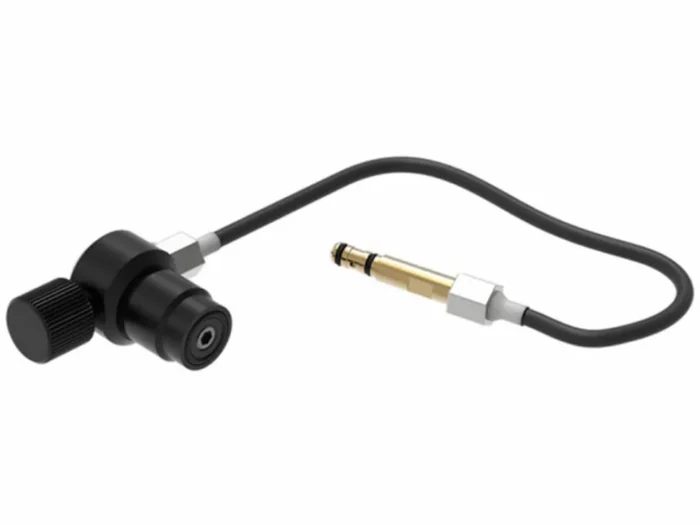
This allows substantial compressed-air storage, although only compatible filling equipment should be used.
The maximum rated pressure should never be exceeded, and the pressure-bearing system should remain free from corrosion, impact damage, or unauthorized modification.
Why External Velocity Adjustment Is Useful
The rifle provides external velocity adjustment through hammer-spring control.
This allows performance to be tailored within the rifle’s intended operating range.
However, maximum velocity is not automatically the most accurate or efficient setting.
A balanced configuration generally prioritizes consistency, appropriate projectile behavior, legal compliance, and sensible air consumption.
How Good Is the Trigger?
The two-stage trigger provides external adjustment.
A predictable trigger can reduce unwanted movement during shot release and improve consistency.
The trigger should remain set within safe manufacturer limits rather than being adjusted excessively light.
Why the AR-Style Grip Matters
The AR15-style grip creates a familiar near-vertical hand position.
This can be comfortable during supported shooting and allows compatible grip options depending on the exact configuration.
Why the Bottle Supports Extended Sessions
One of the strongest reasons to choose the LB rather than the conventional long model is reduced dependence on frequent refilling.
The large reservoir is particularly relevant for shooters who spend extended periods at a range or another lawful shooting location without immediate access to filling equipment.
Where the Rifle Fits Best
The rifle is well suited to precision-oriented recreational shooting, target practice, and other lawful sporting applications where a long barrel and substantial air capacity are desirable.
Its 2.82kg listed weight means it remains relatively manageable despite the 580cc bottle and 520mm barrel.
When the LB Makes More Sense Than the Standard Long Version
The LB makes sense when air capacity is more important than minimizing reservoir size.
Both versions use a 520mm choked barrel and share the same approximate overall length, but the standard long model uses a 285cc cylinder while the LB provides 580cc.
Important Information Before Buying
Before purchasing, confirm the exact calibre, regional power specification, included magazines, fill connector, warranty, optics package, and any accessories.
Also verify local requirements governing airgun ownership, transport, storage, hunting, and pest-control use.
Why the AirMaks Katran LB Is a Strong Long-Format PCP
The AirMaks Katran LB combines a 520mm choked CZ barrel, 580cc 300-bar reservoir, regulated action, external hammer-spring adjustment, ambidextrous side lever, adjustable two-stage trigger, folding aluminium stock, adjustable cheek piece and butt pad, and a 20 MOA optics rail in one platform.
Its defining advantage is the combination of long-barrel precision potential and high air capacity. Consequently, it is particularly attractive to shooters who want extended regulated shooting sessions without moving to the separate higher-power versions of the Katran family.
Air Delivery, Barrel Performance, Trigger Control, Ergonomics, and Long-Term Reliability
Regulated Air Performance
A regulated pre-charged pneumatic system is designed to provide more stable working pressure as the reservoir pressure gradually falls.
This helps reduce unnecessary shot-to-shot variation.
Stable air delivery matters because changes in velocity can alter vertical point of impact, especially over longer distances.
A properly functioning regulator therefore contributes directly to repeatable performance.
Large Reservoir Advantage
A larger air reservoir can support longer shooting sessions between fills.
That is particularly useful when the rifle is used at a range or another lawful location where filling equipment is not immediately available.
However, actual shot count still depends on calibre, power setting, projectile weight, regulator pressure, and the efficiency of the firing cycle.
Pressure Management
The pressure gauge should be monitored during filling and normal use.
The reservoir should never be filled above its approved maximum pressure.
Overfilling does not guarantee better performance and may place unnecessary stress on seals and pressure-bearing components.
A controlled fill using clean, dry compressed air is always preferable.
Air Quality
Clean, dry air helps protect the internal pressure system.
Moisture can contribute to corrosion over time, especially when a rifle is filled repeatedly from poorly maintained equipment.
For that reason, compressors and filling systems should include suitable moisture control and should be maintained correctly.
Fill Port Condition
The fill port should remain clean and undamaged.
Dust, moisture, or damaged sealing surfaces can cause leaks.
The correct connector should always be used.
Forcing an incompatible fitting can damage the fill assembly and create a pressure-related safety concern.
Seal Condition
O-rings and other seals naturally wear over time.
Heat, contamination, repeated pressure cycles, and incorrect lubricants can accelerate deterioration.
A slow pressure loss during storage may be the first sign of a developing leak.
Replacement seals should match the correct specification.
Regulator Stability
The regulator should provide consistent operating pressure throughout the useful portion of the fill.
If velocity begins changing unexpectedly, the regulator should be considered alongside the hammer setting, valve condition, seals, and ammunition.
A properly serviced regulator can support predictable performance for a long time.
Plenum Function
The plenum stores regulated air immediately before the firing cycle.
Its job is to provide a consistent volume of air for each shot.
The relationship between plenum volume, regulator pressure, valve timing, and hammer force influences efficiency and performance.
More air is not automatically better if the rest of the system is not balanced.
Hammer Adjustment
The hammer system influences how much energy is transferred to the valve.
Changing the setting can alter velocity and air consumption.
For most users, the best setup is not necessarily the highest output.
A balanced configuration often produces better consistency, smoother behavior, and improved efficiency.
Shot Efficiency
Efficient air use allows more shots from a single fill.
A rifle operating at unnecessarily high output may consume far more air than needed.
For target use, stable velocity and repeatable accuracy are often more valuable than maximum power.
Shot Consistency
Consistent velocity helps maintain a more predictable trajectory.
If vertical spread increases unexpectedly, air pressure, regulator behavior, ammunition consistency, and mechanical condition should all be checked.
Accuracy problems should be diagnosed methodically rather than by changing several settings at once.
Barrel Quality
The barrel plays a central role in precision.
The bore should remain free from damage, heavy contamination, or corrosion.
Good internal condition supports repeatable projectile guidance.
Aggressive cleaning should be avoided unless there is a clear reason because incorrect tools can damage the bore or muzzle.
Choked Muzzle
A choked muzzle slightly constricts the final section of the barrel.
This can help provide consistent projectile release.
However, practical accuracy still depends on suitable ammunition, stable velocity, optic quality, and shooter technique.
The choke should never be damaged by improper cleaning rods or hard tools.
Crown Condition
The muzzle crown should remain free from dents, scratches, and impact damage.
Because it is the final surface influencing projectile release, even small defects can affect accuracy.
The muzzle should therefore be protected carefully during transport and storage.
Barrel Alignment
The barrel should remain properly aligned with the receiver and optics system.
Any movement can cause point-of-impact changes.
If zero begins shifting unexpectedly, barrel mounting and other mechanical connections should be checked before assuming the optic has failed.
Barrel Support
Long barrels can be more sensitive to accidental side pressure.
Accessories should not press directly against the barrel.
The front structure should support accessories independently so the barrel can remain stable.
Projectile Selection
Different barrels can prefer different projectile designs and weights.
A projectile that performs very well in one rifle may produce average results in another.
Testing several suitable options can reveal which combination produces the smallest and most repeatable groups.
Projectile Condition
Deformed or contaminated projectiles can reduce accuracy.
Skirts, heads, and overall shape should remain consistent.
Ammunition should be stored clean and dry.
Careful handling helps prevent damage before loading.
Magazine Performance
The magazine should rotate smoothly and index correctly.
Damaged springs, cracks, or feeding resistance should be addressed.
If the magazine begins damaging projectiles during loading, group consistency may suffer.
Loading Cycle
The loading mechanism should operate smoothly.
Unusual resistance should never be forced.
A sudden change in lever effort may indicate a damaged projectile, magazine issue, probe problem, or contamination.
The cause should be identified before continued use.
Side-Lever Smoothness
A properly maintained side lever should feel consistent from shot to shot.
Loose fasteners or accumulated dirt can affect operation.
Routine inspection helps keep the action smooth and prevents minor issues from becoming larger problems.
Trigger Feel
A predictable trigger can improve shooting consistency.
The release should feel clean and repeatable rather than excessively light.
A trigger adjusted too aggressively can become unsafe.
Any adjustment should remain within the manufacturer’s intended range.
Trigger Blade Position
The trigger blade should allow a natural finger position.
Good alignment reduces unnecessary sideways pressure during release.
The shooter should not need to twist the wrist or stretch the finger excessively.
Grip Ergonomics
The grip should allow relaxed hand placement.
Excessive tension can introduce movement into the shot.
A comfortable grip also helps the shooter operate the safety and trigger more consistently.
Cheek Support
A correctly adjusted cheek piece helps the shooter achieve the same eye position behind the optic every time.
Repeatable head position improves sight-picture consistency.
The cheek support should be high enough for comfortable alignment but not so high that it forces an unnatural posture.
Butt-Pad Position
The butt pad should sit naturally against the shoulder.
Vertical adjustment can improve alignment from different shooting positions.
Once adjusted, the locking mechanism should remain secure.
Movement during use can reduce consistency.
Stock Length
Correct stock length supports comfortable trigger reach and shoulder position.
If the stock is too long, the shooter may stretch forward.
If it is too short, the body can become cramped.
A suitable setting improves control and reduces fatigue.
Folding Mechanism
The folding hinge should lock securely when extended.
Any looseness should be corrected.
A stable stock is important because movement can affect shoulder position and sight alignment.
The hinge should also remain clean and free from damage.
Optics Rail
The optics rail should remain straight and secure.
Scope mounts should sit flat and tighten evenly.
Loose rail screws or damaged slots can lead to zero shifts.
Fasteners should be checked periodically without excessive tightening.
Scope Mounting
The scope should be mounted with correct eye relief and reticle alignment.
Rings should clamp evenly.
Misaligned mounts can damage the optic tube or create adjustment problems.
A careful installation helps preserve both comfort and accuracy.
Reticle Alignment
A level reticle is especially useful when making elevation corrections.
A canted optic can cause vertical adjustment to introduce horizontal error.
Alignment should therefore be checked carefully during installation.
Parallax Control
Parallax should be adjusted correctly for the shooting distance when the optic provides that feature.
Incorrect parallax can introduce aiming error even when the rifle is stable.
This becomes increasingly noticeable at higher magnification.
Bipod Mounting
A bipod should attach securely to the correct mounting interface.
It should not place pressure directly on the barrel.
Loose mounting hardware can create movement and inconsistent support.
Balance
The rifle’s balance changes with optic size, bipod weight, and other accessories.
A setup that becomes excessively front-heavy can be tiring during longer sessions.
Accessory selection should therefore consider the complete rifle rather than individual components alone.
Supported Shooting
Bench or prone support can help reveal the rifle’s mechanical accuracy.
The rifle should rest consistently on the same areas of the chassis.
Changing support position between groups can introduce variation.
Unsupported Shooting
A lighter and well-balanced setup is often easier to hold without support.
However, personal preference matters.
Some shooters prefer a slightly forward balance because it feels steadier, while others favor quicker handling.
Temperature Effects
Temperature changes can influence compressed-air pressure and seal behavior.
The rifle should not be stored in extreme heat.
Very cold conditions can also change pressure characteristics.
A stable storage environment is preferable.
Moisture Protection
The rifle should be wiped down after use in damp conditions.
Moisture should not be allowed to remain around metal surfaces, fill ports, or pressure fittings.
Good moisture control supports long-term reliability.
Exterior Finish
The external finish should be cleaned with suitable products.
Aggressive solvents can damage coatings, seals, or plastic components.
For routine care, a soft cloth is often sufficient.
Screw Inspection
Repeated use and transport can loosen fasteners.
Stock, rail, grip, and accessory screws should be checked periodically.
Overtightening should be avoided because lightweight components and threads can be damaged.
Leak Detection
Unexpected pressure loss should be investigated.
A slow leak may come from the fill system, gauge, regulator, valve, or seals.
Repeatedly refilling without repairing the cause can waste air and allow the underlying problem to worsen.
Storage
The rifle should be stored unloaded and secured against unauthorized access.
It should be protected from moisture, direct sunlight, excessive heat, and impact.
Local storage requirements should always be followed.
Transport
During transport, the rifle should be unloaded and placed in a protective case.
The barrel, optic, bottle, stock, and controls should be protected from knocks.
Local transportation laws should also be respected.
Routine Cleaning
Routine maintenance should focus on keeping the action, exterior, magazine, and mounting interfaces clean.
The barrel should generally be cleaned when accuracy begins deteriorating or when contamination is suspected.
Excessive cleaning is unnecessary.
Maintenance Records
A simple record of seal replacement, regulator servicing, major adjustments, and accuracy changes can be useful.
Over time, these notes make it easier to identify recurring problems.
Professional Servicing
Work involving pressure-bearing parts, regulators, valves, or internal mechanical components should be handled by a competent technician when specialized knowledge is required.
The air system should never be disassembled while pressurized.
Long-Term Reliability
Long-term reliability depends on clean compressed air, healthy seals, stable regulator operation, a sound barrel, smooth loading components, secure stock hardware, correctly mounted optics, and sensible maintenance.
When the rifle is filled correctly, operated within its intended specifications, stored carefully, and inspected regularly, it can continue to provide consistent air delivery, stable handling, efficient operation, and repeatable precision for many years.
Accuracy Control, Air Management, Handling Balance, Maintenance Planning, and Long-Term Performance
Accuracy Consistency
Reliable accuracy depends on the interaction between the barrel, regulator, trigger, ammunition, optics, and shooting technique.
A rifle can have strong mechanical potential yet still produce inconsistent groups if one of these variables changes between shots.
For that reason, accuracy should be judged through repeated groups under similar conditions rather than through isolated impacts.
Velocity Stability
Stable velocity helps keep vertical dispersion under control.
If shot speed begins changing noticeably, the cause may involve regulator behavior, pressure level, ammunition consistency, seals, or internal tuning.
A systematic approach is more effective than changing several settings at once.
Pressure Awareness
The pressure gauge should be monitored regularly.
The reservoir should remain within the approved operating range.
Filling beyond the stated limit does not automatically improve performance and may increase stress on seals and pressure-bearing components.
Controlled filling with clean, dry air is the better approach.
Air Efficiency
Efficient air use allows more useful shots from each fill.
Higher output settings can consume significantly more air.
For many target applications, a balanced configuration that maintains stable velocity and accuracy is more practical than pushing for maximum output.
Useful Shot Range
The most useful part of a fill is the pressure range where velocity and point of impact remain stable.
Once pressure falls outside that range, consistency may begin to decline.
Keeping simple notes can help the user understand where the rifle performs best.
Regulator Monitoring
A healthy regulator should operate consistently over time.
If unexplained velocity changes or pressure behavior appear, the regulator should be considered along with the valve, hammer system, and seals.
Regular monitoring can reveal developing issues before they become serious.
Seal Performance
Seals should maintain pressure without significant leakage.
O-rings can flatten, harden, or become damaged through age, contamination, incorrect lubrication, or repeated pressure cycles.
Only compatible replacement materials should be used.
Leak Detection
Unexpected pressure loss during storage is an early sign that something may need attention.
Possible areas include the fill fitting, gauge, regulator, valve, and associated seals.
A significant leak should be repaired rather than repeatedly compensated for by refilling.
Barrel Condition
The barrel should remain free from corrosion, heavy fouling, or mechanical damage.
Its internal surface should be treated carefully.
Aggressive cleaning can damage the bore or crown if incorrect tools are used.
Cleaning should therefore be carried out only when needed.
Crown Protection
The muzzle crown should remain protected from impact.
Even minor damage can disturb projectile release and reduce precision.
A padded case and careful handling help prevent accidental contact with hard surfaces.
Barrel Alignment
The barrel should remain properly aligned with the action and optics rail.
Any movement can create point-of-impact changes.
If zero begins shifting unexpectedly, mechanical connections should be checked before assuming the optic itself has failed.
Ammunition Matching
Different projectile designs can behave differently in the same barrel.
Testing several suitable options can help identify the most consistent combination.
The best performer is often the one that groups repeatedly well rather than the one producing the highest velocity.
Projectile Quality
Damaged or inconsistent projectiles can reduce accuracy.
Deformed skirts, uneven heads, contamination, or poor storage can create variation.
Projectiles should remain clean, dry, and protected from unnecessary damage.
Magazine Reliability
The magazine should rotate smoothly and feed consistently.
Cracks, spring problems, or indexing issues can damage projectiles or interrupt loading.
Any unusual resistance should be investigated before the loading mechanism is forced.
Loading Smoothness
The cocking and loading cycle should feel consistent.
A sudden increase in resistance may indicate a magazine problem, damaged projectile, contamination, or probe issue.
Forcing the action can turn a small problem into mechanical damage.
Trigger Control
A predictable trigger supports precise shooting.
The release should be clean and repeatable without becoming excessively light.
Safe operation is more important than chasing the lowest possible pull weight.
Finger Placement
Consistent finger placement can reduce lateral movement during the shot.
The trigger should be reached naturally without forcing the wrist or hand into an awkward position.
Good ergonomics support repeatability.
Grip Comfort
The grip should allow a relaxed hand position.
Excessive tension can move the rifle during release.
A comfortable grip also makes it easier to operate controls consistently.
Cheek Position
Repeatable cheek placement improves sight alignment.
The cheek support should position the eye naturally behind the optic.
The shooter should not need to stretch or tilt the head excessively to obtain a full sight picture.
Butt-Pad Position
The butt pad should sit naturally against the shoulder.
A stable shoulder position helps maintain the same rifle alignment from shot to shot.
Once adjusted, the locking mechanism should remain secure.
Stock Length
Correct stock length improves trigger reach and shoulder comfort.
Too much length can force the shooter forward, while too little can create a cramped position.
A suitable setting reduces fatigue during longer sessions.
Folding Hinge Condition
The folding mechanism should lock firmly when extended.
Any looseness should be corrected because movement can affect shoulder position and sight alignment.
The hinge should also remain clean and free from damage.
Rifle Balance
Balance changes according to optic size, bipod weight, and other accessories.
A front-heavy setup may feel stable on support but can become tiring when held unsupported.
Accessory selection should consider the complete rifle rather than individual components alone.
Bench Stability
A stable bench setup can help reveal the rifle’s true mechanical accuracy.
The support should contact a suitable part of the chassis and should remain consistent between groups.
Changing support position can create variation.
Prone Stability
A correctly mounted bipod can provide useful support from prone.
The attachment should remain secure, and excessive side pressure should be avoided.
Comfortable stock and cheek settings become especially important during longer sessions.
Bipod Security
The mounting interface should be checked periodically.
Loose screws or movement can create inconsistent support.
The bipod should attach to the intended accessory interface rather than directly affecting the barrel.
Optic Mounting
Scope rings should align correctly and clamp evenly.
The optic should not be forced into misaligned mounts.
After installation, all mounting screws should be checked for secure but reasonable torque.
Eye Relief
Correct eye relief improves both comfort and consistency.
The shooter should obtain a full image while maintaining a natural head position.
Poor eye relief can make repeated cheek placement more difficult.
Reticle Alignment
The reticle should remain level when the rifle is held naturally.
A canted scope can introduce horizontal error when elevation adjustments are made.
Careful setup helps preserve predictable point-of-impact changes.
Parallax Control
Parallax should be adjusted for the intended distance when the optic provides that feature.
Incorrect adjustment can introduce aiming error even when the rifle itself is perfectly stable.
This becomes more noticeable at higher magnification.
Zero Stability
A stable zero depends on the optic, mounts, rail, barrel assembly, stock hardware, and ammunition.
If point of impact moves unexpectedly, every mechanical connection should be checked systematically.
Fastener Inspection
Repeated use and transport can loosen screws.
Stock, rail, grip, and accessory fasteners should be checked periodically.
Overtightening should be avoided because lightweight parts and threads can be damaged.
Chassis Condition
The chassis should remain free from cracks, severe wear, or loose sections.
Mounting interfaces should be inspected regularly.
Any structural damage should be assessed before further use.
Accessory Weight
Large optics, bipods, or other accessories can significantly increase total weight.
More equipment does not automatically improve performance.
A simpler setup may provide better balance and handling.
Moisture Control
Moisture should be kept away from the air system and external metal surfaces.
Clean, dry air is preferable for filling.
After use in damp conditions, the exterior should be wiped and allowed to dry appropriately.
Temperature Management
Extreme heat can increase internal air pressure, while very cold conditions can affect pressure and seal behavior.
A stable indoor storage environment is preferable whenever possible.
Exterior Care
The exterior should be cleaned with suitable products.
Aggressive solvents can damage coatings, seals, or synthetic parts.
A soft cloth is usually sufficient for normal maintenance.
Thread Protection
Any unused accessory thread should remain protected.
Damaged threads can make future installation difficult.
Accessories should never be forced onto incompatible threads.
Storage
The rifle should be stored unloaded and secured against unauthorized access.
It should remain protected from direct sunlight, moisture, excessive heat, and impact.
Local storage laws should always be followed.
Transport
During transport, the rifle should be unloaded and placed in a protective case.
The barrel, optic, bottle, stock, and controls should be protected from impact.
Applicable transport rules should also be observed.
Routine Cleaning
Routine maintenance should focus on keeping the action, magazine, exterior, and mounting interfaces clean.
The bore should normally be cleaned when accuracy deteriorates or contamination is suspected.
Unnecessary aggressive cleaning should be avoided.
Magazine Cleaning
The magazine should be kept free from dirt and damaged projectiles.
Its rotation system should continue to operate smoothly.
A small feeding problem can create repeated loading issues if ignored.
Action Maintenance
The loading mechanism should remain clean and smooth.
Excessive oil can attract dust and debris.
Lubrication should therefore be used sparingly and only where appropriate.
Maintenance Records
Keeping notes on seal replacement, pressure behavior, regulator servicing, adjustments, and accuracy changes can be useful.
These records make long-term troubleshooting easier.
Service Planning
Periodic servicing should be based on actual use and condition rather than waiting for complete failure.
Seals, gauges, regulator components, filling systems, and mechanical parts all benefit from timely attention.
Professional Servicing
High-pressure work should be carried out by a competent technician when specialized knowledge or tools are required.
Pressure-bearing components should never be opened while the system is pressurized.
Long-Term Accuracy
Long-term accuracy depends on stable air delivery, consistent ammunition, secure optics, healthy barrel condition, reliable trigger operation, and sensible maintenance.
When one of these factors changes, troubleshooting should be methodical.
Long-Term Ownership
A well-maintained precision pneumatic rifle can remain dependable for many years.
Ownership should include realistic planning for seal replacements, occasional regulator or valve servicing, filling-equipment maintenance, optic care, and ammunition testing.
When the rifle is operated within its intended specifications, supplied with clean dry air, stored correctly, and inspected periodically, it can continue to provide stable handling, efficient air use, consistent shot delivery, and repeatable precision over an extended service life.
Be the first to review “AIRMAKS KATRAN LB”
Related products
Airmaks
Airmaks
Airmaks
Airmaks
Airmaks
Airmaks
Reviews
There are no reviews yet.