
Airmaks Krait Lite
€1,200.00
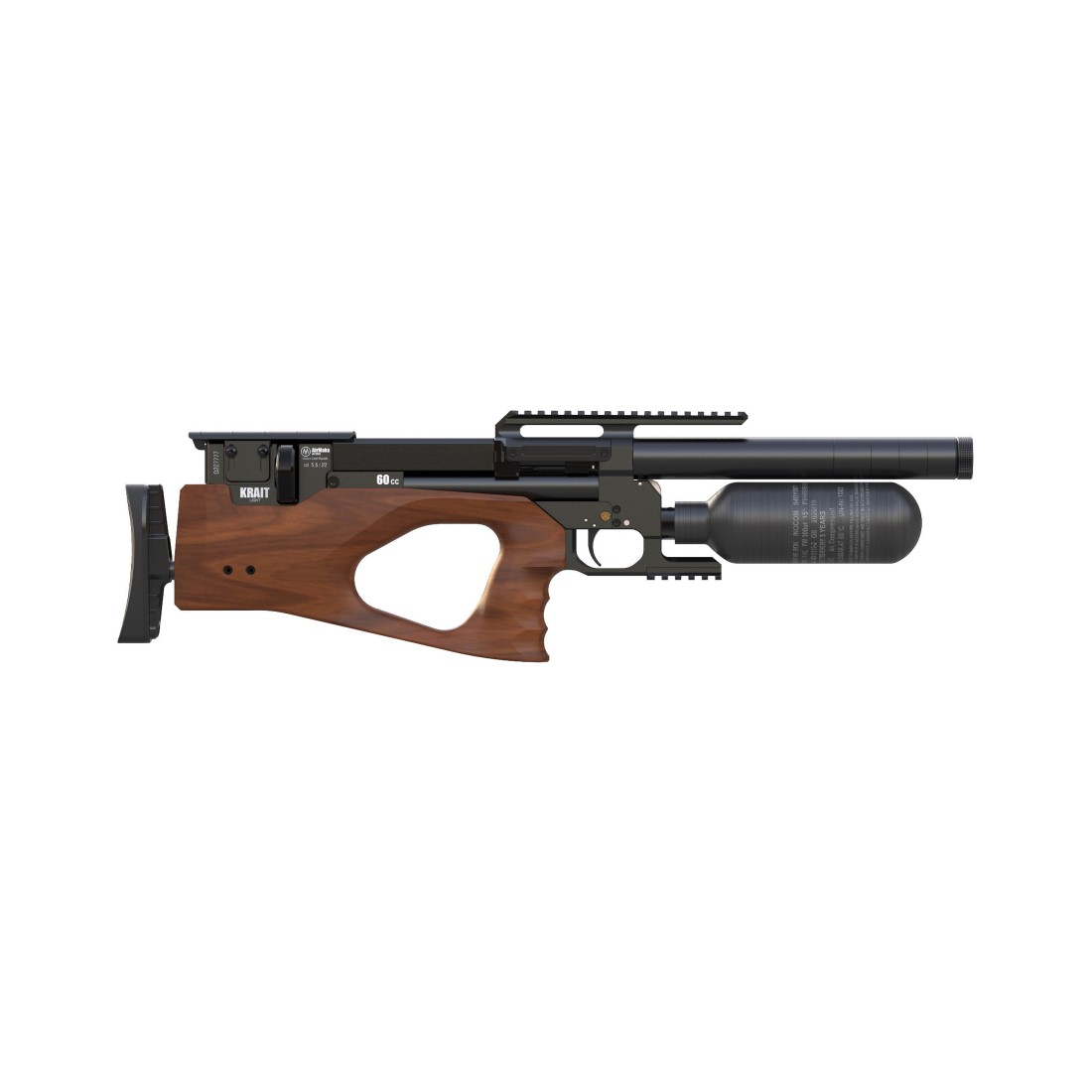
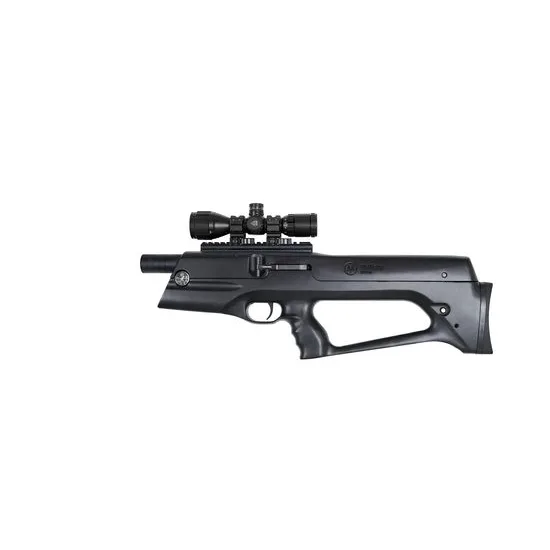
The AirMaks Krait Lite air rifle is designed for those who prioritise lightweight handling and ergonomic comfort. This model features an ergonomic right-hand AR15 grip and a streamlined, compact design that is easy to carry and manoeuvre. It includes a length-adjustable stock with a height-adjustable butt-pad and cheek-piece, ensuring a comfortable fit for any shooter. The AirMaks Krait Lite also boasts a user-friendly easy-cocking side lever, conveniently located near the trigger and capable of switching between right and left sides. It features a two-stage adjustable trigger for precise shooting control.
While the AirMaks Krait Lite focuses on lightweight and simplicity, it maintains the high-quality construction and reliability expected from the AirMaks brand. This model is perfect for those seeking a versatile and easy-to-handle air rifle, without the extra customisation features found in the standard AirMaks Krait or the Krait-T versions.
The Specs:
| Calibre | .177 & .22 |
| Power | <12Ft/lbs |
| Cylinder | 300cc |
| Fill Pressure | 200bar |
| Shots per Fill | 280 shots in .177/ 300 in .22 |
| Magazine Capacity | 18 shots in .177/ 16 shots in .22 |
| Cocking Lever | Side Lever |
| Trigger | Two-staged Trigger |
| Length | 640cm |
| Weight | 2.63kg |
Airmaks Krait Lite – Precision PCP Engineering, Classic Beech Stock and Refined Performance
he Airmaks Krait Lite brings a more traditional character to the modern Krait platform by combining advanced pre-charged pneumatic engineering with an ambidextrous beech stock. Rather than using the predominantly tactical appearance associated with many contemporary PCP rifles, this configuration provides a cleaner, more conventional profile while retaining the adjustable trigger, regulated air system, side-lever operation, Picatinny mounting system, and multi-shot magazine architecture expected from the wider family.
Within the current range, the standard Krait Lite S uses a 400 mm choked barrel, measures approximately 640 mm overall, weighs about 2.63 kg, and carries a 300 cc air supply. Longer and tube-cylinder variants expand the platform further, allowing users to compare different combinations of air capacity, barrel length, dimensions, and overall balance.
What Does PCP Air Rifle Mean?
For anyone asking what does pcp air rifle mean, PCP stands for pre-charged pneumatic. Compressed air is stored inside a reservoir before the rifle is operated. A controlled quantity of that stored air is then released during the firing cycle.
The phrase komprimiran zrak, meaning compressed air, describes this same fundamental operating principle.
Unlike a conventional spring-powered platform, a PCP system does not rely on a large piston moving through the action during every shot. Therefore, internal movement can be reduced, creating the controlled firing characteristics commonly associated with modern AirMaks Arms PCP air rifles.
How Good Is the Airmaks Krait Lite?
One of the strongest characteristics of this platform is the combination of classic stock design and modern mechanical adjustment.
The Lite family uses an ambidextrous beech stock with an adjustable cheek-piece and a butt-pad that can be adjusted for both height and length. The side-lever cocking system can also be changed between the right and left sides, while a two-stage adjustable trigger provides further ergonomic control.
Additionally, the platform incorporates a 20 MOA Picatinny optics rail and a lower accessory rail. Therefore, the rifle retains practical mounting capability without requiring the more extensive side-rail arrangement found on some tactical configurations.
Precision and Barrel Configuration
Precision depends on the interaction between barrel quality, consistent pressure delivery, ammunition, trigger control, optical alignment, and shooter technique.
The shorter Lite configuration uses a 400 mm choked barrel, while the longer Lite L increases barrel length to 520 mm. The Lite L also increases air capacity to 580 cc while maintaining a maximum pressure specification of 300 bar.
The longer version measures approximately 735 mm overall and weighs around 2.9 kg. Magazine capacity varies by calibre, with 18 rounds in .177, 16 in .22, and 14 in .25.
Consequently, shooters can choose between more compact handling or a longer configuration depending on their preferred balance and shooting environment.
Airmaks Katran and Krait Platform Differences
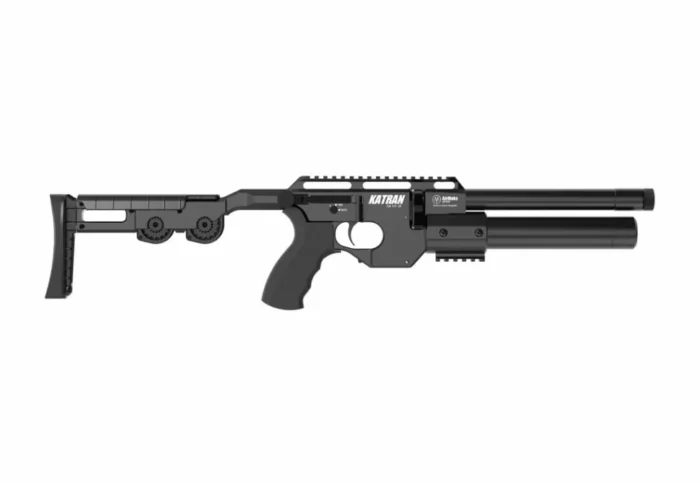
Anyone researching the Lite model may also encounter airmaks katran, katran airmaks, katran, and AirMaks Katran.
Although these platforms come from the same manufacturer, they should not be treated as identical designs. The Katran follows its own chassis architecture, while the Krait family includes tactical, wood-stock, Lite, Pro, and newer MK2 configurations.
Similarly, searches for air max krait and airmaks krait normally refer to the broader Krait family rather than one specific Lite configuration.
Therefore, understanding the exact model designation is important when comparing barrel length, reservoir type, weight, stock design, and adjustment features.
Why Choose the Lite Configuration?
The main reason to consider this configuration is its combination of modern pneumatic technology and traditional ergonomics.
A wooden stock gives the rifle a more conventional appearance, while adjustable cheek and butt-pad positions allow the fit to be refined around different shooters.
Furthermore, several versions are available. The Lite T uses a 200 cc tube cylinder with a 400 mm barrel, measures approximately 640 mm, and weighs about 2.9 kg. Meanwhile, the longer Lite LT uses a 520 mm barrel with a 300 cc tube cylinder and extends to roughly 760 mm overall.
This variety allows users to prioritize compactness, reservoir capacity, tube-cylinder handling, or longer-barrel characteristics.
Air Management and Adjustment
The Lite family incorporates an internal pressure regulator rather than requiring routine external regulator adjustment. On current Lite variants, velocity can still be adjusted through the hammer-spring system, while the valve remains externally adjustable.
This arrangement simplifies the platform compared with configurations offering a greater number of external tuning controls.
Therefore, the design can appeal to users who prefer a regulated system with fewer adjustments to manage during routine use.
Pest-Control Related Searches
People researching compact PCP platforms frequently encounter phrases such as best pellet gun for pest control, pellet gun for pest control, and air rifle for pest control.
Suitability for any such activity depends on local legislation, appropriate calibre, authorized locations, humane practices, and a secure backstop. Responsible use and knowledge of applicable regulations remain essential regardless of the rifle being considered.
Accessories and Supported Shooting
The lower Picatinny rail provides an attachment point for compatible shooting accessories. As a result, users researching supported shooting equipment may encounter products such as the javelin pro hunt tac bipod.
However, mounting compatibility should always be confirmed for the exact accessory and rifle configuration before installation.
AirMaks Arms Brand Search Variations
The correct manufacturer name is AirMaks Arms, although search engines frequently display alternative spellings such as airmaks, airmarks, air marks, ar max, arm max, and max arms.
Likewise, searches involving AirMaks Arms air rifles, AirMaks Arms PCP air rifles, AirMaks Arms PCP rifles, AirMaks Arms for sale, AirMaks Arms shop, and AirMaks Arms USA usually reflect broader brand, availability, and regional research.
The term uramax can also occur in wider airgun keyword datasets, although it is unrelated to the manufacturer’s correct name.
Understanding Unrelated Semantic Search Terms
Broad keyword research occasionally produces phrases such as hamster with gun, hamster with a gun, and hamster holding gun.
These phrases have no technical relationship with the rifle and do not describe any component, feature, accessory, or operating characteristic.
Likewise, repeated searches for air marks, airmaks, and airmaks katran should be interpreted according to their actual search intent rather than treated as technical specifications.
Important Information About the Krait Lite
The key strength of this platform is its balance between classic ergonomics and modern PCP engineering. Depending on the exact version, the family provides 400 mm or 520 mm barrels, bottle or tube reservoirs, capacities ranging from approximately 200 cc to 580 cc, 300-bar maximum pressure, adjustable stock geometry, multi-shot magazines, reversible side-lever operation, regulated air delivery, and standardized optical mounting.
For shooters studying the wider airmaks krait family, the Lite models demonstrate how a precision-oriented pneumatic platform can retain advanced mechanical features while offering the more traditional handling and appearance of a beech-stock rifle.
Engineering Design, Accuracy, Air Management, Ergonomics, and Practical Performance
Refined PCP Engineering
A modern pre-charged pneumatic rifle depends on the precise relationship between its air reservoir, regulator, valve system, hammer mechanism, barrel, trigger, and stock geometry. When these components work together efficiently, the shooter benefits from a smoother firing cycle, predictable handling, and more repeatable performance.
Unlike a traditional spring-powered design, this type of system stores compressed air before use. During each firing cycle, a measured quantity of that stored pressure is released behind the pellet. Because there is no large spring piston moving through the action, internal movement is reduced considerably.
As a result, the firing behavior can feel more controlled. This can make it easier to maintain a stable sight picture and concentrate on trigger technique.
However, mechanical sophistication alone does not guarantee precision. Proper setup, suitable ammunition, stable optics, correct pressure management, and consistent shooting technique all remain essential.
Why Regulated Air Delivery Matters
A regulator helps manage the pressure supplied to the firing system.
As the reservoir is used, its pressure gradually decreases. Without effective regulation, this change could affect pellet velocity from one shot to the next.
A regulated system helps reduce these variations by maintaining a more consistent operating pressure over a useful portion of the fill.
Therefore, the shooter can experience more predictable behavior across repeated groups.
This becomes especially useful during accuracy testing because changes in pellet performance can be evaluated without large pressure fluctuations influencing every result.
Regulation should still be viewed as one part of a larger system. Barrel quality, ammunition, trigger control, environmental conditions, and optic stability all contribute to final performance.
Barrel Quality and Precision Potential
The barrel plays a central role in accuracy.
Its internal rifling guides the pellet and applies rotational stability before the projectile exits the muzzle.
A consistent barrel can help produce repeatable results, but ammunition selection remains equally important.
Pellets that share the same calibre can still differ in weight, head diameter, skirt shape, hardness, and aerodynamic profile.
These small differences may affect how each pellet interacts with the rifling.
Therefore, several suitable pellet types should be tested under similar conditions.
The most dependable results usually come from multiple groups rather than a single impressive target.
Trigger Control and Shot Consistency
A predictable trigger helps the shooter release the shot without disturbing the rifle.
Pressure should build smoothly rather than suddenly.
When the trigger breaks in a consistent manner, the shooter can maintain concentration on the aiming point and avoid unnecessary movement.
A two-stage system can help by creating a clear initial stage followed by a more defined release point.
However, adjustment should always remain within safe limits.
An excessively light trigger is not automatically better.
Control, consistency, and predictable behavior are more important than simply reducing resistance.
Good technique also requires the trigger finger to move independently while the rest of the shooting hand stays relaxed.
Traditional Stock Ergonomics
A well-designed wooden stock can provide a stable and familiar shooting position.
The shape of the grip, cheek area, butt section, and overall balance affects how naturally the rifle fits the shooter.
Adjustability adds further value because different users have different body proportions.
Cheek height influences alignment with the optic.
Butt-pad position affects shoulder contact.
Length adjustment changes trigger reach and overall comfort.
When these features are set correctly, the shooter can achieve a more natural position with less muscular tension.
This becomes particularly important during longer sessions because fatigue can gradually reduce stability.
Balance and Weight Distribution
Overall weight does not completely determine how a rifle feels.
Weight distribution is just as important.
A well-balanced rifle can feel lighter than expected because the mass is positioned close to the shooter’s body.
On the other hand, a front-heavy setup can become tiring during unsupported shooting.
Accessories also influence balance.
A larger optic may raise the center of gravity, while equipment mounted toward the front can shift the weight forward.
Therefore, the complete setup should be considered when evaluating handling.
The goal is to create a configuration that feels stable without becoming unnecessarily heavy.
Magazine Function and Loading
A multi-shot magazine can make repeated shooting more convenient.
However, careful loading remains important.
Pellets should be inserted without damaging their skirts because deformation can affect flight stability.
The magazine should index smoothly and feed each pellet consistently into the barrel.
If the action becomes unusually stiff, the shooter should stop and inspect the system rather than forcing it.
Forced operation can damage ammunition or mechanical components.
During precision testing, some shooters may prefer single loading because it removes the magazine as a possible variable.
Optics and Sight Alignment
A good optic can only perform properly when it is mounted correctly.
The mounting system should remain secure, and the optic should sit at a height that allows a comfortable head position.
Eye relief should also be adjusted so the shooter can obtain a full sight picture without stretching forward or pulling the head backward.
A repeatable cheek position helps maintain consistent alignment.
Once the optic is correctly installed, zero should be confirmed under controlled conditions.
Transport, accessory changes, or changes in ammunition can shift the point of impact, so zero should be checked periodically.
Air Pressure Management
Reservoir pressure should always remain within the manufacturer’s specified range.
Overfilling can place unnecessary stress on seals, valves, fittings, and pressure-related components.
Likewise, allowing pressure to fall below the useful operating range can reduce consistency.
Monitoring pressure throughout a shooting session helps the shooter understand where the rifle performs most predictably.
Charging equipment must also be rated for the required pressure.
Connectors should remain clean, and filling should be performed gradually rather than rushed.
This reduces unnecessary heat buildup and makes it easier to monitor the gauge.
Practical Accuracy in Real Conditions
Real-world performance depends on more than mechanical specifications.
Wind, temperature, shooting position, fatigue, lighting, and ammunition quality can all influence group size.
Outdoor conditions are especially important.
A crosswind can move a pellet sideways, while changing gusts can cause horizontal spread.
Temperature may influence pressure behavior, and unstable surfaces can change the shooter’s position.
Therefore, practical accuracy should be evaluated across several sessions.
One poor group does not automatically indicate a mechanical problem.
Likewise, one exceptional group does not prove perfect consistency.
Long-Term Performance
Reliable performance is preserved through careful maintenance and regular observation.
External surfaces should be kept clean and dry.
Visible fasteners, optic mounts, magazines, and seals should be checked periodically.
Excessive lubrication should be avoided because high-pressure pneumatic systems require appropriate products.
Internal pressure-related components should not be dismantled casually.
Ultimately, long-term consistency depends on good engineering working together with correct setup, careful ammunition selection, safe pressure management, stable ergonomics, regular inspection, and disciplined shooting technique.
Accuracy Development, Shooting Technique, Setup Refinement, and Consistent Performance
Developing Accuracy Through Repeatable Technique
Consistent accuracy is built through repetition, control, and careful observation. A well-designed pneumatic rifle can provide a stable mechanical foundation, but the shooter still determines how effectively that potential is used.
The same shoulder position, cheek contact, grip pressure, breathing pattern, trigger movement, and follow-through should be repeated as closely as possible from one shot to the next. Small changes in body position can shift the sight picture or move the rifle during the firing cycle.
Therefore, accuracy development should not be judged from one target alone. Several groups fired under similar conditions give a much clearer picture of actual performance.
Establishing a Stable Shooting Position
A stable shooting position reduces unnecessary movement and makes it easier to identify whether inconsistencies come from technique or equipment.
When using a bench or supported position, the rifle should rest naturally rather than being forced into alignment. Excessive pressure against a support can change the point of impact and reduce repeatability.
The body should also remain relaxed. If the shooter has to use constant muscular effort to keep the sights on target, fatigue will gradually affect performance.
Natural alignment is therefore important. The rifle should settle toward the intended aiming point with minimal correction.
Cheek Position and Eye Alignment
Consistent cheek placement helps maintain the same relationship between the eye and the optic.
If the head moves higher, lower, forward, or backward between shots, the sight picture may change.
A repeatable cheek position allows the shooter to look through the optic naturally without searching for the correct image every time.
This becomes especially important during longer sessions because small positioning errors can accumulate as fatigue increases.
Comfortable alignment also reduces neck strain and helps the shooter maintain concentration.
Trigger Technique and Controlled Release
Trigger technique has a direct effect on precision.
Pressure should be applied smoothly and progressively.
The shooter should avoid pulling the trigger sideways because lateral movement can shift the rifle away from the intended point of aim.
A relaxed shooting hand can help reduce this problem.
The trigger finger should move independently while the other fingers maintain a consistent but comfortable grip.
Once the shot is released, the shooter should maintain the same position briefly instead of immediately lifting the head or moving the rifle.
This follow-through helps preserve stability throughout the complete firing cycle.
Why Ammunition Testing Matters
Different pellets can behave differently even when they share the same calibre.
Weight, head diameter, skirt shape, material hardness, and aerodynamic profile can all influence performance.
For this reason, ammunition should be tested systematically.
One pellet type should be used across several groups before another is introduced.
The same distance, pressure range, optic setting, rest, and shooting position should be maintained during the comparison.
Changing multiple variables at once makes it difficult to understand what actually improved or reduced accuracy.
Careful inspection is also useful.
Pellets with damaged skirts or obvious deformation should generally be excluded from serious accuracy testing because they can produce unexplained flyers.
Evaluating Group Size Correctly
Group size is one of the most useful indicators of repeatability.
A tight cluster shows that multiple shots are landing close together.
However, one unusually good group should not be treated as proof of consistent performance.
Several groups should be compared before conclusions are made.
Average performance matters more than the single best result.
It is also important to distinguish between precision and zero.
A tight group positioned away from the center may indicate good precision with an incorrect sight setting.
A wide group spread around the center indicates weaker consistency even if the average point of impact appears correct.
Zeroing the Optic
A secure and correctly positioned optic is essential for meaningful accuracy testing.
Before zeroing, the mounts should be checked for movement.
The optic should also provide a full sight picture without forcing the shooter into an uncomfortable head position.
Once the initial zero is established, several confirmation groups should be fired.
This helps ensure that the setting is repeatable.
A change in ammunition may alter the trajectory, so the zero should be checked again after switching pellet types.
Transport can also affect mounting hardware, making periodic confirmation worthwhile.
Managing Reservoir Pressure During Testing
Pressure management should remain consistent during accuracy evaluation.
A regulated system is intended to help control changes in working pressure, but performance can still change when reservoir pressure falls outside the preferred operating range.
Recording pressure at the beginning and end of a group can help identify where the rifle performs most consistently.
Over time, these observations create a practical understanding of the usable pressure window.
The reservoir should always remain within the manufacturer’s stated limits.
Filling should also be performed with properly rated equipment and clean connectors.
Environmental Factors and Outdoor Shooting
Outdoor conditions can affect pellet flight considerably.
Wind is one of the most important variables.
A crosswind can move a pellet sideways, while changing gusts can cause horizontal spread within a group.
The effect becomes more noticeable as distance increases.
Temperature can also influence pressure behavior and the way equipment performs.
Lighting conditions may affect target visibility through the optic.
Uneven ground can change body position.
Therefore, outdoor accuracy should always be interpreted according to the conditions present during the session.
Managing Accessories and Overall Balance
Every accessory changes the way the rifle feels.
A larger optic can increase weight high above the action, while front-mounted equipment can make the rifle feel more nose-heavy.
This does not automatically reduce performance, but the shooter should evaluate whether each accessory genuinely improves the setup.
Unnecessary equipment can add weight without providing practical value.
A simpler configuration may feel more balanced and easier to control.
The ideal setup is usually one that provides the required function without compromising comfort or stability.
Recognizing Changes in Performance
A sudden increase in group size does not always mean that the rifle requires major adjustment.
Simple causes should be checked first.
The optic mounts may have shifted.
The ammunition may be inconsistent.
The magazine may not be feeding smoothly.
The barrel may require inspection.
The shooter may also be fatigued or dealing with changing wind conditions.
A methodical approach is more effective than immediately changing internal settings.
By eliminating one possible cause at a time, the source of the problem becomes easier to identify.
Keeping Useful Shooting Records
Basic records can make long-term accuracy development more systematic.
Useful information may include shooting distance, pellet type, reservoir pressure, weather conditions, group size, and any changes made to the setup.
These notes can reveal patterns that are difficult to remember after several sessions.
For example, one pellet may consistently perform better at a certain distance, or accuracy may begin to change once pressure drops below a particular level.
Recording these details helps replace guesswork with practical evidence.
Building Long-Term Consistency
Reliable performance develops through familiarity.
As the shooter gains experience, the normal trigger feel, balance, pressure behavior, and sight picture become easier to recognize.
This familiarity makes unusual changes more obvious.
It also reduces unnecessary adjustments because the shooter understands what normal performance looks like.
Ultimately, dependable accuracy comes from combining mechanical consistency with disciplined technique, stable body position, careful ammunition testing, correct optic setup, sensible pressure management, and regular observation.
The equipment provides the potential, but repeatable technique is what turns that potential into consistent results.
Reliability, Maintenance, Storage, Safety, and Long-Term Ownership
Long-Term Reliability
A precision pneumatic rifle is expected to perform consistently across repeated shooting sessions, but dependable performance depends heavily on care, storage, inspection, and correct pressure management. Mechanical quality provides the foundation, while good ownership habits help preserve that quality over time.
Several components deserve regular attention. These include the air reservoir, seals, regulator, trigger assembly, barrel, magazine, stock hardware, optic mounts, and filling connections.
Small changes should not be ignored. Unusual pressure loss, a different trigger feel, shifting point of impact, inconsistent cycling, or unexpected noise can indicate that inspection is required.
For that reason, owners should become familiar with how the rifle normally behaves. Familiarity makes it easier to notice minor changes before they develop into larger reliability problems.
Why Preventive Maintenance Matters
Preventive maintenance protects both mechanical performance and long-term durability.
Dust, moisture, loose screws, worn seals, and contaminated filling connectors may gradually affect operation. In many cases, these issues develop slowly, which means they may go unnoticed until accuracy or consistency begins to decline.
External metal surfaces should be wiped after use, especially when the rifle has been exposed to damp conditions.
The stock should also be inspected for scratches, moisture, or loose fittings.
However, maintenance should remain sensible. Constant disassembly is not necessary and may create additional wear if performed incorrectly.
A careful inspection routine is usually more valuable than unnecessary mechanical intervention.
Barrel Care and Cleaning
The barrel directly influences pellet stability and group consistency, so it should be treated carefully.
Frequent aggressive cleaning is not always required.
If grouping remains stable and no contamination is suspected, repeated cleaning may provide little benefit.
When cleaning becomes necessary, suitable tools should be used to avoid damaging the internal rifling or muzzle crown.
The crown is particularly important because it influences how the pellet leaves the barrel.
Damage in this area can affect consistency even when the rest of the barrel remains in good condition.
Therefore, cleaning should focus on preserving the barrel rather than making it excessively polished.
Pressure System Inspection
The pressure system is one of the most important areas of the rifle.
The reservoir, valve, regulator, seals, fittings, and gauge all operate under substantial pressure.
For this reason, owners should never exceed the manufacturer’s stated filling limit.
Overfilling can place unnecessary stress on pressure-related components.
The pressure gauge should also be observed during storage and use.
A gradual pressure drop over a long period may be normal in some circumstances, but rapid or unexplained pressure loss should be investigated.
Internal high-pressure components should not be dismantled casually.
If servicing is required, correct procedures and suitable technical knowledge are essential.
Safe Filling Practices
Charging should always be performed with equipment rated for the required pressure.
The filling connector should be clean before connection.
Dust or debris entering the system may damage seals or affect valve performance.
Filling should generally be carried out gradually.
Rapid pressurization can generate heat and place unnecessary stress on components.
A controlled fill also gives the owner more time to monitor the gauge and stop at the correct pressure.
After filling, the connection should be released according to the proper procedure before the hose is removed.
Attention during this process helps reduce unnecessary wear and improves safety.
Proper Storage
Storage conditions can have a major effect on long-term condition.
The rifle should be kept in a dry, secure environment away from excessive humidity, extreme heat, and unnecessary physical impact.
If it has been used outdoors in wet conditions, visible moisture should be removed before storage.
Placing damp equipment directly inside a closed case can trap moisture around metal components.
A protective case can still be useful during transport and storage because it reduces the risk of scratches, knocks, and optic damage.
However, the rifle should be clean and dry before being enclosed for extended periods.
Protecting the Wooden Stock
A wooden stock requires slightly different care from synthetic or metal chassis systems.
Moisture, excessive heat, and prolonged exposure to direct sunlight can affect the finish and, in extreme cases, the wood itself.
The stock should be wiped gently after handling or outdoor use.
Strong household cleaning products should be avoided because they may damage the finish.
Likewise, the rifle should not be stored against heaters or inside extremely hot vehicles.
Stable storage conditions help preserve both appearance and structural integrity.
Optic and Mounting Checks
The optic should be inspected regularly because even a small amount of movement can change the point of impact.
Mounts should remain secure, and the optic should stay in the same position relative to the rifle.
However, screws should not be tightened excessively.
Over-tightening can damage threads, mounts, or optic tubes.
If zero changes unexpectedly, the mounting system should be checked before assuming that the barrel or air system has developed a problem.
This simple inspection can prevent unnecessary adjustments.
Magazine Maintenance
The magazine should operate smoothly and consistently.
Dust, pellet fragments, or damaged components can interfere with indexing.
If the magazine begins to feel stiff or irregular, it should be inspected rather than forced.
Pellets should also be loaded carefully.
Damaged skirts may affect flight stability and can occasionally create feeding problems.
Keeping magazines clean and protected during storage helps maintain reliable operation.
Environmental Conditions
Temperature can influence both air pressure and material behavior.
Very high temperatures may increase reservoir pressure, while cold conditions can affect seals and overall pressure behavior.
For this reason, a filled rifle should not be left inside a hot vehicle or exposed to strong sunlight for long periods.
Rain and humidity also require attention.
Temporary exposure does not automatically cause damage, but the rifle should be dried carefully afterward.
Environmental awareness therefore contributes directly to long-term reliability.
Transport and Protection
Transport should be planned carefully.
The rifle should be unloaded and secured so that it cannot move freely during travel.
A protective case can reduce impact, vibration, and optic movement.
Local regulations may also specify how pneumatic rifles must be transported.
Because these requirements differ between regions, owners should confirm the rules that apply where they live or travel.
Responsible transport protects both the equipment and the people around it.
Safe Handling Habits
Safe handling should remain consistent at all times.
The muzzle should always point in a safe direction.
The trigger should remain untouched until the shooter is ready to fire.
Before cleaning, transporting, storing, or handing the rifle to another person, its condition should be checked.
A mechanical safety can provide additional protection, but it should never replace correct handling habits. Airmaks Krait Lite
Muzzle discipline and trigger discipline remain essential regardless of whether the rifle is believed to be loaded.
Choosing a Suitable Shooting Environment
A suitable shooting area requires a secure backstop and a clear understanding of what lies beyond the target Airmaks Krait Lite.
Open space alone does not automatically make a location safe Airmaks Krait Lite.
Pellets can travel farther than inexperienced users may expect Airmaks Krait Lite.
Approved ranges provide controlled firing directions and properly arranged target areas Airmaks Krait Lite.
Private land may also be suitable where local law allows it and the owner has provided permission Airmaks Krait Lite.
People, animals, roads, buildings, and neighboring property should never be placed within the possible line of fire.
Building a Reliable Ownership Routine
A consistent routine makes long-term ownership easier.
Before shooting, pressure can be checked, the optic inspected, the magazine tested, and the shooting area confirmed safe.
During use, any unusual mechanical behavior should be noted.
Afterward, the rifle can be inspected, wiped clean when necessary, and stored properly.
This approach helps identify minor issues before they affect performance.
Ultimately, long-term reliability depends on the combination of proper maintenance, safe charging, correct storage, careful handling, stable optics, regular inspection, and disciplined use.
Good engineering creates performance potential, while responsible ownership helps preserve that potential over many shooting sessions.
Be the first to review “Airmaks Krait Lite”
Related products
Airmaks
Airmaks
Airmaks
Airmaks
Airmaks

Airmaks
Airmaks
Reviews
There are no reviews yet.