
Airmaks Krait Air Rifle
€1,050.00
Introducing the Airmaks Krait – Unleash the Power in Style!
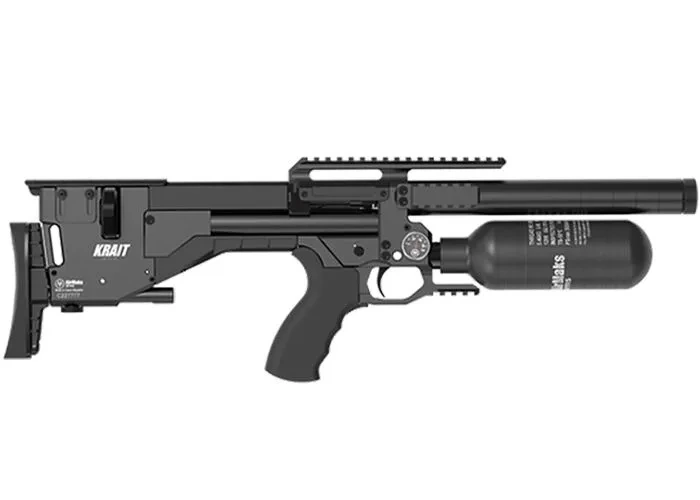
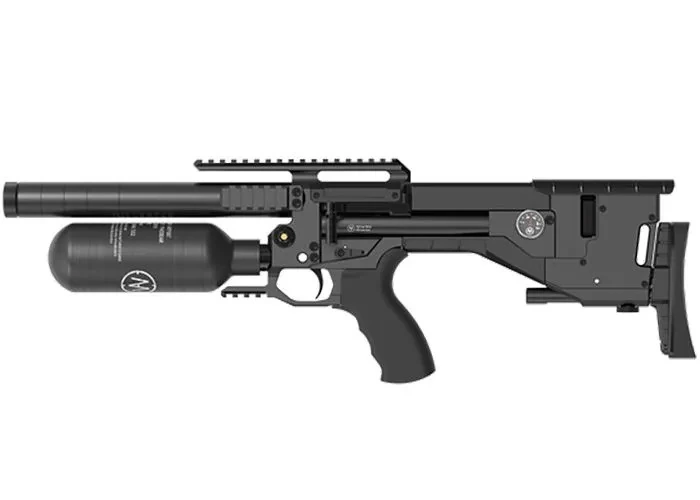
Behold the Airmaks Krait, a compact variant that redefines lightweight comfort in a sleek bullpup configuration, accompanied by an array of convenient features. Say farewell to the hassle of de-gassing the gun for regulator adjustments, as this masterpiece offers seamless tuning. The .22 (5.5 mm) variant boasts an ingenious anti-double feed system, while the reversible side lever caters to your every need.
Wrapped in an ergonomically formed, rubber AR15 grip, this rifle ensures a firm hold, molding to your hand like a custom fit. Embrace versatility as both right-handed and left-handed shooters find solace in its design. With an easily adjustable stock length and vertically customizable butt pad, achieving the perfect shooting stance is a breeze. The cheek piece, too, bows to your wishes, offering height and angle adjustments with simplicity.
The allure continues with a reversible side lever, crafted to glide effortlessly, gracefully cocking the rifle. The barrel dons a fluted shroud, complemented by a muzzle equipped with removable silencer modules and a ½ UNF thread, accompanied by a thread protector for swift silencer attachment. Revel in the possibilities with four Weaver/Picatinny rails – two on the sides, one for bipods ahead of the trigger guard, and one canted forward at an angle of 20 MOA, elevating your rifle scope’s vertical adjustment range.
The Airmaks Krait system boasts a 60 cc plenum, a reservoir of power that knows no bounds. With the regulator’s external adjustability, you need not part with your airgun’s air. Unlock the true potential as the extended stock reveals the set screw for the hammer spring, controlled with an allen/inbus key, empowering you to fine-tune the Krait’s power output at will.
The Airmaks Krait – where power and style intertwine, offering a symphony of elegance and performance. Prepare to embark on a journey of precision, tailored to your desires, as you leave your mark with unparalleled shooting excellence!
This item can only be sold to persons 18 years and older.
For this item we have to carry out an age check.
You can upload a copy/scan/photo of a legal identification document such as a passport, European ID or driver’s license in the order. Parts of the document may be made illegible or designated as a copy. However, your name, document number and place of issue must be legible. Your copy ID will only be used for verification purposes and will not be retained. If you are not able to upload it right now, we will contact you per email before shipping
We can ship these items only to the countries listed below:
Belgium Bulgaria Cyprus Czechia Denmark Estonia Finland France Germany Greece Hungary Ireland Italy Kroatia Latvia Lithuania Luxembourg Monaco Netherlands Poland Portugal Romania Slovakia Slovenia Spain Austria Sweden United States
Specifications
| Brand | Airmaks |
|---|---|
| Model | .22 / 5,5, .25 / 6,35 |
| Cocking system | Side lever |
| Magazine capacity | 14 (.25), 16 (.22), 18 (.177) |
| Weight (gram) | 2500 |
| Barrel length (mm) | 400 |
| Length (mm) | 605 |
| Mounting base | Weaver / Picatinny |
| Rifle Stock Type | Ambidextrous |
| Stock material | Aluminum |
| Extra accessories included |
Case, Fill probe, Magazine, O-ring kit |
Airmaks Krait Air Rifle – Precision PCP Engineering, Compact Performance and Advanced Adjustability
The airmaks krait represents AirMaks Arms’ compact, precision-focused approach to modern pre-charged pneumatic rifle engineering. Designed around a bullpup configuration, the platform brings the action behind the trigger to reduce overall length without forcing the manufacturer to use an unusually short barrel. Consequently, the rifle combines maneuverable dimensions with the barrel length, air capacity, adjustability, and stability expected from a serious PCP platform.
People occasionally search for the same product using variations such as air max krait, while broader brand searches may include airmaks, airmarks, air marks, ar max, arm max, or max arms. However, AirMaks Arms is the correct manufacturer name. The Krait family now covers numerous configurations, ranging from compact 400 mm-barrel versions to 520 mm long models and specialized 700 mm variants.
What Does PCP Air Rifle Mean?
For shooters asking what does pcp air rifle mean, PCP means pre-charged pneumatic. Compressed air is stored inside a high-pressure reservoir and released through the firing system in controlled quantities.
The term komprimiran zrak also refers to compressed air and therefore describes the fundamental energy source behind this type of rifle. Unlike a traditional spring-powered mechanism, the system does not depend on a heavy piston moving through the action during every firing cycle. This characteristic contributes to the controlled behavior associated with many modern AirMaks Arms PCP air rifles.
How Good Is the Airmaks Krait?
The Krait family emphasizes adjustability. On the standard Krait S, AirMaks specifies an externally adjustable pressure regulator, externally adjustable valve, hammer-spring velocity adjustment, two-stage trigger, adjustable cheekpiece, adjustable butt-pad, and interchangeable right- or left-side cocking lever. It also uses a 20 MOA Picatinny optics rail and additional accessory rails.
The standard Krait S measures approximately 610 mm overall, weighs about 2.5 kg, carries a 300 cc cylinder rated to 300 bar, and uses a 400 mm choked barrel. It is offered in .177, .22, and .25 configurations. Magazine capacities vary by calibre, including 18 shots in .177, 16 in .22, and 14 in .25.
Why Precision Is Important
Precision comes from the interaction between barrel quality, regulator consistency, trigger control, pellet selection, pressure management, optic stability, and shooter technique. Therefore, one specification should never be viewed as the sole measure of accuracy.
The longer Krait L, for example, uses a 520 mm choked barrel, a 580 cc air cylinder, and the same 300-bar maximum pressure rating while maintaining a relatively compact 705 mm overall length. This variation illustrates how the platform can be configured around different handling and precision requirements.
Airmaks Katran and Krait Differences
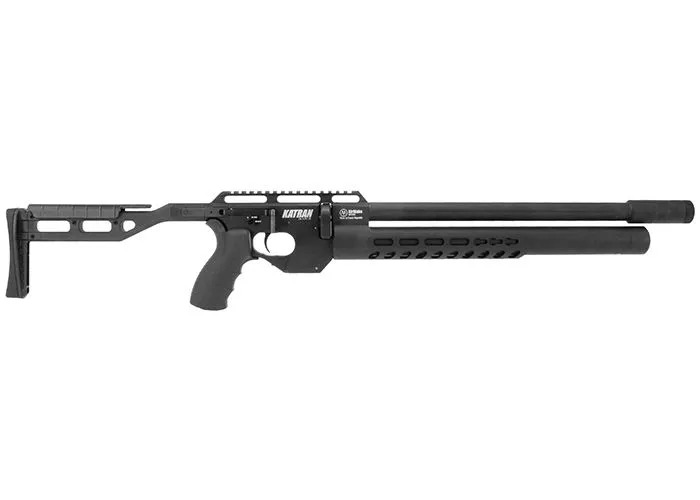
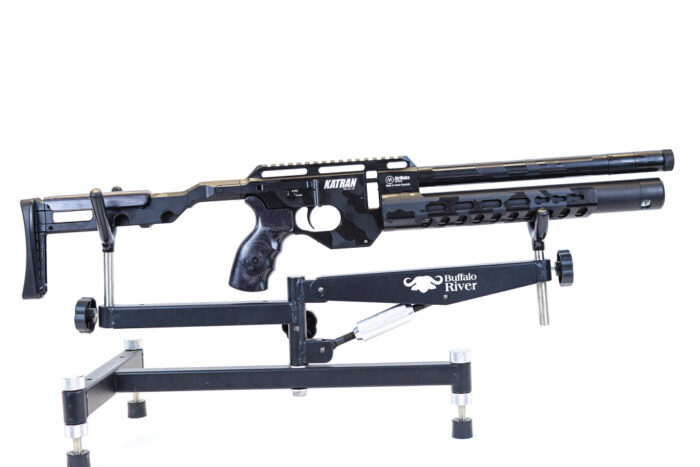
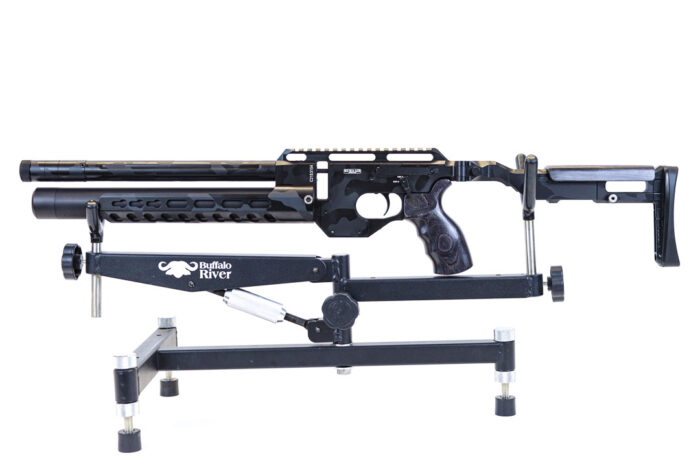
Anyone researching the Krait will frequently encounter the airmaks katran, katran airmaks, katran, and AirMaks Katran. These names belong to another major AirMaks platform rather than being alternate names for the Krait.
Both platforms form part of the wider range of AirMaks Arms air rifles and AirMaks Arms PCP rifles, although their chassis designs, air systems, dimensions, ergonomics, and available configurations differ.
Therefore, searches for airmaks katran and airmaks krait should be treated as separate product research categories.
Where and When the Krait Design Makes Sense
Compact dimensions can make a bullpup platform practical where maneuverability and efficient overall length matter. At the same time, longer Krait versions provide additional barrel and reservoir capacity for users whose priority is a more substantial platform.
For example, the Krait X HP uses a 700 mm barrel, 700 cc cylinder, 885 mm overall length, and .22, .25, or .30 calibre options. By comparison, the compact standard rifle remains significantly shorter.
Supported shooting accessories may also be researched alongside the platform. A term such as javelin pro hunt tac bipod can appear when shooters investigate stable supported positions, although mounting compatibility should always be confirmed for the specific configuration.
Pest-Control Related Searches
Search phrases such as best pellet gun for pest control, pellet gun for pest control, and air rifle for pest control regularly overlap with PCP research. Appropriate use depends on local laws, authorized locations, suitable backstops, humane standards, calibre restrictions, and responsible shooting practices.
AirMaks Arms Availability and Brand Searches
Online research frequently includes phrases such as AirMaks Arms for sale, AirMaks Arms shop, and AirMaks Arms USA. These terms generally reflect people researching regional availability rather than different rifle models.
Likewise, AirMaks Arms PCP air rifles, AirMaks Arms PCP rifles, AirMaks Arms air rifles, AirMaks Katran, and air max krait represent common ways users explore the manufacturer’s wider product ecosystem.
The unrelated term uramax can occasionally appear within broad airgun keyword data but should not be interpreted as another name for AirMaks Arms.
Understanding Unrelated Search Phrases
Some keyword databases can also produce unusual phrases such as hamster with gun, hamster with a gun, and hamster holding gun. These terms have no engineering connection to the Krait and should not be mistaken for product specifications.
Similarly, spellings such as airmarks, air marks, and repeated searches for airmaks often reflect typing variations rather than different manufacturers.
Important Information About the Krait Platform
What makes the Krait technically noteworthy is its combination of compact architecture and extensive external adjustment. Depending on the version, the family provides 400 mm, 520 mm, or 700 mm barrel configurations, multiple reservoir capacities, adjustable regulators, configurable stocks, multi-shot magazines, ambidextrous controls, and several accessory-mounting solutions. The newer MK2 range also introduces revised configurations, including carbon-fiber air bottles and external hammer-spring adjustment.
For precision-oriented users studying modern PCP engineering, these characteristics explain why the Krait has developed into a broad family rather than remaining a single fixed configuration.
Engineering, Accuracy, Handling, Air Management, and Real-World Performance
Advanced PCP Engineering
Modern pre-charged pneumatic rifle design depends on precise coordination between the air reservoir, regulator, valve, hammer system, barrel, trigger, and stock geometry. When these components operate together correctly, the shooter receives a smoother firing cycle and more consistent performance across a useful portion of the air fill.
Unlike a spring-powered rifle, a PCP system stores compressed air before use. During each firing cycle, a controlled volume of that stored air is released behind the pellet. Because there is no heavy spring piston accelerating forward inside the action, internal movement is reduced considerably. As a result, the shooter can maintain a more stable sight picture and experience a predictable firing response.
However, mechanical sophistication alone does not guarantee accuracy. Proper setup, suitable pellets, stable optics, correct pressure management, and disciplined shooting technique remain essential.
Regulated Air Delivery and Shot Consistency
A regulator is one of the most important components in a precision-oriented PCP system. Reservoir pressure changes as the rifle is used, but the regulator helps provide the firing valve with a more consistent working pressure.
Consequently, pellet velocity can remain relatively stable throughout the useful portion of the fill. This consistency is particularly valuable when shooting repeated groups because large velocity variations can change the pellet’s trajectory and point of impact.
Regulation also makes testing more meaningful. When the air system behaves consistently, the shooter can better evaluate differences between pellet weights, pellet shapes, optic settings, and shooting positions.
A properly functioning regulator should therefore be viewed as part of a complete accuracy system rather than simply an isolated mechanical feature.
Barrel Design and Precision Potential
The barrel plays a central role in determining the rifle’s precision potential. Rifling engages the pellet as it travels through the bore, creating rotational stability before the projectile exits the muzzle.
However, not every pellet will interact with a barrel in exactly the same way. Small differences in diameter, skirt design, head shape, weight, and manufacturing consistency may affect grouping.
For this reason, pellet testing remains important. A shooter may discover that one pellet produces excellent groups while another performs less consistently, even when both are technically suitable for the calibre.
The condition of the barrel also matters. Excessive fouling, damaged rifling, or improper cleaning techniques can affect accuracy. Therefore, barrel maintenance should be performed carefully and only with suitable equipment.
Why Trigger Quality Matters
A good trigger allows the shooter to release the shot without disturbing the rifle’s alignment. When trigger movement is predictable, pressure can be applied gradually while the aiming point remains stable.
Heavy, inconsistent, or abrupt trigger movement can cause the rifle to shift at the exact moment the shot is released. Even small movements can become significant when shooting at small targets or longer distances.
A two-stage trigger can help provide a defined first stage followed by a more predictable release point. However, trigger adjustment should always remain within safe manufacturer recommendations.
The shooter’s technique remains equally important. Smooth finger pressure, correct hand placement, and consistent follow-through contribute significantly to repeatable accuracy.
Ergonomics and Shooter Comfort
Ergonomics affect both comfort and precision. A rifle that fits the shooter naturally is easier to hold consistently during repeated sessions.
Cheek position influences alignment with the optic. Butt-pad placement affects shoulder contact and overall stability. Grip angle changes wrist position, while trigger reach determines whether the index finger can engage the trigger comfortably.
When these elements can be adjusted, the shooter can create a more natural firing position rather than forcing the body to adapt to a fixed stock.
This becomes especially valuable during longer sessions. Excessive muscle tension can lead to fatigue, and fatigue often causes inconsistent positioning. Therefore, good ergonomics contribute indirectly to accuracy by reducing unnecessary physical effort.
Balance and Compact Handling
Overall dimensions do not tell the complete story of how a rifle feels. Weight distribution is equally important.
A compact design can keep much of the rifle’s mass close to the shooter’s body. This may improve maneuverability and reduce the leverage created by a long, front-heavy configuration.
However, different shooters may prefer different balance characteristics. Some appreciate a slightly forward-weighted feel because it can create stability from supported positions. Others prefer a more neutral balance for easier movement and quicker repositioning.
The ideal configuration therefore depends on shooting style, body size, optic weight, accessory selection, and intended use.
Magazine System and Practical Operation
A multi-shot magazine can make repeated shooting more convenient because the shooter does not need to manually insert a pellet into the breech after every shot.
Smooth magazine indexing is important because each pellet should enter the barrel consistently. The magazine should also be loaded correctly to avoid pellet deformation.
Damaged pellet skirts can negatively affect aerodynamics and accuracy. Therefore, pellets should be handled carefully when loading the magazine.
Some shooters may also prefer a single-shot loading system during precision testing. Loading one pellet at a time allows the shooter to inspect each pellet more carefully and can help eliminate magazine-related variables when evaluating group size.
Optics and Sight Alignment
A precision rifle requires a correctly installed optic if consistent aiming is expected.
The scope mount should remain secure, and the optic should be positioned so the shooter can achieve a comfortable eye position without excessive head movement.
Correct eye relief reduces the need to reposition the head between shots. Likewise, a stable cheek position helps the shooter maintain consistent alignment with the optical axis.
Zeroing should be performed under controlled conditions whenever possible. Once a reliable zero has been established, changes caused by wind, distance, pellet selection, or environmental conditions become easier to evaluate.
Pressure Management and Filling Safety
High-pressure air requires careful handling. Only properly rated filling equipment should be used, and reservoir pressure should never exceed the manufacturer’s specified limit.
Filling should generally be performed gradually because rapid pressurization can generate heat and place unnecessary stress on components.
Connections should also be inspected before charging. Damaged seals, worn fittings, or contaminated connectors should not be ignored.
The pressure gauge provides important information about the remaining air supply, but shooters should still understand the rifle’s usable pressure range rather than simply filling to maximum pressure every time.
Real-World Accuracy Factors
Laboratory specifications cannot account for every condition encountered during actual shooting.
Wind can move pellets laterally. Temperature can influence air pressure and pellet behavior. Shooter fatigue can change grip consistency, while unstable rests can alter point of impact.
Therefore, real-world precision depends on both mechanical performance and environmental awareness.
A rifle that produces excellent groups indoors may behave differently outdoors because of wind and changing atmospheric conditions. Understanding these variables helps the shooter distinguish between mechanical inconsistency and environmental influence.
Maintenance and Long-Term Reliability
Regular inspection helps preserve reliable operation. External metal surfaces should be kept clean and dry, while seals, magazines, fasteners, and mounting points should be checked periodically.
Over-tightening screws should be avoided because unnecessary force may damage threads or components.
Internal high-pressure components should not be dismantled casually. Servicing regulators, valves, reservoirs, or pressure-related components requires appropriate knowledge and correct procedures.
Ultimately, long-term precision depends on more than initial engineering quality. Proper maintenance, safe pressure management, suitable ammunition, secure optics, careful handling, and consistent shooting technique all work together to preserve dependable performance over time.
Practical Use, Shooting Stability, Accuracy Development, Setup, and Long-Term Ownership
Practical Shooting Performance
A precision-oriented pneumatic rifle becomes most useful when its mechanical capability is matched with correct setup and consistent shooting technique. Even a well-engineered platform can produce poor results when the optic is loose, the ammunition is inconsistent, the shooter changes position between shots, or pressure management is ignored.
For this reason, practical performance should be evaluated as a complete system. The rifle, optic, ammunition, rest, shooting position, environmental conditions, and shooter technique all contribute to the final point of impact.
A stable platform can make accuracy development easier because the shooter receives clearer feedback from each group. When mechanical behavior remains consistent, changes in group size can often be traced more easily to technique, ammunition, wind, or setup.
How to Improve Accuracy
Improving accuracy begins with consistency. The same shooting position should be used whenever possible, particularly during testing.
The shoulder position, cheek contact, grip pressure, trigger finger placement, and breathing pattern should remain similar from shot to shot. Small changes can affect the way the rifle moves as the shot is released.
A stable rest can also help during accuracy evaluation. Using a supported position reduces some of the movement created by the shooter and makes it easier to identify the rifle’s mechanical potential.
However, the rifle should not be forced aggressively into the rest. Excessive pressure can change alignment and create inconsistent results.
The goal is to establish a repeatable position that allows the rifle to remain naturally aligned with the target.
Ammunition Selection and Testing
Ammunition selection can significantly affect group size.
Two pellets of the same calibre may behave differently because of differences in weight, head diameter, skirt design, hardness, and aerodynamic profile. Therefore, choosing ammunition only by calibre is not enough when maximum precision is required.
A useful testing method involves shooting several controlled groups with one pellet type before changing to another. The same distance, shooting position, fill pressure, and optic setup should be maintained during the comparison.
This approach helps isolate ammunition as the primary variable.
Consistency within each tin or batch also matters. Damaged pellets, deformed skirts, or visibly irregular examples can produce unexpected flyers. Careful handling can therefore improve the reliability of testing results.
Understanding Group Size
Group size provides a practical way to evaluate precision.
A tight group indicates that multiple shots have landed close together. However, one good group does not always prove consistent performance.
Several groups should be fired under similar conditions before making conclusions. This provides a more representative picture of how the rifle and ammunition combination performs.
The shooter should also distinguish between precision and zero.
A rifle may produce a very tight group that is positioned away from the desired aiming point. In that situation, the rifle may still be precise, but the optic requires adjustment.
Conversely, shots that average around the center but form a large pattern indicate weaker precision even though the average point of impact appears correct.
Optic Setup and Zero Confirmation
The optic should be securely mounted before any serious accuracy testing begins.
Loose rings, movement in the mounting system, or inconsistent eye position can create apparent accuracy problems.
The shooter should confirm that the optic remains correctly aligned and that the mounting screws are tightened according to appropriate specifications.
Zero should be confirmed at a practical distance suited to the intended shooting environment.
After the initial zero has been established, several groups should be fired to confirm that the point of impact remains stable.
Changing ammunition may require another zero check because different pellet weights and profiles can produce different trajectories.
Shooting Position and Body Alignment
Natural body alignment reduces unnecessary muscle tension.
The shooter should avoid forcing the rifle toward the target using muscular effort alone. Instead, the body and rifle should be positioned so the sights naturally settle near the intended aiming point.
This approach becomes increasingly important during longer sessions because fatigue can gradually reduce stability.
A consistent cheek position is especially important when using an optic. If the head moves significantly between shots, the sight picture may change.
Likewise, inconsistent shoulder pressure can affect stability and follow-through.
Comfortable alignment allows the shooter to focus more attention on the trigger and aiming process.
Trigger Technique and Follow-Through
Trigger technique is one of the most important elements of precision shooting.
Pressure should be applied smoothly rather than suddenly. The trigger finger should move independently without pulling the grip sideways.
When the shot releases, the shooter should continue looking through the optic and maintain the firing position briefly.
This is known as follow-through.
Moving immediately after the shot can disturb the rifle during the final stage of the firing cycle. Developing disciplined follow-through therefore helps create more repeatable results.
Wind and Environmental Conditions
Outdoor shooting introduces variables that are not always present indoors.
Wind is particularly important because a pellet can be moved sideways during flight. The effect generally becomes more noticeable as distance increases.
Wind direction can also change rapidly. A calm firing point does not necessarily mean conditions are calm farther downrange.
Temperature, humidity, and lighting may also influence the shooting experience. Changes in lighting can affect how clearly the target is seen through the optic, while temperature can influence pressure behavior and equipment performance.
Keeping notes about environmental conditions can help identify patterns over time.
Managing Air Pressure
Air pressure should be monitored throughout the shooting session.
A regulated system is designed to provide consistent operating pressure across a useful portion of the reservoir fill, but performance can eventually change as pressure falls below the regulator’s effective range.
Shooters can learn where this change occurs by observing velocity data or point-of-impact behavior over repeated sessions.
The reservoir should never be filled above the manufacturer’s stated limit.
Only properly rated charging equipment should be used, and connections should be kept clean to prevent contamination from entering the system.
Storage and Routine Care
Proper storage contributes to reliability.
The rifle should be stored in a dry environment away from excessive moisture, extreme heat, and unnecessary physical impact.
External surfaces can be wiped after handling to remove moisture, fingerprints, and dirt.
Moving components should be kept clean, but excessive lubrication should be avoided. High-pressure pneumatic systems may require specific lubricants, and unsuitable oils or greases should not be introduced into pressure-related components.
The owner’s manual should always be followed when servicing seals or internal assemblies.
Building Long-Term Consistency
Long-term precision develops through a combination of equipment familiarity and disciplined practice.
The shooter gradually learns how the rifle behaves at different pressure levels, how particular ammunition performs, how the trigger feels, and how environmental conditions affect point of impact.
Recording group sizes, ammunition types, pressure ranges, and weather conditions can make this process more systematic.
Ultimately, reliable performance is achieved when mechanical consistency, correct maintenance, careful setup, suitable ammunition, stable shooting positions, and disciplined technique are combined. This approach provides a more realistic understanding of precision than relying on a single specification or one successful group.
Reliability, Safety, Ownership Experience, Environmental Performance, and Responsible Use
Reliability During Regular Use
Long-term reliability depends on how well the rifle is maintained, stored, handled, and operated over time. A precision pneumatic platform contains several components that work together under pressure, so dependable performance requires more than simply filling the reservoir and firing.
The air system, regulator, valve, seals, magazine, trigger assembly, barrel, optic mounting points, and stock hardware should all remain in good condition. When these areas are routinely inspected, small problems can often be identified before they begin affecting accuracy or operation.
Consistency is usually the first sign of a healthy system. If the rifle begins producing unusual pressure loss, inconsistent velocity, unexplained shifts in point of impact, or changes in trigger behavior, the cause should be investigated before continued use.
Routine observation therefore plays an important role in maintaining dependable performance.
Why Proper Maintenance Matters
Preventive maintenance protects both performance and component life.
Dust, moisture, damaged seals, loose screws, contaminated filling connectors, and poor storage conditions can gradually affect reliability. Some problems develop slowly, which means the shooter may not immediately notice a change.
External surfaces should be wiped down after use, especially when shooting outdoors. Moisture should not be allowed to remain on metal components for long periods.
The barrel should also be treated carefully. Excessive cleaning is not always necessary, and aggressive cleaning methods can create more problems than they solve. If accuracy remains stable, frequent deep cleaning may not be required.
When cleaning does become necessary, appropriate tools should be used so the crown and internal surfaces are not damaged.
High-Pressure Air Safety
Compressed-air systems operate at pressures that require careful handling.
The reservoir should never be filled above the maximum pressure specified by the manufacturer. Exceeding that limit can place unnecessary stress on seals, valves, reservoir components, and fittings.
Only equipment designed for the required pressure should be used during filling.
The filling connector should remain clean because dirt or debris introduced into the system can damage seals or interfere with valve operation.
Charging should also be performed gradually. Rapid filling can create heat within the reservoir and fittings. A controlled fill makes it easier to monitor the pressure gauge and reduces unnecessary thermal stress.
The rifle should never be serviced internally while the air system remains pressurized unless the manufacturer’s procedure specifically requires a controlled pressure state and the work is being performed by someone with appropriate knowledge.
Storage for Long-Term Ownership
Good storage conditions help preserve reliability.
The rifle should be kept in a dry environment away from excessive humidity, direct heat, and locations where it may be knocked or dropped.
A protective case can reduce exposure to dust and physical damage, although the rifle should not be stored while wet.
If the rifle has been used in damp conditions, external moisture should be removed before storage.
The optic also deserves attention. Lens caps can protect the glass, while secure mounting hardware helps prevent movement during transport.
Accessories should be checked periodically because vibration and repeated use can gradually loosen screws or mounting hardware.
Long-term ownership becomes easier when these small checks become part of a normal routine.
Environmental Performance
Outdoor performance can vary with environmental conditions.
Temperature is one of the most important factors because compressed air, lubricants, seals, and materials can behave differently in extreme conditions.
Cold conditions may affect pressure behavior and seal flexibility, while very high temperatures can increase pressure within the reservoir.
For this reason, the rifle should not be left for extended periods inside a hot vehicle or exposed to direct sunlight when fully pressurized.
Wind is another major factor.
A pellet travels relatively slowly compared with many firearm projectiles, so crosswinds can noticeably influence trajectory. The effect becomes more significant as distance increases.
Understanding wind direction and strength therefore becomes part of practical accuracy development.
Rain and moisture also require attention. A brief period in light rain does not automatically create a problem, but the rifle should be dried carefully afterward.
Understanding Practical Precision
Real-world precision should be evaluated across multiple sessions rather than based on one exceptional group.
A combination of controlled testing, consistent ammunition, stable shooting positions, and known environmental conditions provides a more reliable picture of performance.
Shooters should avoid making major adjustments after only one poor group.
An unexpected result may come from wind, body position, optic movement, damaged ammunition, fatigue, or a simple mistake in technique.
Several groups should therefore be compared before changing equipment settings.
This approach prevents unnecessary adjustments and helps the shooter understand the rifle more accurately.
Responsible Use and Safe Shooting Areas
Every shooting environment should include a reliable backstop and a clear understanding of what lies beyond the target.
A pellet can travel farther than many inexperienced shooters expect, particularly when fired at an upward angle.
Therefore, open fields without a proper backstop may not automatically represent safe shooting locations.
Approved ranges provide one of the most controlled environments for practice because firing directions and target areas are clearly defined.
Private land may also be suitable when local law allows it and the shooter has permission from the property owner.
Regardless of location, people, animals, roads, buildings, and neighboring properties must remain completely outside the potential line of fire.
Safe Handling Habits
Safe handling should remain consistent whether the rifle is loaded or unloaded.
The muzzle should always point in a safe direction.
The trigger should not be touched until the shooter is ready to fire.
Before handling, transporting, cleaning, or storing the rifle, its condition should be confirmed.
The safety mechanism is useful, but it should never replace proper handling habits.
Mechanical safeties can fail or be operated incorrectly. Safe muzzle direction and trigger discipline remain the primary safeguards.
When another person handles the rifle, they should also understand the basic operating procedure before use.
Why Setup Should Be Checked Regularly
A rifle that was correctly configured several months earlier should not automatically be assumed to remain unchanged.
Optic mounts may loosen.
Stock screws can shift.
Magazine components may become dirty.
Seals may gradually wear.
Therefore, periodic inspection is important.
A brief function check before a serious shooting session can identify many simple issues.
The pressure level, optic position, mounting hardware, magazine operation, and trigger behavior should all feel normal before accuracy testing begins.
If something feels different, it should be investigated rather than ignored.
Building Confidence Through Familiarity
Familiarity is one of the most valuable aspects of long-term ownership.
As the shooter spends more time with the rifle, small characteristics become easier to recognize.
The shooter learns how the trigger breaks, where the preferred cheek position feels most natural, how the rifle balances with different accessories, and how the point of impact changes under different conditions.
This knowledge allows problems to be detected earlier.
It also makes setup more efficient because the shooter understands what normal operation feels like.
A consistent routine helps reinforce this familiarity.
Filling, checking pressure, inspecting the optic, loading carefully, verifying the target area, and recording results can all become part of the same process.
Long-Term Performance and Responsible Ownership
Strong long-term performance does not come from engineering alone.
It comes from the combination of proper maintenance, safe pressure management, correct storage, careful handling, stable optics, suitable ammunition, and regular inspection.
When these areas are managed well, the rifle can remain predictable and enjoyable over extended use.
Responsible ownership also means understanding the limits of the equipment.
No rifle should be treated as perfectly accurate under every condition, and no adjustment can compensate for unsafe handling or poor judgment.
A well-maintained pneumatic platform provides its best results when the shooter combines technical understanding with patience, discipline, and respect for safety.
That approach supports reliable accuracy, protects the equipment, and creates a more consistent ownership experience over the long term.
Be the first to review “Airmaks Krait Air Rifle”
Related products
Airmaks
Airmaks
Airmaks

Airmaks
Airmaks
Airmaks
Reviews
There are no reviews yet.